Braille translator vs braille transcriber: is there a difference?
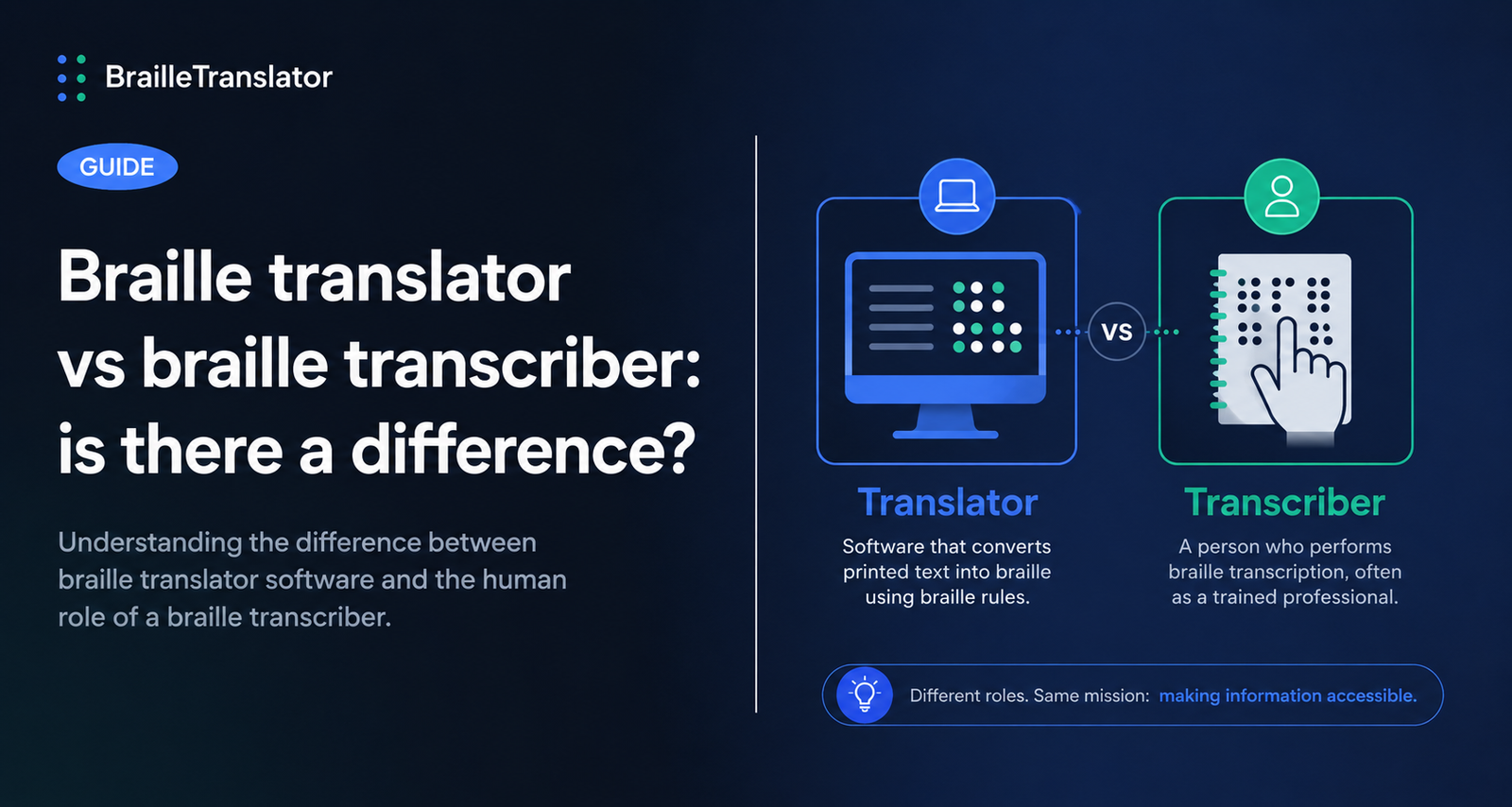
Yes, but not the same difference everywhere you look, and that inconsistency is worth understanding rather than glossing over. In the most common usage, “translator” refers to software that converts printed text into braille, and “transcriber” refers to the person doing that conversion work, often as a certified profession. But at least one widely cited source defines the terms in the opposite direction entirely, reserving “translation” for converting between 2 different languages’ braille codes and “transcription” for the everyday print-to-braille process most people actually mean. This tool is a braille translator in the software sense, converting English text into braille characters. It doesn’t convert between languages, and it isn’t a human transcription service.
Software that converts printed or digital text into braille using established braille rules.
A person who performs braille transcription, often as a trained or certified professional.
Translator usually means the software
Wikipedia’s own entry on the subject is direct about this: despite the name, a braille translator doesn’t perform language translation. It converts inkprint, ordinary printed or digital text meant for the eye, into braille meant for the finger, using the same underlying language the whole way through. The word “translator” stuck as the industry term for this category of software anyway, likely because “transforming one kind of text into another” is close enough to what translation colloquially means to a general audience, even though no language actually changes.
This tool fits that same category. It takes English text and produces English braille, grade 1 or grade 2, using UEB rules. Nothing about the language changes in that process, only the script it’s represented in.
Transcriber usually means the person
Separately from the software question, “transcriber” has a specific, well established meaning as a human role. A braille transcriber is someone who takes on the actual conversion work as a job, often a certified one. Real job postings for the role list requirements like a Library of Congress Certificate demonstrating proficiency as a braille transcriber, which tells you this isn’t an informal label, it’s a recognized credential.
The workflow described by the American Foundation for the Blind lays out exactly how the human role and the software work together rather than competing with each other. A transcriber enters text into a standard word processor, edits it, and saves the file. That file gets opened in braille translation software, which converts it and displays it on screen as simulated braille, sometimes called simbraille, so a sighted transcriber can proofread the output before it ever reaches paper. Once the transcriber confirms the translation and formatting are correct, they send the file to a braille embosser to be printed, typically onto tractor-feed paper sized 8 and a half by 11 inches or 11 and a half by 11 inches, with some embossers producing single-sided pages and others capable of double-sided, interpoint braille. In that description, the transcriber is the person, and the translator is the tool the person uses as part of their job. Searching for a “braille transcriber” is often a search for that human professional or service, not for software at all, which matters if you’re looking for something specific and keep landing on translator tools instead.
It’s also worth noting how consistently the software side of the industry has settled on “translator” as the actual product name, not just as loose description. Named commercial and research tools in this space include Win Braille, Supernova, a Cipher Braille Translator, and Braille Master, alongside general-purpose text to braille converters, and every one of them uses “translator” or “converter” in its own name rather than “transcriber.” That naming pattern holds across the whole category, which is part of why the software meaning is the one most people encounter first.
A second, conflicting definition worth knowing about
Here’s where it gets genuinely inconsistent rather than just a matter of software versus human. At least one detailed source on braille terminology defines things the other way around entirely. In that framing, braille transcription is the process of converting printed text into braille, the everyday meaning most people actually have in mind, while braille translation is specifically the process of converting one language’s braille code into a different language’s braille code, English braille into French braille, for instance. That source explicitly warns that confusing the two “conveys a misleading belief that braille is a different language rather than merely a different system of reading and writing a specific language.”
That’s the opposite assignment from how Wikipedia and most software naming conventions use the same 2 words. Neither side is simply wrong, they’re describing a real linguistic distinction, converting print to braille versus converting between different languages’ braille systems, and disagreeing about which word belongs to which side of that distinction. That disagreement is exactly why you’ll find the terms used inconsistently depending on which source you’re reading, and it’s worth knowing both usages exist rather than assuming one is universally correct.
Why “translator” won by usage even though it’s imprecise
Multiple sources across this research agree on one thing even while disagreeing on definitions: calling this software a “translator” isn’t technically precise, since no language-to-language conversion happens in the most common use case. One industry source states this outright, that the accurate professional term is braille transcription, while phrases like “translate braille” or “text to braille translator” remain common in everyday and commercial use anyway. Precision lost out to familiarity. “Translator” is the word people search for and the word most software is named with, so it’s the term that stuck, even among sources that will tell you directly it isn’t quite right.
What this tool actually is
Being specific matters more than picking a side in a terminology debate. This is a braille translator in the software sense that’s most common across the industry, a tool that converts English text into English braille, grade 1 or grade 2, using UEB rules, displayed and exportable in multiple formats. It doesn’t convert between different languages’ braille codes, so it isn’t a “translator” in the sense that second, less common definition uses the word. It also isn’t a certified human transcription service, if you specifically need a credentialed person to transcribe an official document, that’s a different kind of service entirely from what any piece of software, including this one, provides.
Try the translation side directly
See the software definition in action with our braille translator, converting English text into UEB braille in grade 1 or grade 2, exactly the process this page has been describing throughout.
Open the translatorFrequently asked questions
Usually not. “Translator” most commonly refers to software that converts text into braille, while “transcriber” most commonly refers to the person doing that work, often as a certified role.
No, in the most common usage. Braille translator software converts printed text into braille using the same underlying language, only the script changes. At least one source uses “translation” differently, to mean converting between 2 different languages’ braille codes specifically.
Yes. It’s a recognized professional role, and some positions require a Library of Congress Certificate demonstrating proficiency as a braille transcriber.
Because there’s a genuine underlying distinction, converting print to braille versus converting between different languages’ braille systems, and different sources assign the words “translation” and “transcription” to opposite sides of that distinction.
No. This tool converts English text into English UEB braille, grade 1 or grade 2. It doesn’t convert between different languages’ braille systems.