Before braille: the chaotic decades of competing tactile alphabets
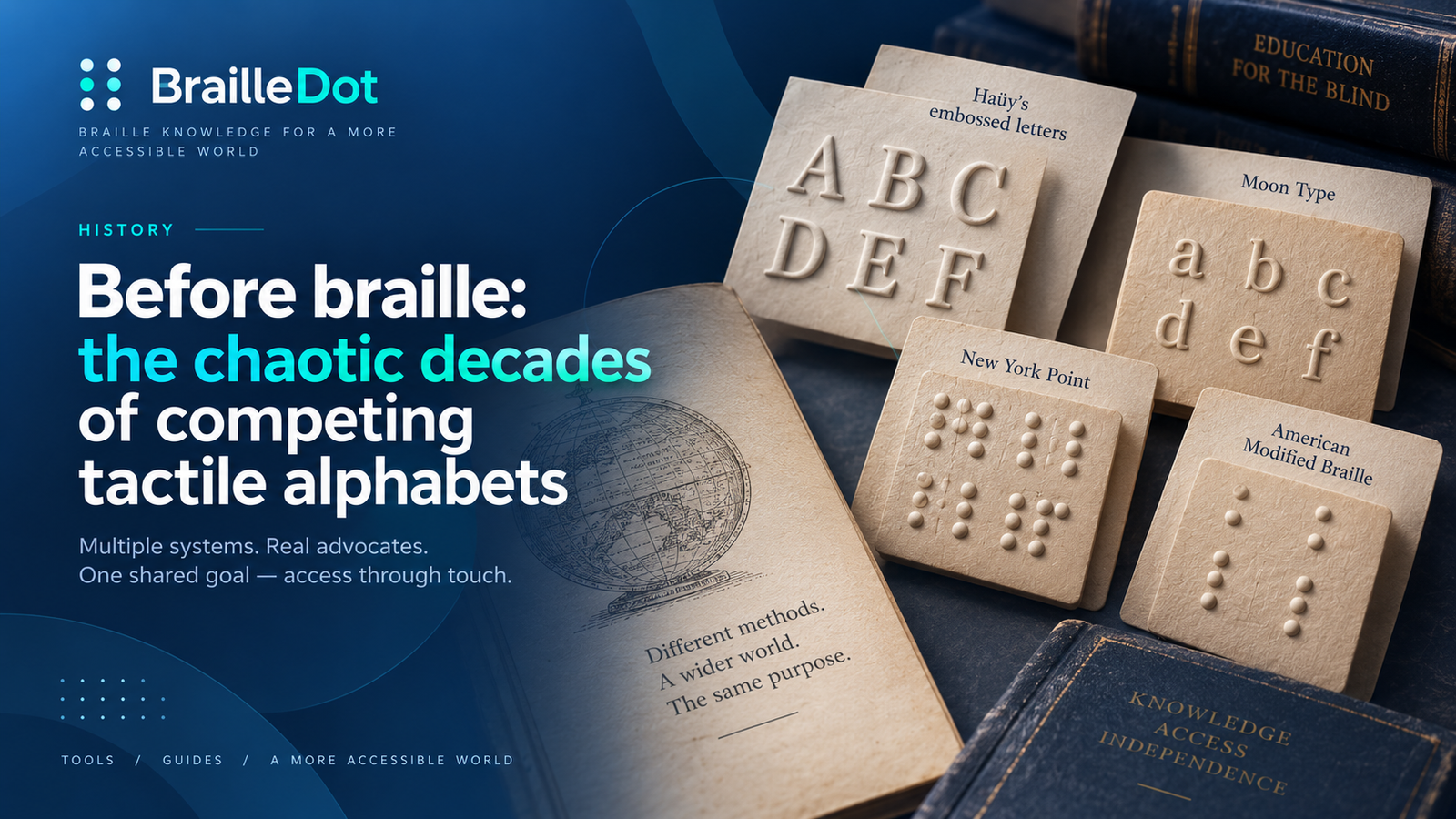
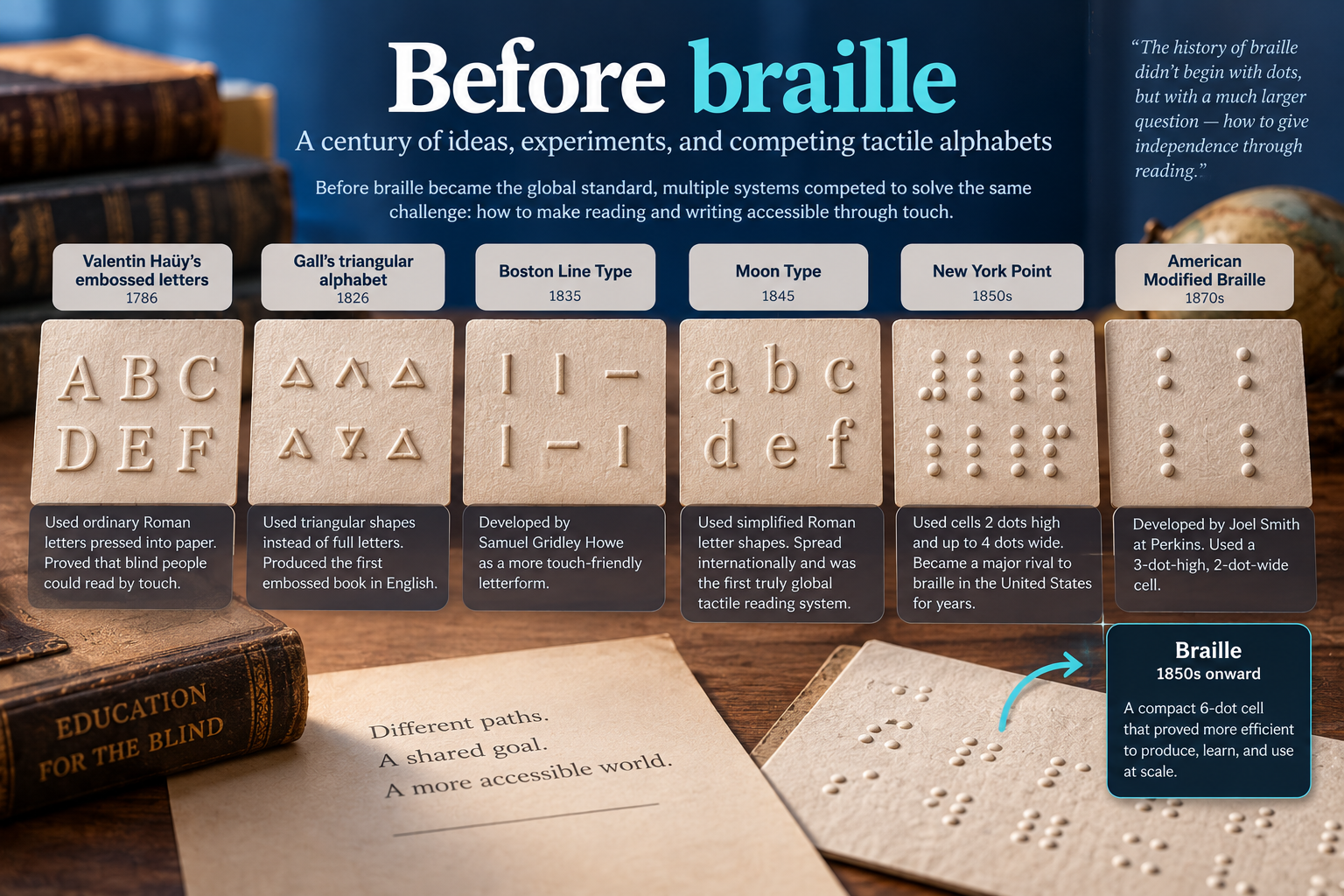
In 1771, a French linguist named Valentin Haüy watched a public spectacle in Paris where blind people were dressed up and mocked for entertainment at a festival. It stuck with him. Roughly 13 years later, he founded what became one of the first schools for blind students anywhere in the world, and by 1786 he’d produced the first embossed book they could read with their fingers. His method was straightforward, pressing ordinary Roman letters into damp paper so the shapes could be felt rather than seen. It worked, and it was also the very same school a young Louis Braille would later attend, where Charles Barbier’s flawed 12-dot system arrived decades afterward and set off the chain of events covered in our history of braille.
Embossed letters solved one problem and created several more
Haüy’s approach proved a blind person could read raised text at all, which was itself the breakthrough. What it didn’t solve was speed or efficiency. Full-sized Roman letters, embossed large enough to be distinguished by touch, take a fingertip far longer to read than a compact symbol built specifically for touch would. That gap between “readable” and “efficiently readable” is what set off decades of competing attempts to build something better, and nobody agreed on what better should actually look like.
Gall’s triangular alphabet appeared in 1826 and produced the first embossed book in English. Samuel Gridley Howe developed Boston Line Type in 1835, another attempt at a more touch-friendly embossed letterform. Philadelphia Line followed as yet another regional variant. Then, later in the same century, William Bell Wait developed New York Point, a system using cells 2 dots high and up to 4 dots wide, which spread widely enough across the United States to become a genuine rival to braille itself for years. Joel Smith, a piano tuner working at Perkins, developed his own competing system in the 1870s, American Modified Braille, using a 3-dot-high, 2-dot-wide cell. None of these were minor footnotes invented and forgotten overnight. Each had real institutional backing, real students learning it, and real advocates convinced it was the correct path forward.
The practical cost of that disagreement landed on blind readers themselves. Because sighted educators and institutions couldn’t settle on a single system, some students were expected to learn as many as 5 or 6 different tactile alphabets just to access whatever material happened to be available in whichever system it had been produced in. Literacy wasn’t the obstacle for these readers so much as fragmentation, the same problem repeated in a different form every time a new school or region picked its own preferred code.
Moon Type took a completely different path, and won first
Not every alternative was built from dots. In 1845, William Moon, an Englishman who had gone blind himself at 21, developed a system using simplified versions of actual Roman letter shapes rather than an abstract dot code. That design choice had a specific practical advantage, someone who had already learned to read print before losing their sight had a real head start with Moon Type, since the letterforms still resembled what they already knew, unlike braille’s abstract dot patterns, which require learning an entirely new symbol system from scratch regardless of prior reading experience.
Moon published his system in 1847, and it spread internationally faster than braille itself did in its early decades. Missionaries carried it to India, China, Egypt, Australia, and West Africa, and by the 1850s, Moon Type had a real claim to being the first tactile reading system for the blind adopted on a truly global scale, well before the 1878 World Congress vote that eventually made braille the international standard. That’s a detail worth sitting with on its own, the very idea of an internationally shared reading system for blind people predates braille’s own worldwide standardization by decades. For a real stretch of the 19th century, it wasn’t obvious which system, if any, was going to win.
Reading Moon Type involved its own distinct convention too. Lines alternate direction, read left to right, then right to left on the next line, then back again, a pattern called boustrophedon, borrowed from an ancient Greek term describing how an ox turns at the end of a field while plowing. It’s a detail that shows how differently this system approached the whole reading experience compared to what eventually became standard.
What eventually decided the outcome
Moon Type’s letterforms, being full Roman letter shapes rather than compact dot cells, took up considerably more space on a page and were more expensive and time-consuming to emboss at scale. Braille’s 6-dot cell, by contrast, packed far more information into a much smaller physical footprint, which mattered enormously once large-scale book production became the actual goal rather than proving a concept could work at all. Cost and production efficiency, not any single technical flaw in Moon’s design, were what eventually let braille overtake it for mainstream use.
Moon Type never disappeared entirely. It’s still used today, in a narrow but real niche, for people who lose their sight later in life and find relearning through familiar letterforms easier than starting fresh with an abstract dot system, and for some readers with additional fine motor difficulties that make distinguishing dot patterns harder than distinguishing letter shapes. Braille won the wider adoption battle, but it didn’t win by default, and it didn’t win quickly, and neither did any single competitor win outright while the field was still crowded. Systems like New York Point had genuine institutional backing and real student populations of their own for years, which is exactly why the eventual shift toward braille as the shared standard took decades of gradual adoption rather than a single, obvious moment where everyone agreed at once. For decades, a blind reader in the mid-1800s had real reason to bet on several different systems succeeding, and the version of history where dots became the universal standard was far less obvious at the time than it looks in hindsight.
Why the history of tactile alphabets still matters
The story before braille explains why having a compact, consistent tactile system mattered so much. The eventual success of braille wasn’t simply the result of inventing raised dots. It came from developing a system that could represent language efficiently, be reproduced at scale, and be read through touch with a compact set of consistent symbols. That same six-dot foundation is what readers encounter when learning how braille dots are read today, while the later development of different forms of braille helped extend the system across languages and writing environments. You can also see how that basic system developed beyond its original French context in our guide to braille in different languages.
Explore the braille system that won the standardization battle
See how modern English braille works with our braille translator, and explore the difference between grade 1 and grade 2 through our grade 1 vs. grade 2 braille guide.
Open the translator