The magazine that outlived the war of the dots, and 3 generations of the family that ran it
How the Matilda Ziegler Magazine for the Blind survived competing tactile systems, built a worldwide readership, and remained in continuous publication for 107 years.
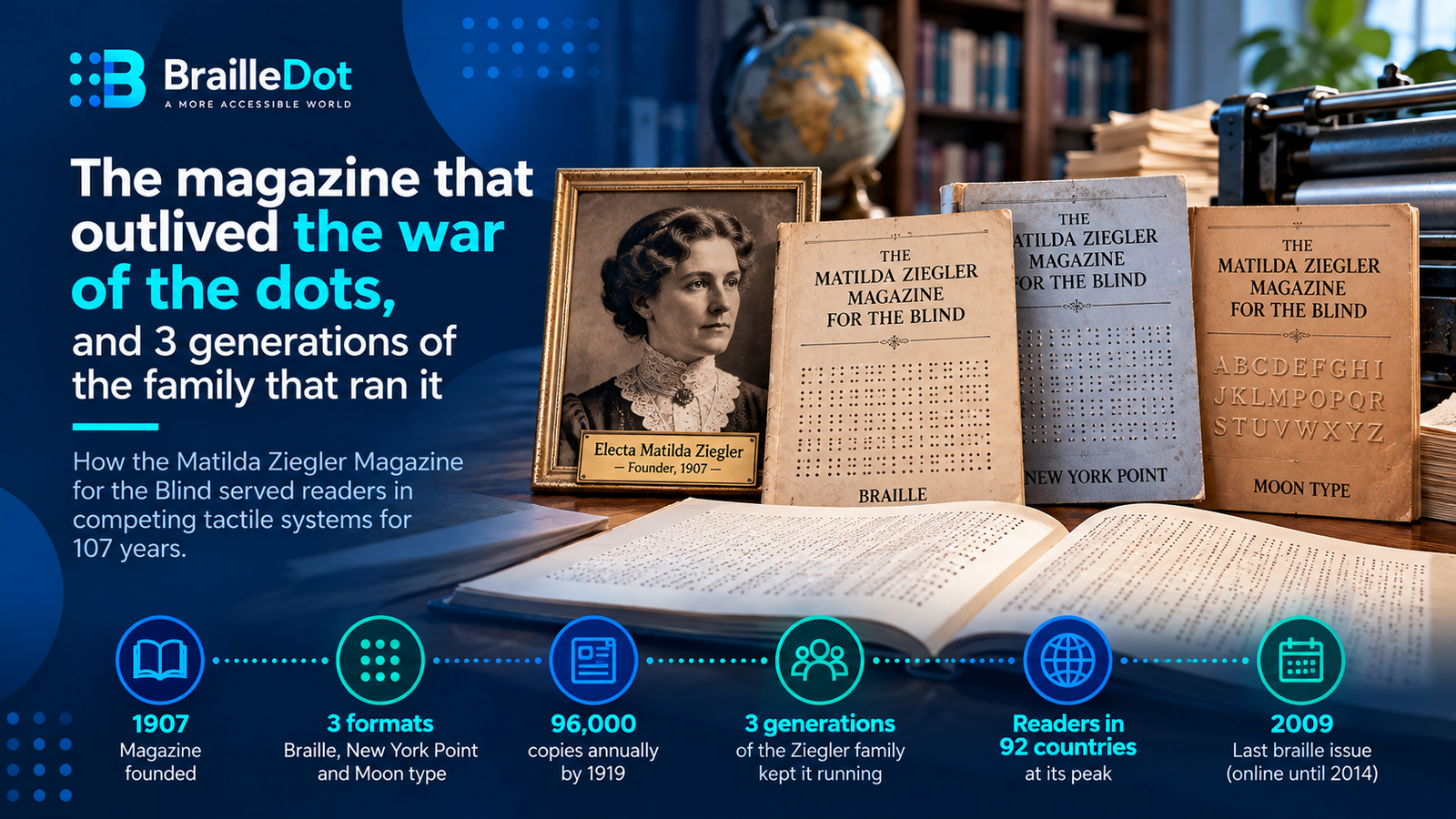
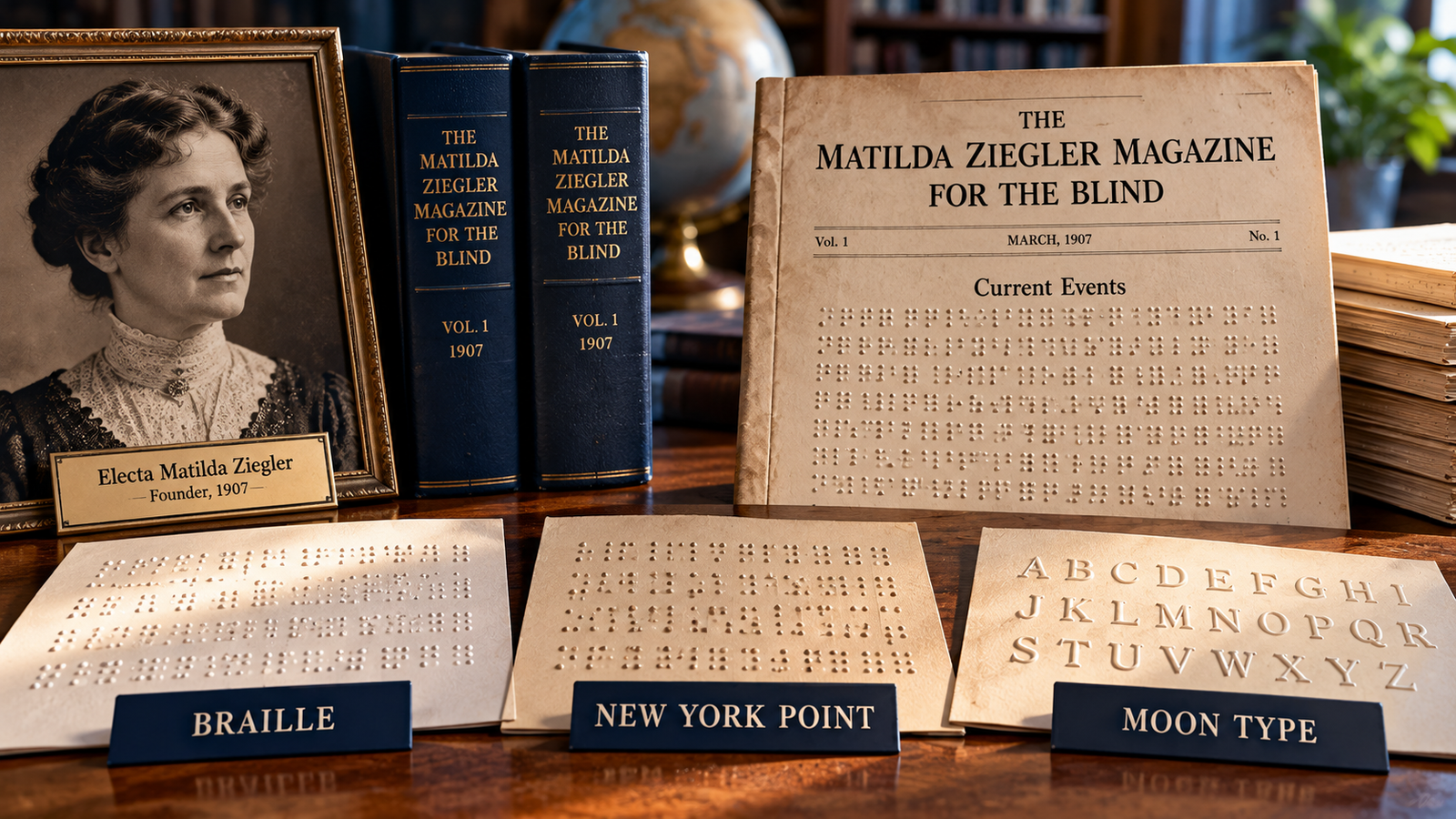
In March 1907, Electa Matilda Ziegler, an heiress with a blind son from an earlier marriage, founded a magazine for blind readers and handed the editorship to Walter G. Holmes, a man with a blind brother of his own. Neither of them came to this as a business venture. A blind physician later told Ziegler he’d rather be doing what she was doing for blind people than hold the presidency of the United States or the throne of England. Holmes ran the magazine for nearly 40 years. Ziegler funded it entirely out of her own fortune. What they built together ran for 107 years and managed something no other publication from that era did, it stayed in continuous print across every major rival tactile system the period produced.
One magazine, every competing system at once
The Matilda Ziegler Magazine for the Blind launched simultaneously in braille and New York Point, the 2 systems locked in the decades-long conflict covered in our piece on the war of the dots. For several years it added a third edition in Moon type, the raised-letter alternative covered in our piece on the tactile systems that came before braille’s dominance. At a moment when American institutions were fighting bitterly over which single code deserved to win, this 1 magazine simply printed itself in whichever formats its actual readers were using, rather than picking a side in the fight going on around it.
The formats didn’t all last equally long. The New York Point edition continued until 1963, more than 3 decades after the 1932 London Type Conference had already resolved the war in braille’s favor, a real illustration of how slowly an established reader base actually shifts even after a standard has officially been settled elsewhere. By 1966, the magazine had narrowed to braille alone.
Rather than waiting for the tactile-code debate to settle, the Ziegler magazine served readers in the systems they were already using.
The content itself was deliberately ordinary
Nothing about the magazine’s actual content was specialized or clinical. It covered current events, literature, and poetry alongside material specifically relevant to blindness, built as general-interest reading rather than a disability-focused publication that happened to be embossed. That was close to the entire point. A blind reader in 1910 had plenty of material written specifically about blindness and remarkably little written simply for their own enjoyment the way a sighted reader took for granted, and the Ziegler was built to close that particular gap rather than add to the first pile.
The scale by 1919 is startling on its own
Within its first dozen years, the Ziegler had grown into a genuine industrial operation. By 1919, it was producing 96,000 copies annually, more than 6 million embossed pages a year, run on a dedicated braille printing press built for the purpose. That same year, in the entire United States, it was 1 of only 2 large-circulation magazines for blind readers distributed completely free of charge, the other being a religious publication, Christian Record Services for the Blind. The paper it printed on was supplied by a blind man specifically, a small detail that fit the magazine’s own stated aim of being produced for the blind and by the blind as far as that was practically possible.
3 generations of 1 family kept it running
Ziegler didn’t fund the magazine informally. In 1929 she established a permanent endowment, the E. Matilda Ziegler Foundation for the Blind, specifically to guarantee the magazine’s finances and support other services for blind people beyond it. She lived long enough to see the magazine’s 25th anniversary in March 1932 and died 6 months later at 91.
Her son, William Ziegler Jr., took over stewardship of both the foundation and the publishing company after her death, while also serving as president of the American Foundation for the Blind, the same organization behind Robert Irwin’s work covered in our pieces on the war of the dots and the origins of talking books. His own son, William Ziegler III, eventually succeeded him at the foundation and publishing company, continuing in that role until his death in 2008. 3 generations of a single family carried direct responsibility for 1 magazine across more than a century, an unusual continuity for any publication, let alone one with no subscription revenue funding it.
The magazine begins
Electa Matilda Ziegler founded the publication and appointed Walter G. Holmes as editor.
A permanent foundation
Ziegler established the E. Matilda Ziegler Foundation for the Blind to secure the magazine’s future.
The third generation
William Ziegler III continued the family’s direct stewardship until his death.
The ending came with real weight attached to it
The last braille issue of the Ziegler was published in November 2009, after which the magazine continued briefly online before ending entirely in 2014. Discontinuing the print edition affected 4,200 braille subscribers and 5,400 cassette subscribers spread across 92 countries, a truly global readership for a publication most Americans had never heard of. The National Federation of the Blind’s own public reaction to the closure described it as happening in the midst of what they called a braille crisis gripping the country and the world, language that placed the magazine’s end inside the broader, ongoing concern about declining braille literacy rather than treating it as an isolated business decision.
The print edition ended after more than a century of service, but its readership extended across 92 countries and included thousands of braille and cassette subscribers.
What outlasted the magazine itself
The E. Matilda Ziegler Foundation for the Blind is still active today, now directing its funding toward vision research rather than magazine production, awarding several million dollars in grants over the past decade. A separate, still-running publication, the Braille Book Review, began in 1938 and continues describing new braille titles through the National Library Service, a different kind of periodical serving a related purpose. The magazine itself is gone, but the philanthropic instinct that started it in 1907, funded by 1 woman’s fortune for the sake of a son she never expected the wider public to think much about, is still writing checks more than a century later.
A publication that outlasted its original era
The Ziegler magazine began during the era of competing tactile systems, adapted as braille became standardized, and continued serving readers for more than a century. Its publication history shows how accessibility infrastructure can survive changes in technology, standards, and generations when the underlying need remains.