How braille works in different languages around the world
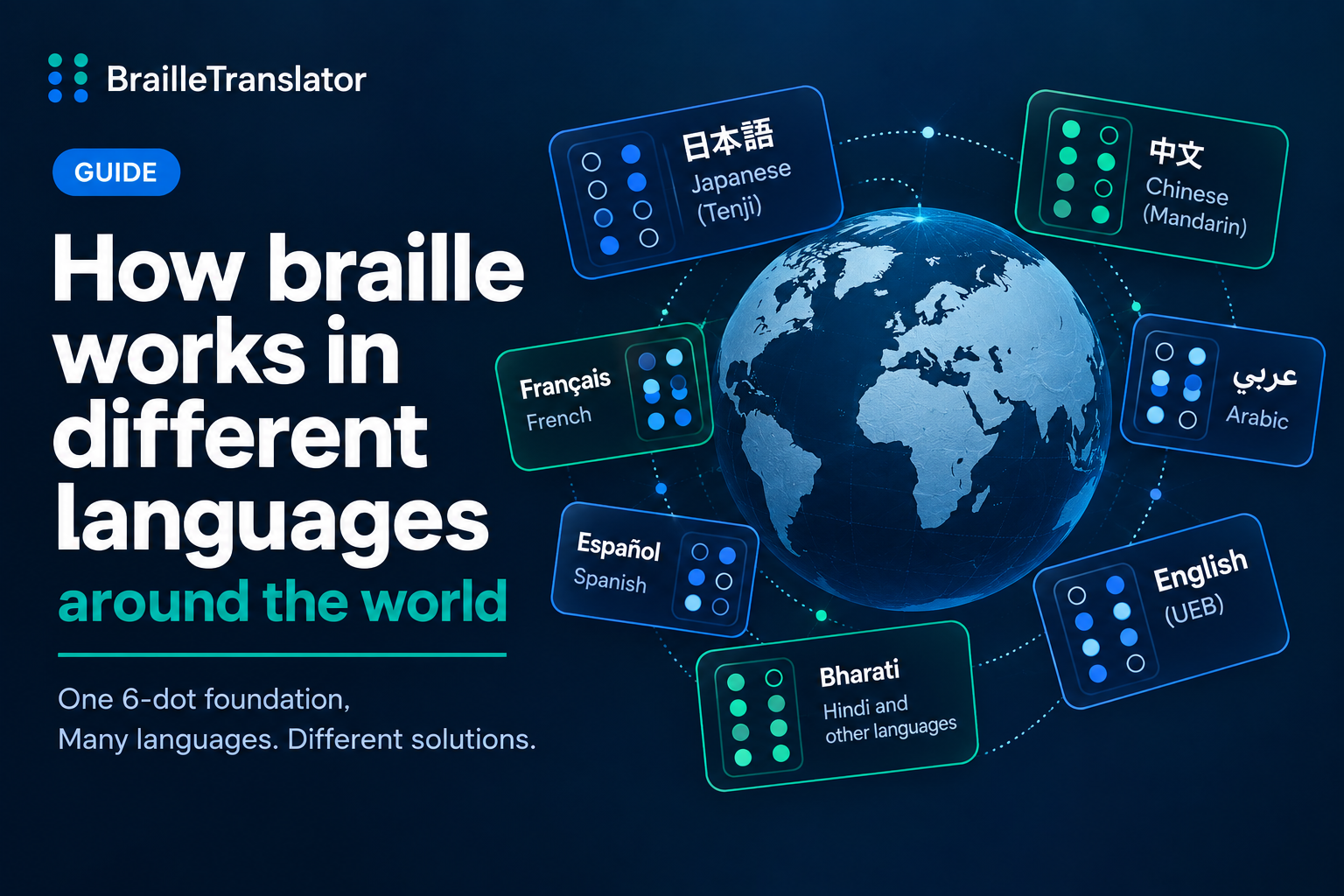
Braille isn’t 1 universal alphabet shared by every blind reader on earth. It’s a 6-dot framework, the same physical cell Louis Braille worked out in the 1820s, that gets independently redesigned for whatever language it’s adapting to. Different languages haven’t just swapped in different letters using the same rules. Some arrived at genuinely different structures. Japanese braille has no contractions at all. Chinese braille has to encode tone, something English literary braille never has to think about. Arabic braille doesn’t even follow the reading direction of printed Arabic. The framework is shared. Almost everything built on top of it isn’t.
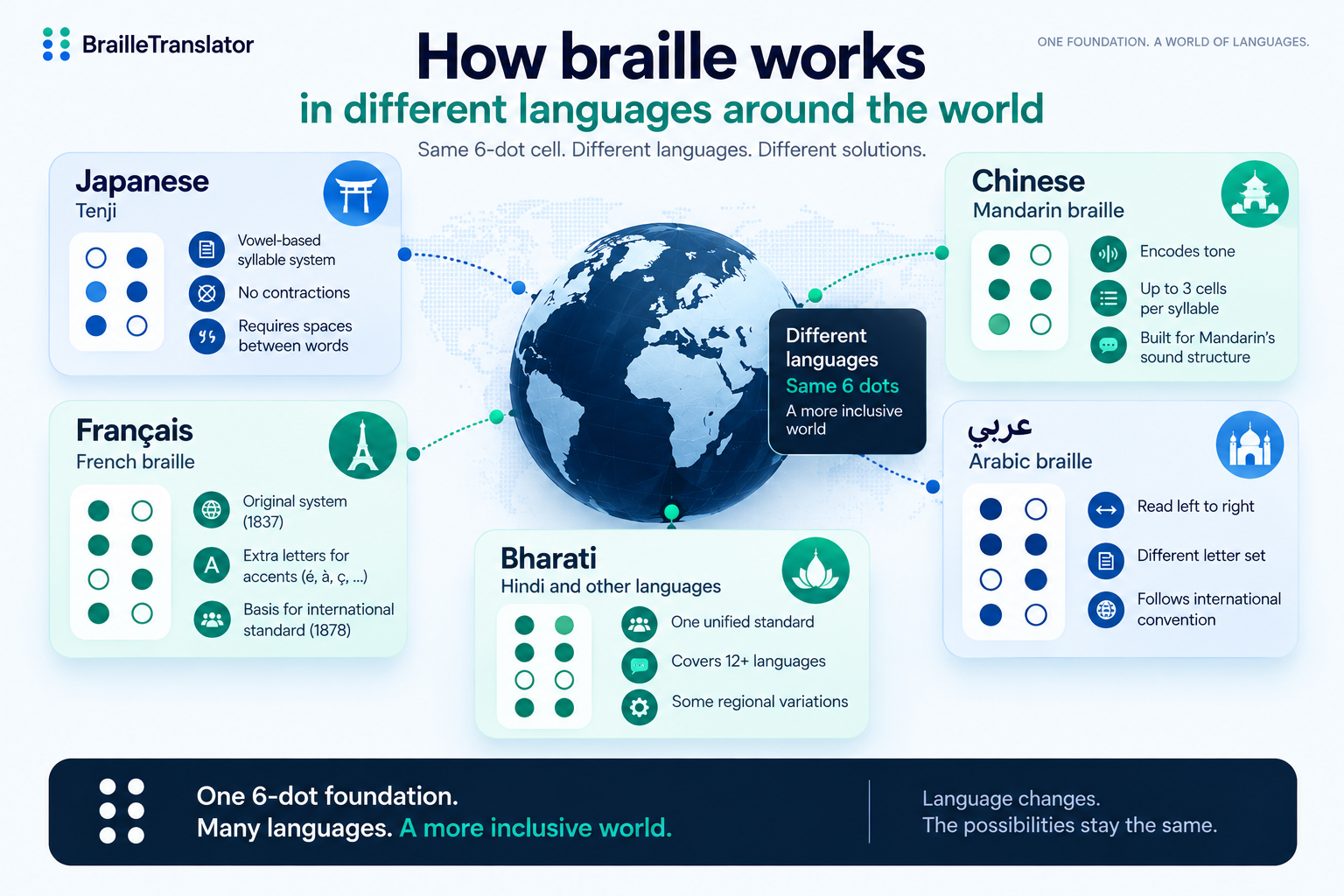
Uses syllable-based braille with no contracted form and requires spaces between words and clauses.
Mandarin braille can use separate cells for initials, finals, and tone because pronunciation carries meaning.
Arabic braille is read left to right even though printed Arabic is written and read right to left.
Bharati braille provides a unified system across numerous South Asian languages and scripts.
Japanese braille has no contractions at all, and needs spaces print Japanese doesn’t use
Japanese braille, called tenji, is built on a genuinely different linguistic principle than English braille. It’s a vowel-based abugida, meaning every character represents a consonant-vowel syllable, and the 2 parts occupy fixed, separate positions inside the same cell. Vowels sit in the upper-left of the cell, dots 1, 2, and 4, and can stand entirely on their own. Consonants sit in the lower-right, dots 3, 5, and 6, and can’t appear by themselves, they always attach to a vowel. The semivowel y gets its own specific treatment using dot 4 in isolation. None of this maps onto how English braille is built, where every cell represents a single letter, number, or whole word rather than a fixed consonant-vowel pairing.
Standard tenji represents kana, the phonetic syllables of Japanese, and has no way to directly represent kanji, the logographic characters borrowed from Chinese that make up a large part of ordinary written Japanese. Text has to be converted to its phonetic kana reading before it can be transcribed at all.
Here’s the detail that surprises people most. Tenji has no contracted form whatsoever, nothing resembling the wordsigns and groupsigns that make up English grade 2 braille, covered in full in our grade 2 contractions reference. Every syllable is spelled out in full every time. And where English print already separates words with spaces, printed Japanese normally doesn’t space words at all, kanji and kana run together with no gaps. Tenji reverses that entirely, requiring a blank cell between every single word and clause specifically to keep the text readable by touch. A blind Japanese reader’s braille looks more spaced out than the print text it came from, the exact opposite of what happens going from English print to English braille.
Worth knowing as an aside, a separate supplementary system called Kantenji was developed in the 1960s specifically to encode actual kanji characters directly, rather than only their kana reading. It uses an 8-dot cell instead of 6, where the lower 6 dots still carry the ordinary tenji kana value and the 2 additional dots layer on information about which kanji is meant. It’s a genuinely more advanced, less common system built as an addition to standard tenji, not a replacement for it.
Chinese braille encodes tone, something English braille never has to represent
Mandarin Chinese braille is built around syllables too, but the underlying problem it solves is different from Japanese. Mandarin is a tonal language, the same syllable spoken with a different pitch contour is a different word entirely, and that tone has to be represented somehow if the text is going to be read back correctly. Chinese braille handles this by breaking a syllable into up to 3 separate cells, 1 for the initial consonant sound, 1 for the final vowel or rime sound, and 1 specifically to mark tone, based on the sound structure of standard Mandarin romanization rather than on individual Chinese characters directly.
That’s an entire dimension of information English braille was never designed to carry. English spelling doesn’t encode pitch, so English literary braille, and the UEB standard this translator implements, has no equivalent mechanism at all. It’s a clear example of how a braille system’s structure follows the demands of the specific language it serves rather than a single fixed template applied everywhere.
Arabic braille reads left to right, even though printed Arabic reads right to left
This is the flattest, most surprising fact in this whole comparison. Printed Arabic is written and read right to left. Arabic braille is read left to right, the same direction as English, French, and most other braille scripts worldwide. The tactile medium didn’t inherit the reading direction of the print language it represents, it follows the broader international convention instead. For a reader who knows both printed Arabic and Arabic braille, the reading direction itself is one of the first things that has to be relearned, not just the shapes of individual letters.
Even languages sharing the alphabet still need their own extra letters
It’s tempting to assume that languages using the same Latin alphabet as English, French, Italian, Catalan, would all share 1 braille system with only minor tweaks. That’s not quite what happened either. French Braille is the original system, Louis Braille’s own 1837 version, and it became the basis for the international convention adopted in 1878, covered in our history of braille. But only the 25 basic letters of the French alphabet, plus w, ever became truly universal across countries. W specifically had to be tacked onto the end of the French sequence to accommodate English, since French itself barely uses the letter.
French still needed its own extra cells well beyond that shared 26, to cover its own accented letters, ç, é, à, è, ù, â, ê, î, ô, û, ë, ï, ü, and ö each got a dedicated cell of their own. Neighboring Latin-alphabet languages then had to make their own individual decisions about how to handle whatever the shared French system didn’t already cover. Italian Braille stays very close to French but reuses the same cell for both ò and ó, since French braille only ever defined one of them. Catalan Braille needs its own set of accented letters too, ç, à, é, è, í, ï, ó, ò, ú, and ü, and in a couple of cases reassigns a cell French uses for one accented letter to a different one Catalan needs instead, French ù becomes Catalan ú, for instance. Even English’s own history has a footnote here, an early American version of English Braille tried reassigning w, x, y, z to follow English alphabetical order instead of the French decade pattern. That attempt didn’t become the lasting standard, and today’s English and UEB systems still follow the original French-derived letter order.
That international consistency turned out to matter in a very concrete way. Algerian Braille once went the opposite direction entirely, reassigning its codes to match Arabic alphabetical order, which broke compatibility with braille used everywhere else. Modern Arabic Braille, the version actually in wide use today, instead kept the French sorting order specifically to stay interoperable with the rest of the world’s systems, even while its reading direction, covered above, still runs opposite to printed Arabic.
One shared framework covering many completely different languages
Everything covered so far follows the same basic pattern, 1 language, its own dedicated braille system. India took the opposite approach entirely. Before the country’s independence, 11 separate braille scripts were in simultaneous use across different regions and languages. By 1951, those were consolidated into a single unified standard called Bharati Braille, which has since also been adopted by Sri Lanka, Nepal, and Bangladesh.
What makes this genuinely different from everything above is the sheer range of languages 1 system now covers, Hindi, Marathi, and Nepali through the Devanagari script, along with Bengali, Gujarati, Kannada, Malayalam, Odia, Punjabi, Tamil, Telugu, and Sinhala, spanning 2 entirely separate language families, Indo-Aryan and Dravidian, whose print scripts don’t resemble each other visually at all. It’s structured as an abugida, where the default inherent vowel isn’t written unless it starts a syllable or comes before another vowel, a genuinely different mechanism from how English braille handles vowels as ordinary standalone letters.
It isn’t perfectly uniform even within this unification, worth stating honestly rather than glossing over. Nepali braille differs slightly between India and Nepal, Tamil differs slightly between India and Sri Lanka, and Bengali Braille has more significant differences between India and Bangladesh. Urdu Braille as used in Pakistan doesn’t follow the Bharati standard at all, despite Urdu being one of the languages Bharati Braille itself can represent in India. Even a genuinely unifying framework still has real regional exceptions once it meets the practical reality of separate countries maintaining their own conventions.
What stays constant across every one of these systems
Despite how differently each of these languages solved their own transcription problems, every single one of them, tenji, Chinese braille, Arabic braille, French and its Latin-alphabet relatives, Bharati braille’s dozen languages, and the UEB this site is built around, is still constructed from the identical 6-dot cell, 2 columns of 3, covered in our history of braille. That structure hasn’t changed since Louis Braille worked it out by hand in the 1820s. What differs entirely is how each language’s specific linguistic needs, tone, syllable structure, reading direction, accented letters, contraction or no contraction, get mapped onto that shared physical framework. The framework is universal. Almost everything built on top of it is not.
What this means for a UEB-specific translator
This translator implements English UEB specifically, the standardized adaptation of that shared 6-dot framework built for English text, grade 1 and grade 2 alike. It doesn’t implement tenji, Chinese braille, or Arabic braille, and it couldn’t simply be pointed at text in those languages and produce correct output, since each of those systems follows genuinely different internal rules, not just a different vocabulary layered onto the same logic. Knowing that distinction matters if you’re ever evaluating whether a tool built for one language’s braille code can honestly claim to handle another.
Try the English system this translator actually implements
See UEB, the specific system this piece contrasts against every language above, in action with our braille translator.
Open the translatorFrequently asked questions
No. Every braille system shares the same 6-dot cell structure, but how that structure gets used varies significantly. Some languages, like Japanese, have no contractions at all, while others, like Chinese, need extra cells just to represent tone.
No. Tenji, the Japanese braille system, has no contracted form at all. Every syllable is spelled out in full, unlike English grade 2 braille, which uses wordsigns and groupsigns to shorten common words and letter patterns.
Mandarin Chinese braille breaks a syllable into up to 3 cells, one for the initial consonant, one for the final vowel sound, and one specifically to mark tone, since the same syllable spoken with a different tone is a different word in Mandarin.
No. Despite printed Arabic reading right to left, Arabic braille is read left to right, following the same broader convention used by most other braille systems worldwide.
Bharati braille is a unified standard covering Hindi, Marathi, Nepali, Bengali, Gujarati, Kannada, Malayalam, Odia, Punjabi, Tamil, Telugu, and Sinhala, spanning 2 separate language families. It’s also used in Sri Lanka, Nepal, and Bangladesh, though some regional variation still exists between countries.