The real history of braille: from a military code to a global standard
Braille wasn’t invented from scratch. It started as a teenager’s fix for a military-adjacent writing system so flawed that a fingertip couldn’t even read a full character in a single touch. Louis Braille began working on it at 11, published his own version at 20, and by the time his system became the global standard it is today, he’d already been dead for decades. Along the way, the story picked up a dramatized detail that even careful historians have had to go back and correct.
A childhood accident, then a school with only 3 books
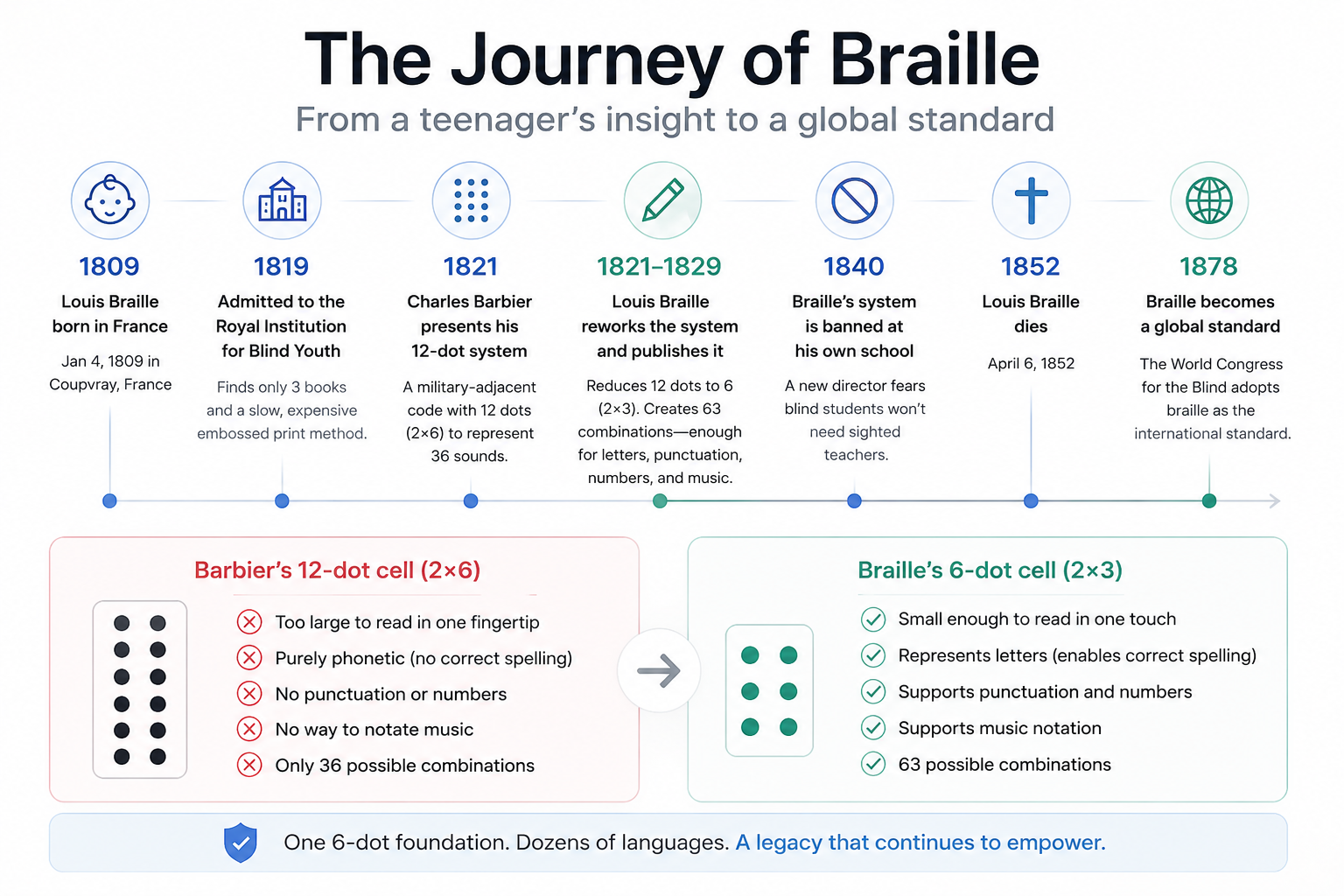
Louis Braille was born on January 4, 1809, in Coupvray, France, the son of a village leatherworker. At age 3, playing in his father’s workshop, he struck his own eye with an awl, the pointed tool his father used to punch holes in leather. The wound became infected, the infection spread to his other eye, and by age 5 he was completely blind in both eyes.
At 10 years old, Braille was admitted to the Royal Institution for Blind Youth in Paris, one of the first schools for blind students anywhere in the world. What he found there wasn’t much of a library. The school owned just 3 books. The only method available at the time for producing text a blind reader could feel was embossed print, large raised letters formed by pressing paper against carved wooden blocks shaped like reversed letterforms. It worked, technically, but it was slow, expensive, and produced books too large and too costly to make in any real quantity.
A teenager’s fix: 12 dots down to 6
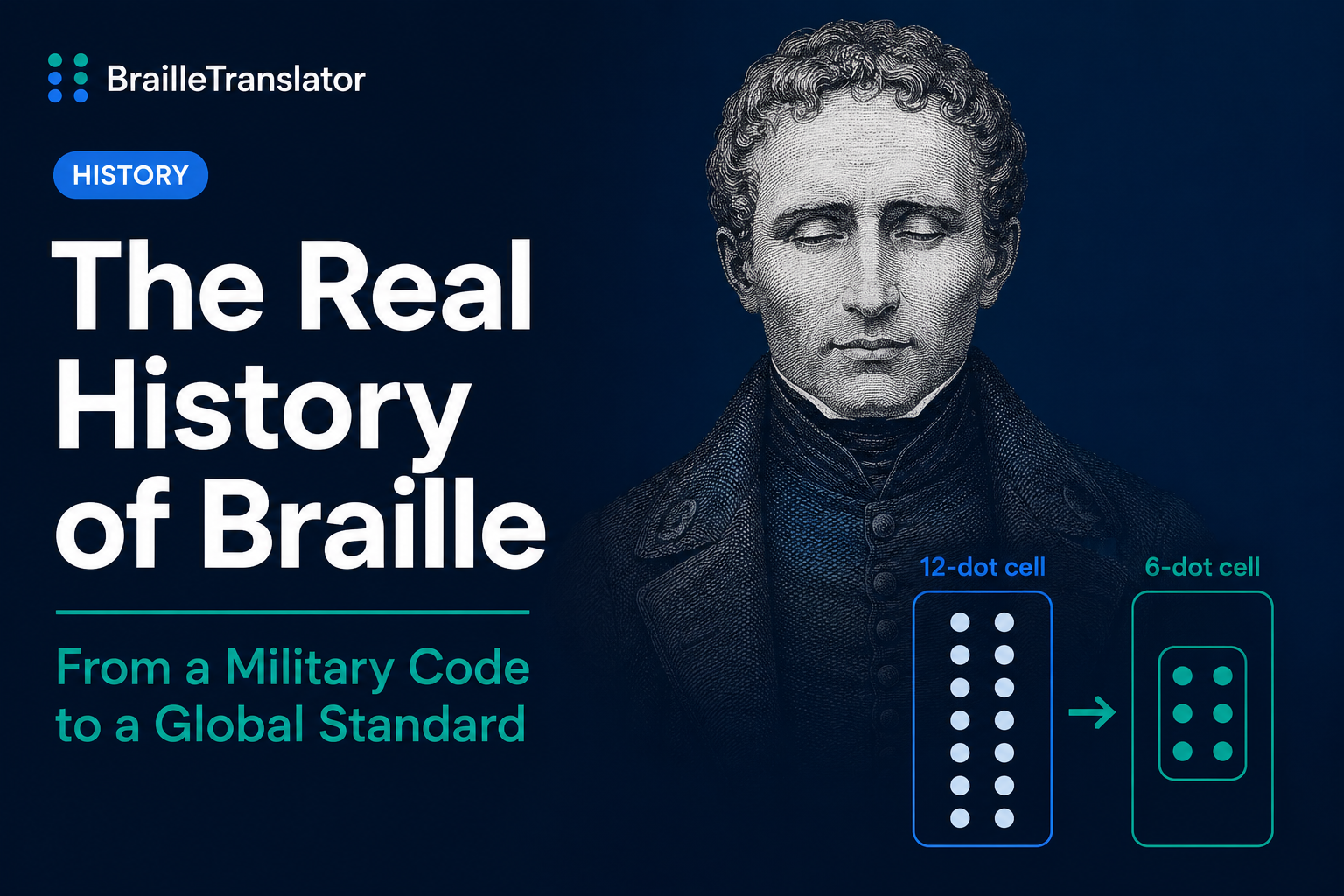
Braille was inspired by what Barbier had shown the school, and frustrated by everything it couldn’t do. Starting around age 11, he spent years reworking it, using Barbier’s own stylus and grid-ruled slate as his starting tools. His central insight was structural. A 12-dot cell was 2 dots too tall for a fingertip to read in one motion. Braille cut it down to 6 dots, 2 columns of 3, small enough to read under a single fingertip in one touch, and found that just 6 dot positions could still produce 63 distinct combinations, more than enough for a full alphabet, and eventually for punctuation, numbers, and music notation too, all things Barbier’s system had no way to represent. He published his system in 1829 and revised it in 1837.
The system’s own school tried to ban it
Braille stayed at the Royal Institution long after finishing his own education, teaching history, algebra, and geometry there as an adult. He was also a serious, professional musician, an accomplished cellist and organist who held church organist positions at Saint-Nicolas-des-Champs and later Saint-Vincent-de-Paul.
Despite all of that, and despite the fact that his own system had been developed inside that very school, a new director banned braille there in 1840. The stated fear was that if blind students could read and write independently, sighted teachers would no longer be needed. It’s a genuinely strange footnote, the invention succeeding well enough to threaten the institution that helped produce it, well before the wider world had even caught up to it.
Recognition that came after he was already gone
Louis Braille died in 1852. Widespread institutional adoption of his system, by schools, governments, and other organizations, largely happened after his death, not during his lifetime. It took until 1878 for the World Congress for the Blind to vote braille into place as the internationally recognized writing system for blind readers, 26 years after the man who invented it had already died without seeing that recognition happen.
What actually survived unchanged
What’s remarkable, looking back, is how little of the core structure has actually changed. The 6-dot cell, 2 columns of 3, and the 63 possible combinations inside it are exactly what every modern braille code is still built on, including UEB, the specific standard this translator implements, covered in more depth in our grade 1 vs grade 2 braille guide. Braille himself designed his original system for French. Everything since, English braille, UEB, and the dozens of other language adaptations that exist today, has been built as a layer on top of that same 6-dot foundation he worked out as a teenager with a stylus and a slate. It’s also worth remembering, as covered in our piece on braille translators versus transcribers, that braille was never a separate language to begin with, just a different way of writing the languages that already existed, which is exactly why a single 6-dot system could eventually be adapted to so many of them.
See the modern version in action
Everything Braille built by hand in the 1820s, this translator produces instantly. Try our braille translator to see the direct descendant of that original 6-dot system at work.
Open the translatorFrequently asked questions
Louis Braille, a blind French student, invented it starting around age 11 and published his system in 1829, when he was 20. He based it on and significantly improved a flawed 12-dot system shown to him by Charles Barbier in 1821.
That specific dramatic version of the story is a later embellishment. Research from the Perkins School for the Blind traces it to a fictionalized 1950s biography. Barbier’s own 1815 publication presented his raised-dot method as 1 of 12 general rapid-writing systems, not a purpose-built military code, and he didn’t use the term “night writing” himself.
He began working on it around age 11, shortly after seeing Barbier’s system in 1821, and published his own version in 1829 at age 20.
No. His own school banned its use in 1840, fearing it would make sighted teachers unnecessary. Widespread institutional adoption largely happened after Braille’s death in 1852.
In 1878, the World Congress for the Blind voted to make braille the internationally recognized writing system for blind readers, 26 years after Louis Braille had died.