Is There A Grade 3 Braille?
Is there a grade 3 braille?
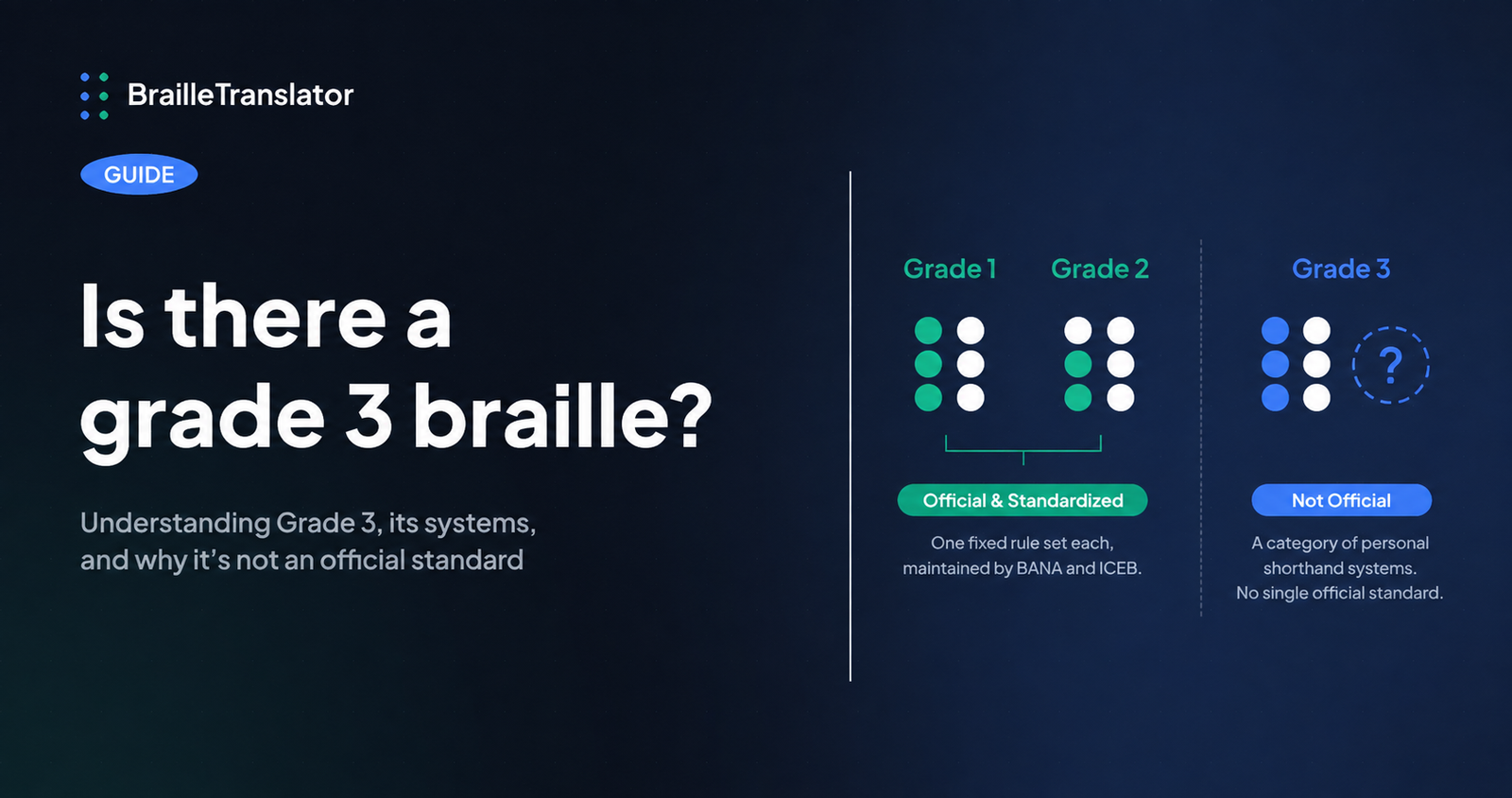
Not officially, not the way grade 1 and grade 2 are. Grade 1 and grade 2 are both standardized codes with one fixed rule set each, maintained by BANA and ICEB, which is why every properly built UEB translator produces identical output for the same input. “Grade 3” is different. It’s a category name for a range of personal shorthand systems that individual braille users developed to write and take notes even faster than grade 2 allows, and no single version of it has ever been adopted as an official standard. This translator supports grade 1 and grade 2 for exactly that reason, they’re the 2 levels that actually have one agreed set of rules to implement.
One fixed rule set each, maintained by BANA and ICEB. Every properly built translator produces identical output.
A category name for several different personal shorthand systems. No single version was ever adopted as an official standard.
Grade 3 is a category, not one code
This is the part that gets flattened in a lot of quick explanations. There isn’t one grade 3 system that everyone who uses it agrees on. There are several distinct, named systems that all pursue the same goal, writing faster than grade 2, through different specific rules. One account from a longtime braille user describes 3 separate systems in active use: Adams Speed Braille, an approach so elaborate it reportedly takes several volumes of text just to learn its rules, a general braille shorthand code, and Grade Three Braille specifically, which the same account calls the most popular of the 3 precisely because it’s the easiest to actually pick up. A separate, more recent system called BUOC, developed in the 1980s by Rebecca Maxwell in Australia, adds several hundred more contractions on top of grade 2 as its own supplement. None of these are the same system, and none of them are interchangeable with each other. Someone fluent in one wouldn’t automatically be able to read text written in another.
Grade Three Braille itself, the most established of these, isn’t undocumented either. Guides exist, including a published “Guide to Grade Three” and a “Key to Grade Three Braille,” with a code manual dating back to a 1919 edition. Having a written rulebook somewhere isn’t the same thing as being an officially recognized code, though. BANA and ICEB never adopted any version of grade 3 the way they adopted grade 1 and grade 2, which means there’s no single authority anyone can point to as the definitive version, and no requirement that two people’s personal grade 3 match each other exactly.
The 2 techniques that make it faster
Whichever specific system is being used, grade 3 style shorthand generally leans on 2 core techniques beyond what grade 2 already does. The first is outlining, dropping vowels that aren’t already part of an existing contraction or diphthong and aren’t in a word’s stressed syllable. The second is a set of rules for leaving out spaces between certain specific types of words that would normally be written separately. Together, these compress text noticeably further than standard grade 2 contractions alone manage. One documented example puts it plainly, the sentence “To be happy, keep changing” comes out considerably shorter once outlining and spacing rules are applied, on top of whatever grade 2 contractions were already doing the work.
Why it stayed unofficial
This isn’t an oversight or something waiting to be formalized eventually. The reasons it’s stayed unofficial are structural. Grade 1 and grade 2 work as universal standards because a governing body defines one exact rule set and everyone transcribing in that code follows it, which is what makes a book printed in grade 2 in one country readable by a grade 2 reader anywhere else. Grade 3 systems were built by individuals and small communities to solve a personal problem, writing and reading their own notes faster, not to be read by strangers. Multiple systems developing independently, each optimized for their own users rather than for universal agreement, is exactly why no single version ever became the kind of thing a governing body could standardize into one code the way UEB was.
The real-world use case reflects that directly. Grade 3 shorthand shows up in personal letters, diaries, and notes, not in published books, signage, or anything meant for a general audience. One documented use case is particularly practical, using grade 3 to edit material already transcribed in grade 2, squeezing revisions into margins using grade 3’s more compact signs rather than re-transcribing an entire page from scratch. That’s a genuinely useful trick for someone who already knows both systems, but it only works because both people involved, or just the one person editing their own draft, already share the same personal rule set.
What this means for a UEB translator
A translator needs one fixed, agreed rule set to implement, since the entire point is producing correct, predictable output every time. Grade 1 and grade 2 both qualify, they’re each exactly one thing, defined once, by one governing body, whether that body is BANA in the US or ICEB internationally. Grade 3 doesn’t qualify by that same standard, because it isn’t one thing to begin with. Implementing “grade 3” in a translator would mean picking one specific personal system among several genuinely different ones and presenting it as the definitive version, which it isn’t. This translator sticks to grade 1 and grade 2, the 2 levels that are actually standardized, rather than encoding one particular shorthand system as though it were universal.
If you’re looking to write or read faster
Grade 2 itself, used correctly, already saves substantial space over grade 1, covered in more depth in our grade 1 vs grade 2 guide. For most reading and writing, that’s the level actually built for speed at scale, since it’s what every trained braille reader already knows and every published book already uses. Grade 3 style shorthand exists as a further option for individual practice once someone is already fluent, not something to expect in any published material or from any standard translation tool, including this one.
Try grade 1 and grade 2 directly
See both standardized grades side by side with our braille translator, switching between them on the same text to compare how much grade 2’s contractions alone actually save.
Open the translatorFrequently asked questions
No. Grade 1 and grade 2 are both standardized by governing bodies like BANA and ICEB. Grade 3 refers to a category of personal shorthand systems that were never adopted as an official standard by either body.
Most grade 3 style systems combine outlining, dropping vowels that aren’t part of a contraction or a word’s stressed syllable, with rules for omitting spaces between certain types of words, on top of the contractions grade 2 already uses.
No. Because grade 3 isn’t one standardized system, different versions use different specific rules. Fluency in one particular grade 3 system doesn’t guarantee the ability to read a different one.
No. This translator implements grade 1 and grade 2, the 2 officially standardized levels. Grade 3 isn’t a single fixed code, so there’s no one definitive version to implement.
Grade 3 style systems were developed independently by individuals and small communities to speed up their own personal reading and writing, rather than being designed for universal use. That’s structurally different from how grade 1 and grade 2 were built, which is why no governing body has ever unified grade 3 into one official code.