Invention that let blind readers feel print directly, without braille
The Optacon: a father’s invention that let blind readers feel print directly, without braille
How John Linvill’s Optacon turned printed letters into tactile shapes, giving blind readers a direct way to access print without first converting it into braille.
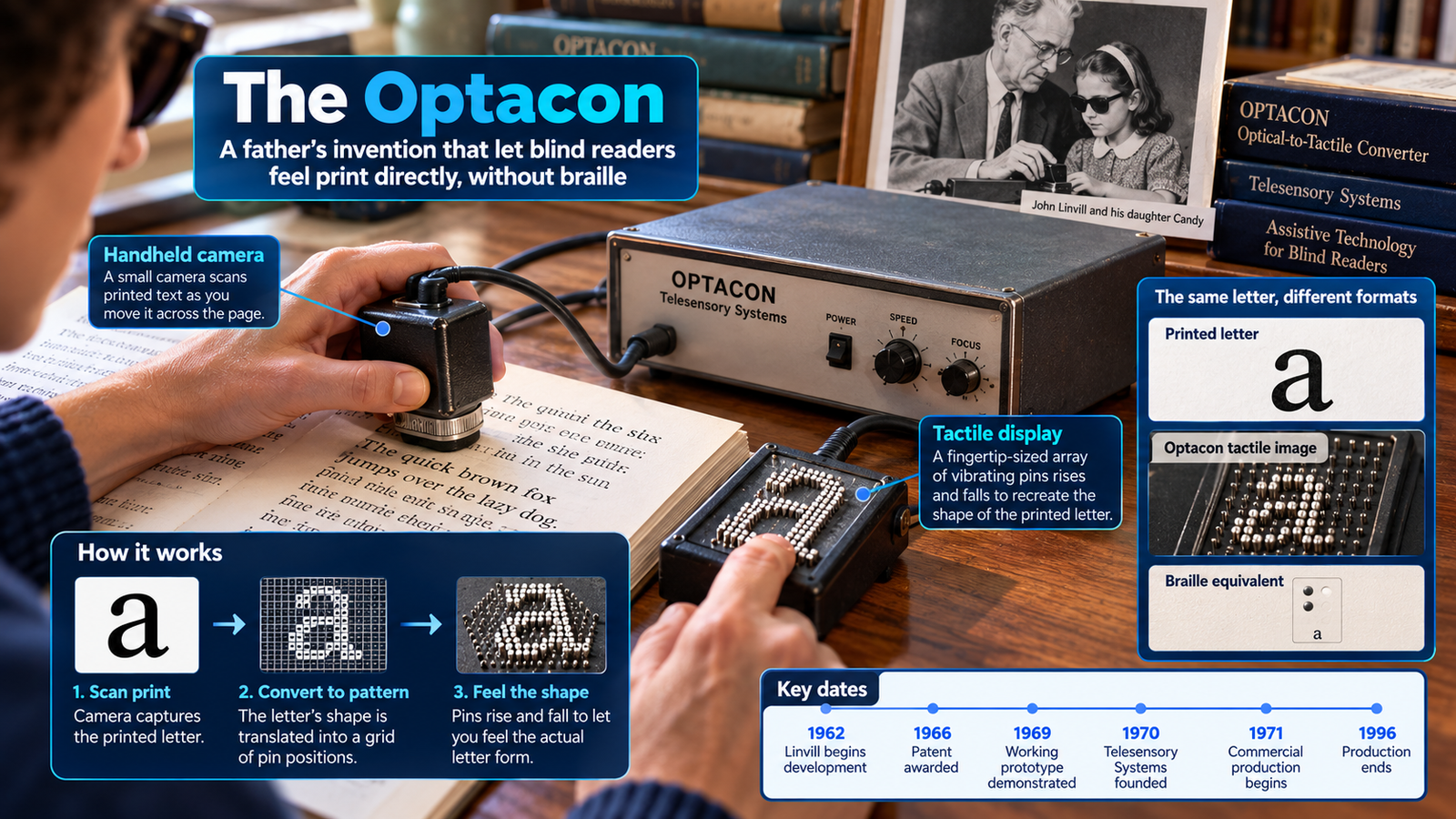
John Linvill, an electrical engineering professor at Stanford, had a daughter named Candy who’d been blind since age 3. In 1962 he started working on a way for her to read ordinary printed material herself, without anyone first having to convert it into braille or read it aloud to her. What he eventually built didn’t use braille at all. It let a blind reader feel the actual shape of printed letters directly, in something close to real time, which made it a fundamentally different approach from everything else this site normally covers.
It didn’t translate text, it transmitted the letter shapes themselves
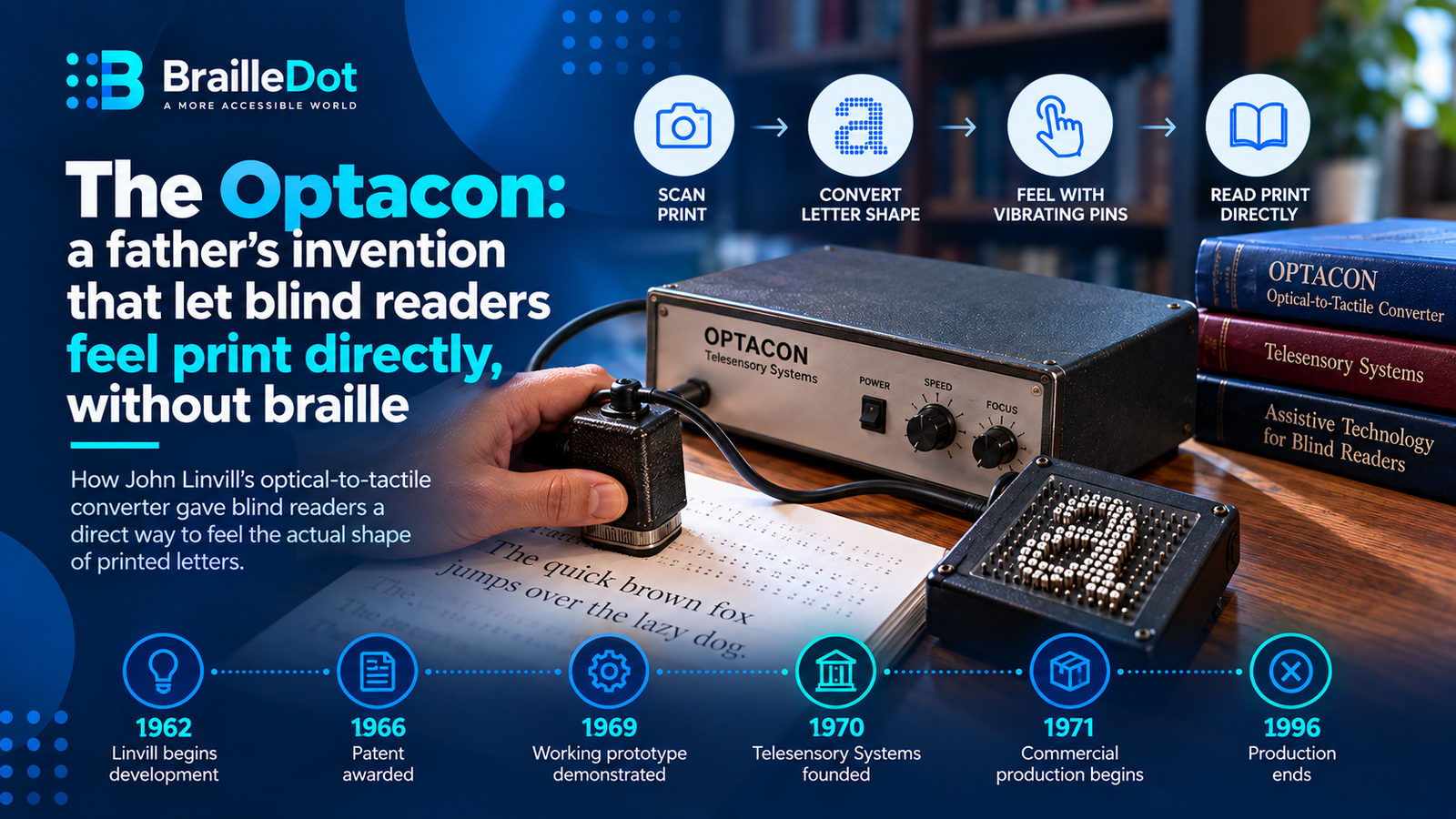
The device Linvill built, called the Optacon, short for optical-to-tactile converter, paired a small handheld camera with a fingertip-sized array of vibrating pins. A user moved the camera across a line of printed text, and the pins beneath their finger rose and fell to recreate the literal outline of whatever letter the camera was currently seeing, magnified onto that small tactile display. There was no conversion into braille cells happening anywhere in the process. The reader was feeling an actual, direct tactile image of the print character itself, shape for shape, rather than a symbol standing in for it.
Linvill received a patent for the device in 1966, after reportedly being inspired by seeing a high-speed printer using small pins during a visit to an IBM laboratory in Germany. A working prototype was demonstrated in 1969, and in 1970 Linvill, along with colleague Jim Bliss and other Stanford researchers, founded Telesensory Systems specifically to manufacture and distribute it. Production ran from 1971 until the device was finally discontinued in 1996.
The Optacon did not convert printed letters into braille. It converted the visual shape of each character into a tactile pattern that the reader could feel directly.
Reading letter shapes by touch was its own hard skill, even for fluent braille readers
The honest, often-overlooked part of the Optacon’s story is how difficult it actually was to use well. Learning to interpret raw printed letterforms through a vibrating tactile display, in real time, while physically scanning a camera across text, was a different skill entirely from reading braille, and the difficulty didn’t scale down for someone who already read braille fluently. Dedicated Optacon training schools were established specifically to teach this skill, with financial backing from the US government, because the device wasn’t something a new user could simply pick up and use effectively without real instruction.
For those who stuck with the training, the payoff was described in strong terms at the time. Lyle Thume, an Optacon user who directed blind rehabilitation services at a Detroit institute, described it in 1973 as opening up an entirely new world for blind people, not an overstatement given what it actually offered, direct, independent access to printed material with nobody else involved in the process at all.
OCR eventually did the same job with far less training required
The Optacon’s eventual decline came from a direction that has real relevance to what this site’s own translator does. As personal scanners and optical character recognition software matured, offering a path from printed text to speech or braille output without requiring years of specialized tactile training, the market for a device as demanding to learn as the Optacon shrank steadily. That’s the same underlying technology, OCR converting an image of printed text into usable digital text, that newer tools rely on today, a direct technological descendant of the problem Linvill was trying to solve by hand decades earlier, just solved through a completely different mechanism.
Optacon
Converts the visual shape of printed characters into tactile patterns felt directly through vibrating pins.
OCR
Converts an image of printed text into digital characters that can then be spoken aloud or converted into braille.
Braille
Represents written language through standardized tactile symbols rather than reproducing the visual shape of printed letters.
Something real was lost in that transition, worth stating plainly rather than treating OCR as a strictly better replacement in every situation. A scanner needs a flat, well-positioned surface to read from effectively. The Optacon, being a small handheld camera a user could move freely, let someone read things a scanner setup handles poorly or not at all, text on an oddly shaped food can, a clothing label sewn into an irregular seam, anything positioned somewhere a flatbed or document scanner simply can’t reach. Portability and direct, immediate access were the Optacon’s real advantages, and those specific advantages didn’t fully transfer to the OCR-based tools that eventually replaced it in the broader market.
The Optacon had its own predecessor, decades earlier
Linvill’s device wasn’t actually the first attempt at converting print into something a blind person could perceive directly, without braille as an intermediate step. An earlier device called the Optophone, developed in 1913, took a different sensory route entirely, converting light patterns from printed letters into distinct sounds a trained user could learn to interpret by ear rather than by touch. One documented user, Mary Jameson, began using it in 1918 and kept practicing for decades, eventually reaching a reading speed of 60 words per minute by 1972, proof that even an unusually demanding sensory-substitution device could become real, functional reading given enough sustained practice. The Optacon and the Optophone solved the same underlying problem roughly half a century apart, using 2 completely different senses, touch and hearing, as the channel.
Optophone
An early sensory-substitution device converted printed patterns into sounds that users learned to interpret.
Linvill begins the project
John Linvill began developing a way for his blind daughter to read ordinary print independently.
Optacon patent
Linvill received a patent for the optical-to-tactile converter.
Commercial production
Telesensory Systems began producing and distributing the Optacon.
Production ends
The Optacon was eventually discontinued as newer technologies changed how printed information could be accessed.
An award named after Louis Braille, for a device that didn’t use braille
In 1984, Linvill received the Louis Braille Prize from a German blind association specifically for inventing the Optacon, an award carrying the name of the person whose 6-dot system this entire site is otherwise built around, given for a device that solved the same underlying problem, independent reading access for blind people, through an entirely different mechanism that never touched braille at all. It’s a reminder that braille, as central as it is, has never been the only serious answer to the question of how a blind person reads, a point our piece on how refreshable braille displays actually work picks up from a different angle, covering the technology that eventually did combine digital text with genuine braille output in a way the Optacon never attempted to.
A different answer to the same reading problem
The Optacon took an unusual route to independent reading: instead of translating print into braille, it let the reader feel the printed character itself. Its history sits between early sensory-substitution experiments and the OCR-driven accessibility tools that followed, showing how many different technical approaches have been used to solve the same fundamental problem.