Grade 2 braille contractions: the complete reference
Grade 2 braille contractions: the complete reference
This translator implements 181 distinct grade 2 contractions: 23 alphabetic wordsigns, 24 strong wordsigns and groupsigns, 14 lower wordsigns and groupsigns, 33 initial-letter contractions, 12 final-letter groupsigns, and 75 short form words. This page lists every one of them with its braille cell. If you want the concept explained first, what a wordsign or groupsign actually is, our grade 1 vs grade 2 braille guide covers that. This page is the reference itself.
Alphabetic wordsigns
A single letter cell stands in for an entire common word. These are the simplest contractions in grade 2, one cell, one word, no other rule involved.
Strong wordsigns and groupsigns
Five signs in this group do double duty. And, for, of, the, and with stand alone as whole words, but the exact same cell also functions as a groupsign inside a longer word. Everything else in this category is groupsign-only or wordsign-only.
Wordsign and groupsign (5)
Wordsign only (6)
Groupsign only (13)
Worth noticing directly: child and ch share a cell, shall and sh share a cell, this and th share a cell, which and wh share a cell, out and ou share a cell, still and st share a cell. That’s not a coincidence, the wordsign is built from the groupsign it’s related to, which is part of why UEB is learnable as a system rather than 181 unrelated symbols to memorize individually.
Lower wordsigns and groupsigns
Be and in also do double duty, standing alone as words and appearing as groupsigns inside longer words. These signs use the lower part of the cell (dots 2, 3, 5, 6), which is also why they’re placed differently in a line than upper-cell signs.
Wordsign and groupsign (2)
Wordsign only (4)
Groupsign only (8)
Initial-letter contractions
These take a familiar letter shape and add a dot pattern to signal that the cell means a whole word instead of that letter. They split into three groups depending on which dots get added.
Dot 5 added (22 words)
Dots 4 and 5 added (5 words)
Dots 4, 5, and 6 added (6 words)
Final-letter groupsigns
These sit at the end of a word rather than the beginning, standing in for a common word ending rather than a whole word.
Dots 4 and 6 (5 endings)
Dots 5 and 6 (7 endings)
Short form words
Short form words use a shortened sequence of cells, more than one but fewer than a full spelling, to represent a longer word. Unlike wordsigns, these are built by combining smaller signs already covered above, letters and groupsigns strung together to form a compressed version of the word.
Notice braille itself is one of the 75, spelled as b, r, l rather than the full word. That’s not a special case for this site’s content, it’s simply one of the 75 words UEB defines a short form for.
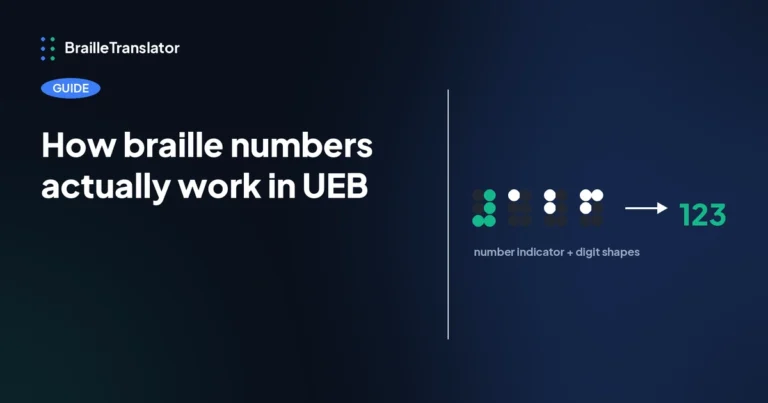
Contractions aren’t the only layer with its own dot patterns. See our braille punctuation reference for how commas, quotes, and currency symbols are built, or how braille numbers actually work for digits, decimals, and the letter indicator.
Try these against your own translation
Type any of these words into our braille translator and switch between grade 1 and grade 2 to see the contraction fire in real time, or check a word you’re unsure about directly instead of relying on memory.
Open the translatorFrequently asked questions
This translator implements 181 distinct contractions: 23 alphabetic wordsigns, 24 strong signs, 14 lower signs, 33 initial-letter contractions, 12 final-letter groupsigns, and 75 short form words.
A wordsign is a single cell that stands for an entire word on its own. A short form word uses a shortened sequence of more than one cell, built from letters and groupsigns, to represent a longer word.
Yes. And, for, of, the, with, be, and in each function as both a standalone wordsign and a groupsign used inside longer words, using the exact same cell for both roles.
It depends on the category. Initial-letter contractions represent whole words built from a letter shape with dots added. Final-letter groupsigns instead represent common word endings and only apply at the end of a word.