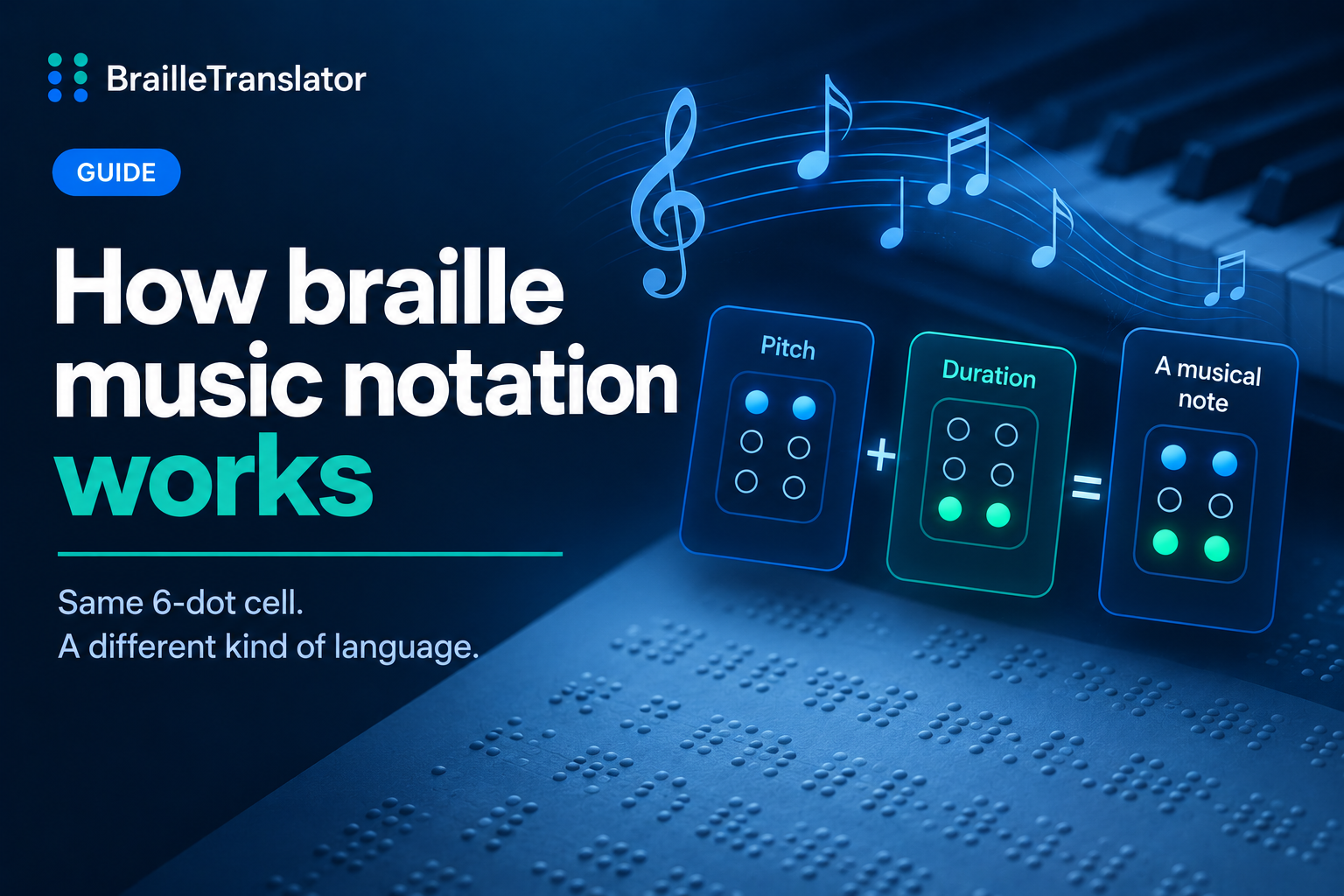
How braille music notation works
Braille music isn’t printed sheet music translated into braille. It’s its own notation system, with its own rules, also invented by Louis Braille himself, completed around 1834 but not officially adopted until 1852, the same year he died, echoing the exact same slow recognition his literary code faced, covered in our history of braille. It uses the identical 6-dot cell as literary braille, but a single cell here does something literary braille’s cells never have to do, encode 2 completely different pieces of musical information at once. There’s also no visual staff anywhere in the system, which changes not just how the notation looks, but how a blind musician actually learns a piece in the first place.
The same cell encodes both pitch and duration at once
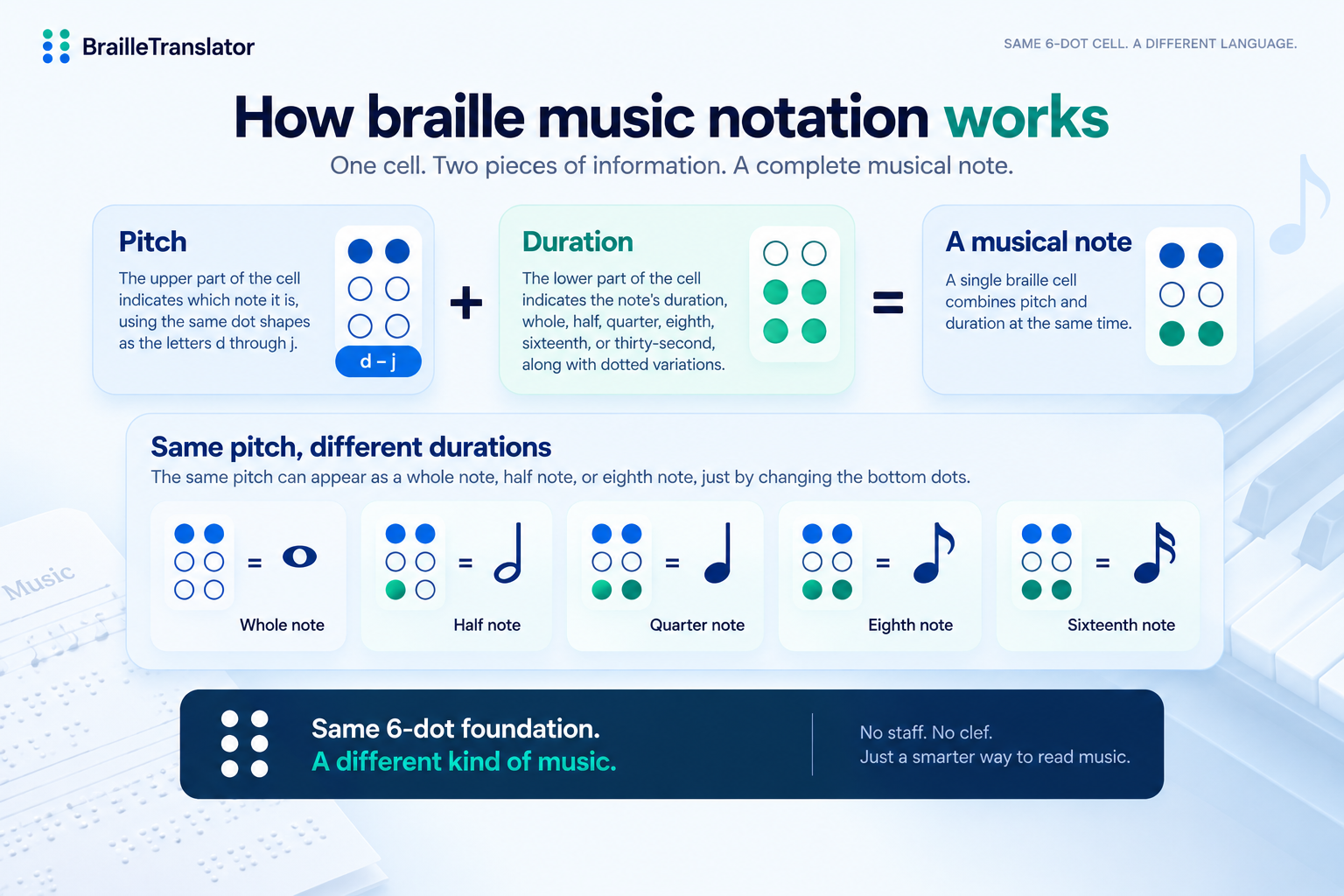
In braille music, a single cell carries 2 separate pieces of information simultaneously. The upper part of the cell indicates which note it is, reusing the same dot shapes literary braille uses for the letters d through j. The lower part of that same cell indicates the note’s duration, whole, half, quarter, eighth, sixteenth, or thirty-second, along with dotted variations of each. That means the identical pitch can appear as a whole note, a half note, or an eighth note, purely by changing 2 dots at the bottom of the cell while the top stays exactly the same.
This is the same underlying principle that shows up elsewhere in braille in a completely different context, a small, specific change to part of a cell shifting its meaning entirely, the way an added dot turns a plain letter into a contraction in our grade 2 contractions reference. Braille music applies that same logic to an entirely different kind of information, pitch and rhythm layered into 1 physical cell instead of spread across a printed staff.
Octave signs replace the staff and the clef entirely
Printed music tells you which octave a note belongs to by where it sits on the staff, above or below the lines, higher or lower relative to the clef. Braille music has no staff to place a note on, so it solves the same problem with a dedicated octave sign placed directly in front of the note, with nothing else allowed to sit between the 2. There are 7 recognized octaves, and octave 4 is the one containing middle C. Several of these signs are genuinely simple, distinct shapes, dot 4 alone marks the first octave, dot 4 doubled marks the octave below that, dot 4-5 marks the second octave, dot 3-4-5-6 marks the third, dot 4-5-6 marks the fourth, and dot 5-6 marks the fifth.
Because octave signs already pin down exact pitch, clef signs become genuinely unnecessary and are usually left out of a braille transcription entirely. There’s also a real space-saving rule built in for octave marks specifically. A melodic leap of a 4th or a 5th is assumed to stay within the same octave as the note before it unless a new octave sign explicitly says otherwise, which means the notation doesn’t need to repeat an octave sign after every single note, only when the octave genuinely changes or a leap is large enough to create real ambiguity.
Rhythm ambiguity gets resolved by context, the same way it does elsewhere in braille
Because a single duration cell can represent 2 different possible values depending on context, whole or sixteenth, half or thirty-second, that ambiguity has to be resolved somehow. Most of the time, the piece’s current time signature makes it clear which of the 2 possible readings is meant, the same way context resolves ambiguous cells elsewhere in literary braille. In the genuinely confusing cases, a half note followed immediately by a thirty-second note is the standard example, an explicit disambiguating sign gets inserted between the 2 notes rather than leaving the reader to guess. Sharps, flats, and natural signs, by contrast, are used exactly as they appear in printed music, one of the few places braille music borrows a convention directly rather than reworking it.
There’s no staff, so you can’t sight-read and play at the same time
This is the practical reality that separates braille music from print far more than any individual symbol does. Because the entire system is linear, a sequence of cells read left to right with no visual layout at all, there’s no way to glance ahead the way a sighted musician scans a printed staff while playing. A professional blind musician describing her own process put it plainly, when asked how she learns a piece from braille notation, the honest answer is that she doesn’t read and play simultaneously at all. She starts by reading and singing the line, then uses technology to listen, read, and eventually play, building the piece up rather than sight-reading it in real time. For music with multiple parts, this typically means learning 1 hand’s part fully, then the other, then combining them from memory, since there’s no way to visually track both at once the way printed notation allows.
Physical space adds another real constraint. A single bar of braille music can take up considerably more room than the same bar in print, sometimes filling most of a page for something that would be a few inches of printed staff. Braille music has its own dedicated shorthand specifically to manage this, distinct signs for repeating a single beat, a partial bar, a full bar, or even a specific earlier bar or section, so a repeated musical phrase doesn’t have to be written out in full every single time it recurs.
Louis Braille invented this too, and it faced the same slow recognition
Louis Braille finished his work on this system around 1834, the same period he was still refining his literary code, but it wasn’t officially adopted until 1852, the year he died, the identical pattern of delayed recognition that met his literary system. The current governing standard, the Music Braille Code, was most recently revised in 2015 under the sponsorship of the Braille Authority of North America, confirming this isn’t a historical curiosity, it’s an actively maintained system still in real use today.
What this means for a literary translator like this one
This translator implements literary UEB, English text translated to grade 1 or grade 2 braille. It doesn’t generate music notation, which is a genuinely separate system with its own dedicated rules for pitch, duration, and octave that have nothing to do with translating written English. If you’re working with sheet music specifically, that’s a different, specialized transcription process entirely. For everyday English text, our braille translator handles that directly.
Try the literary system this translator actually implements
See English UEB braille in action with our braille translator, while keeping in mind that braille music uses a separate notation system designed specifically for musical information.
Open the translatorFrequently asked questions
Louis Braille invented it himself, the same person who created the literary braille system. He finished his work on it around 1834, though it wasn’t officially adopted until 1852, the year he died.
No. A single cell encodes both the note’s pitch, in its upper portion, and its duration, in its lower portion, at the same time. The same pitch can become a whole note, half note, or eighth note purely by changing the duration portion of the cell.
Generally, no. Because braille music has no visual staff, most musicians read and learn a piece first, often reading and singing it, before playing it from memory rather than sight-reading and performing simultaneously.
Not for every note. A melodic leap of a 4th or 5th is assumed to stay within the same octave as the previous note unless a new octave sign says otherwise, which reduces how often the sign needs to repeat.
No. This translator implements literary UEB for English text. Braille music notation is a separate system with its own dedicated rules for pitch, duration, and octave.