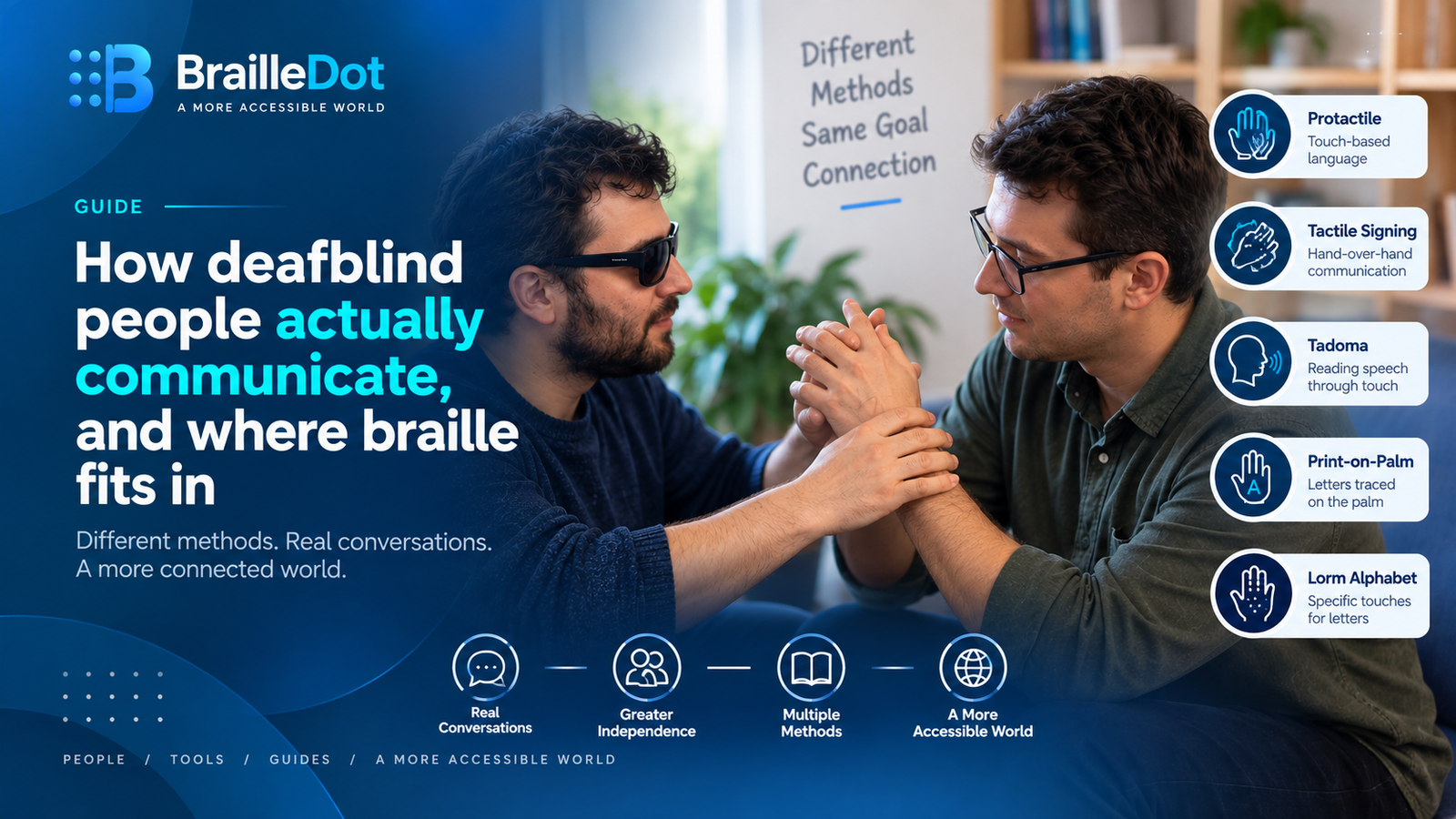
How deafblind people actually communicate, and where braille fits in
In 2007, 3 deafblind colleagues working at the Deaf-Blind Service Center in Seattle, aj granda, Jelica Nuccio, and Jackie Engler, ran into a specific, recurring problem. American Sign Language relies heavily on facial expression and visual space, so using it as a deafblind person meant working through an interpreter, either translating in real time for a group or limiting a conversation to 2 people at a time using hand-over-hand signing. The 3 of them started working out a different way to talk directly with each other, built entirely around touch rather than adapted from something visual. What they created became known as Protactile, and it’s now used by a growing community of deafblind people across the country.
Protactile isn’t ASL translated onto skin
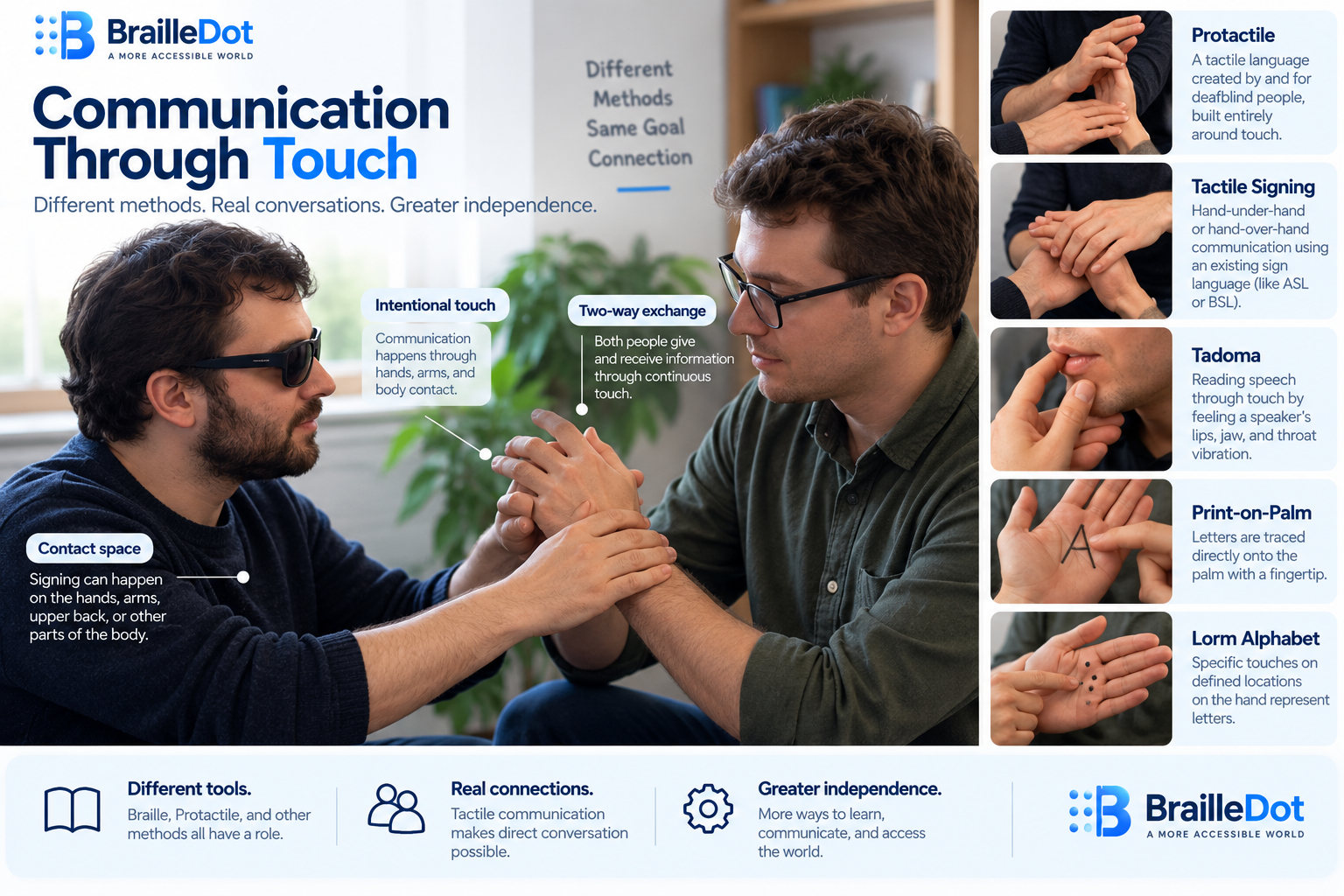
The most common misunderstanding about Protactile is treating it as sign language with the visual parts stripped out and touch swapped in. That’s not quite what it is. ASL depends on facial expression and spatial positioning to carry meaning, a hearing, sighted viewer picks up automatically, none of which transmits through touch. Protactile replaces those visual mechanisms with concepts built for touch specifically, contact space, where signing happens directly on the body, hands, arms, upper back, and even the knees or thigh depending on how someone is seated, and reciprocity, a constant 2-way exchange of touch that lets both people confirm understanding continuously rather than 1 person simply receiving information passively the way a listener does in spoken conversation.
Braille and Protactile solve 2 different problems
It’s worth being precise about where braille actually sits in all of this, since the 2 systems get conflated more often than they should. Braille’s primary role is representing written language, text that already exists or is being composed, meant to be read or written down. Protactile and the other tactile communication methods covered below exist for something braille was never built to do, live, real-time conversation between people in the same room. A deafblind person might use braille to read a book or write a note, and use Protactile or a different tactile method entirely to have an actual back-and-forth conversation minutes later. They’re complementary tools for genuinely different tasks, not competing systems where 1 makes the other unnecessary.
If you want to understand how braille itself represents written language, our braille translator provides a practical way to convert English text into grade 1 or grade 2 UEB and see the underlying braille representation directly.
Beyond Protactile, several distinct methods exist for live conversation
Tactile signing, sometimes called hand-under-hand or hand-over-hand communication, lets a deafblind person follow an existing sign language, commonly British Sign Language or ASL, by placing their hands over the signer’s hands to track the shapes and movements through touch. A related method, the deafblind manual alphabet, spells out each letter of a fingerspelling alphabet directly onto the palm of the deafblind person’s hand.
1 of the more remarkable methods is Tadoma, a way of reading speech itself through touch rather than reading text or signs at all. The deafblind person places a thumb against the speaker’s lips and fingers along the jaw and cheek, with the little finger often resting near the throat to pick up vocal vibration directly. It lets someone follow spoken conversation in real time using touch alone, without any signing system standing between them and the speaker’s own voice.
For someone who already learned the printed alphabet before losing their sight or hearing, a method called print-on-palm lets a communication partner trace individual letters directly onto the deafblind person’s palm with a fingertip, spelling words out the same way they’d already learned to read them. It’s the same underlying logic that made Moon Type easier for people who lost their sight later in life, covered in our piece on the tactile alphabets that came before braille, leaning on letterforms someone already knows rather than requiring an entirely new symbol system. The Lorm alphabet takes a related but distinct approach, using specific touches and movements mapped to defined locations on the hand rather than tracing letter shapes directly. For deafblind people with some remaining vision, a simpler technique called tracking involves resting a hand on the signer’s wrist, using that contact to help locate and follow hand position well enough to make out signs that would otherwise be too far away or too dim to see clearly on their own.
Technology is starting to bridge the gap in real time
Some newer assistive devices combine speech recognition software with refreshable braille displays, the same pin-based hardware covered in our piece on how refreshable braille displays actually work, specifically to convert spoken conversation into braille a deafblind person can read as it happens, rather than requiring a trained tactile-signing interpreter to be physically present. It’s a direct, practical extension of hardware originally built for reading static text into something that can also carry live spoken conversation, converted into braille output in something close to real time.
A few things worth knowing if you’re communicating with someone who is deafblind
Practical guidance compiled by organizations working directly with the deafblind community converges on a few consistent points. Identify yourself by name whenever you enter or leave a room, since a deafblind person can’t rely on seeing you arrive or leave the way a sighted person would. Address the deafblind person directly rather than speaking to a companion or interpreter about them. Ask before assuming someone needs assistance rather than simply providing it unannounced. If someone uses tactile signing and places a hand on top of yours to begin communicating, a light, friendly squeeze back is a widely recognized way to acknowledge the greeting and signal you’re ready to continue.
Where braille fits into the bigger picture
Braille remains one part of a much larger communication toolkit. It provides a way to represent written language through touch, while Protactile, tactile signing, fingerspelling, Tadoma, and other methods provide ways to communicate directly with another person in real time. For deafblind people, the most useful approach isn’t necessarily choosing one system over another. Different situations call for different tools, and the ability to move between them is what makes communication more flexible and independent.
Understanding that distinction also makes it easier to see why braille technology continues to matter. A braille translator can turn written English into UEB braille, while a refreshable display can make that text physically readable through raised pins. Live tactile communication then fills an entirely different role, allowing two people to exchange information directly rather than simply reading a prepared text.
Explore how written English becomes braille
Convert English text into grade 1 or grade 2 UEB with our braille translator, then explore how braille fits alongside the wider world of tactile communication.
Open the translator