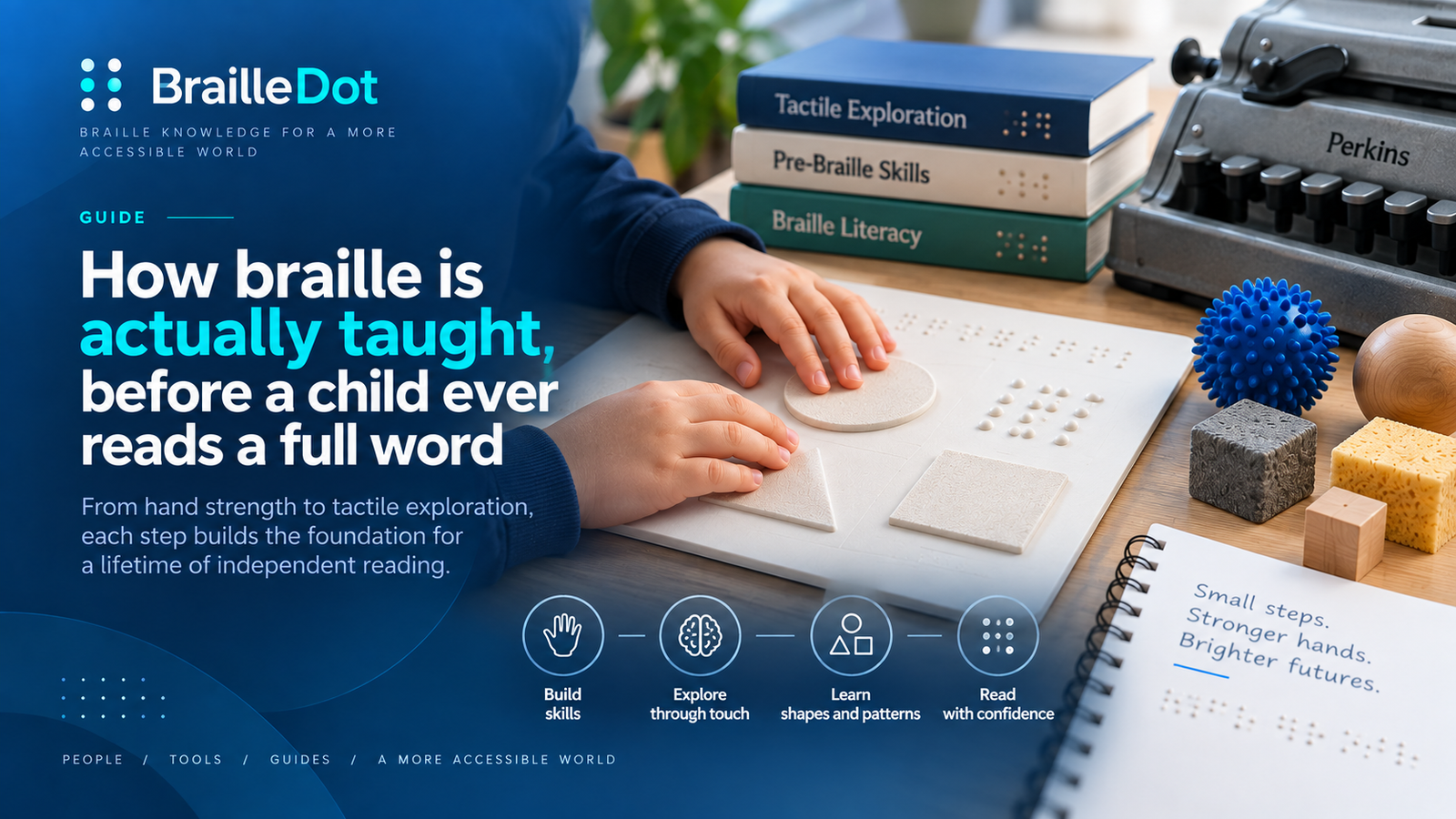
How braille is actually taught, before a child ever reads a full word
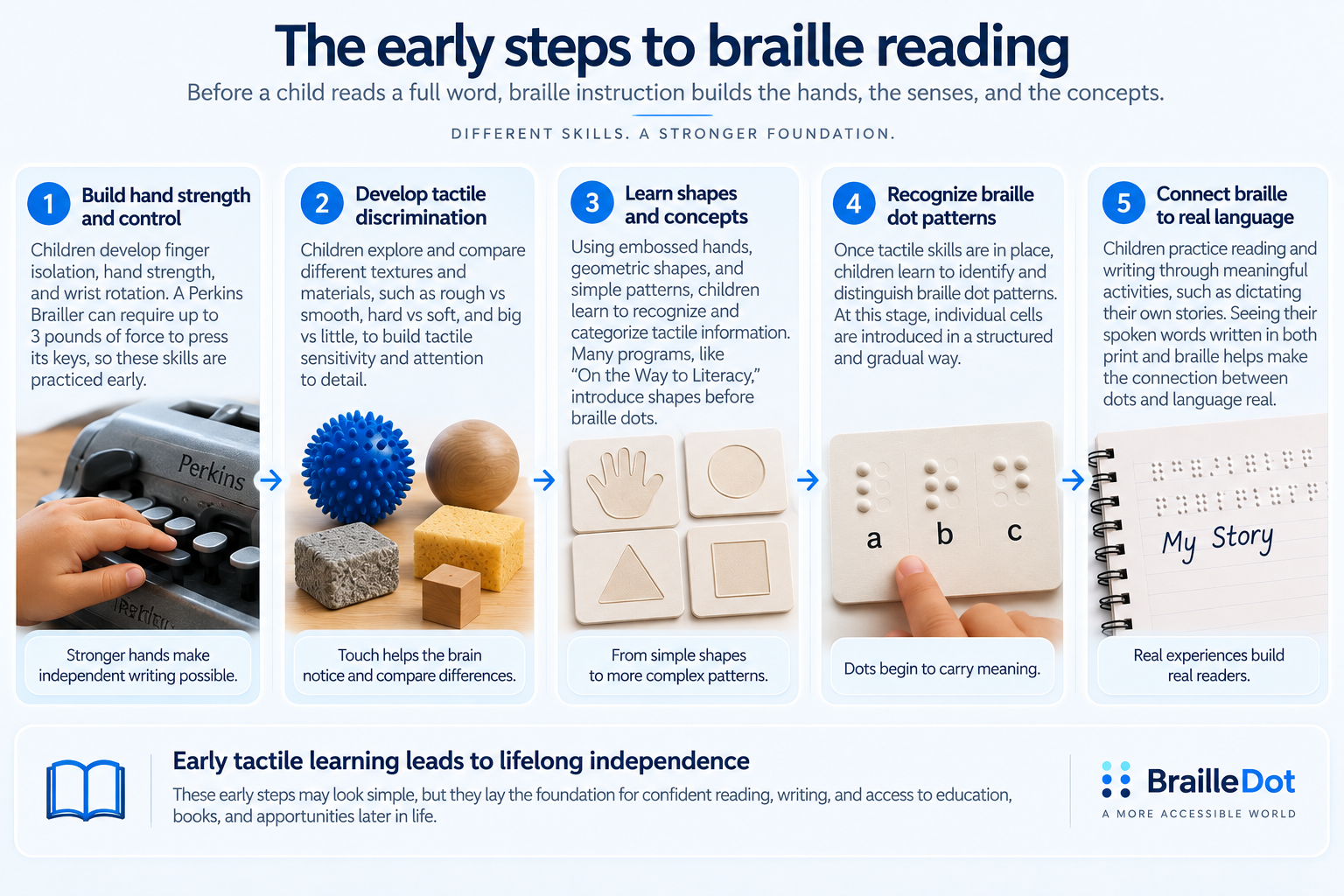
Before a child learns a single braille letter, a teacher is usually working on something that has nothing to do with reading at all, hand strength. A Perkins Brailler requires as much as 3 pounds of force to press its keys, real physical effort for small hands, which is one reason finger isolation and wrist rotation get built up deliberately before formal instruction starts, not assumed to already be there. Braille literacy doesn’t begin with the alphabet. It begins with the body learning to do things a sighted child’s hands never have to.
What actually happens during the pre-braille stage
The stage before formal reading instruction, generally called pre-braille, focuses on tactile discrimination and the basic concepts a child needs before dots on a page can mean anything at all. That includes distinguishing rough from smooth, hard from soft, big from little, and developing enough tactile sensitivity to notice fine differences under a fingertip. The specific exercises look different from how a sighted child’s early learning usually works. A sighted toddler sorting objects by color has a rough tactile equivalent in a blind child sorting objects by material instead, paper items in 1 pile, metal items in another, building the same underlying skill, categorization based on a specific shared trait, through touch rather than sight.
Structured materials exist specifically for this stage. A widely used 3-volume set called “On the Way to Literacy” moves a child through embossed hands and simple geometric shapes in its first 2 volumes before introducing actual braille dots in the third, a deliberate progression from general tactile awareness to the specific skill of distinguishing dot patterns. None of this is optional groundwork that could be skipped to get to “real” reading faster. Without it, a child encountering an actual braille cell for the first time is trying to learn 2 things simultaneously, what a raised dot even feels like as information, and what a specific pattern of dots means, instead of just the second one.
This groundwork typically starts well before a child reaches school age at all. Guidance aimed at parents of infants and toddlers frames pre-literacy work as something that begins in the home, long before any formal classroom instruction, through ordinary play, sensory exploration, and simple activities like scribbling with a braillewriter or slate and stylus the same way a sighted toddler scribbles with crayons before ever forming an actual letter. The comparison matters. A sighted child’s early mark-making looks purposeless to an adult but is doing real developmental work, building the motor patterns writing will eventually depend on. The same logic applies to a blind toddler’s early tactile play, it looks unrelated to reading, and it’s actually laying down the physical and conceptual groundwork the entire system depends on later.
The real debate over when to introduce contractions
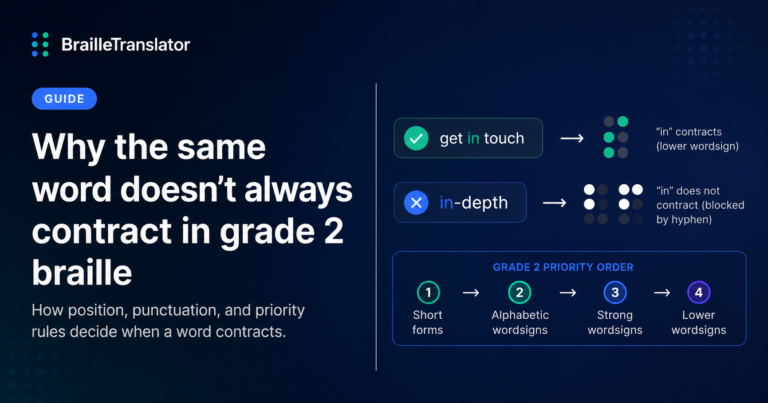
Once a child moves into actual letter and word instruction, a genuine, unresolved disagreement exists among teachers of the visually impaired about sequencing, specifically whether to introduce grade 2’s contractions right away or hold off. Our own grade 1 vs grade 2 braille guide covers what actually separates the 2 systems technically. This is a different question entirely, which one a child should learn first, and reasonable, experienced teachers land on different answers.
Teaching contracted braille from the start has a real advantage, a child can read and write actual words immediately rather than spelling everything out letter by letter, and far more published braille material exists in contracted form than uncontracted, so early access to real books is easier. The cost is that a child has to learn wordsigns and groupsigns at the same time as the 26 letters themselves, and relying on a shortcut like a single cell for “but” before fully internalizing spelling can meaningfully interfere with decoding and spelling skills compared to sighted peers, who spell every word out in full for years before learning any shortcuts of their own.
The alternative, teaching uncontracted grade 1 first and introducing contractions gradually in early elementary years, builds a stronger spelling and decoding foundation before layering shortcuts on top of it. Its own cost is more practical than pedagogical, there simply isn’t much published material available in uncontracted form, which limits how much a child can read independently during those early years compared to a peer who jumped straight into contracted text. Neither approach is settled as clearly superior. It’s a real trade-off between reading fluency now and spelling foundation later, and different children, and different teachers, land differently on it.
A technique that ties the code to actual meaning
One specific method shows up repeatedly in how experienced teachers bridge the gap between “these are dots” and “these dots are language.” A child dictates a short story about something real that happened to them, and the adult writes it down in both print and braille side by side, then has the child read it back aloud, repeatedly. The point isn’t the story itself. It’s that the child sees their own spoken words turned into braille they can then read back, making the connection between the code and actual meaning concrete rather than abstract, in a way that generic practice sentences written by someone else don’t accomplish nearly as directly.
What this groundwork is actually building toward
None of this is really about braille as an isolated skill. Hand strength, tactile categorization, the contraction sequencing decision, and the dictated-story method are all pieces of the same longer project, building a reader capable of full independence later rather than someone who can merely identify letters. Teachers who’ve followed students from early childhood into adulthood describe watching that independence take hold over decades, not months, which is a useful reminder that the slow, physical, unglamorous work at the very start of braille instruction is doing far more than it looks like it’s doing at the time.
That physical foundation also connects to the machines many braille readers eventually use for writing. The Perkins Brailler remains built around the same fundamental six-dot writing structure that makes tactile writing possible, while modern tools such as refreshable braille displays carry braille into digital environments.
Start exploring braille translation
When you’re ready to work with English braille, our braille translator converts text into grade 1 or grade 2 UEB directly.
Open the translator