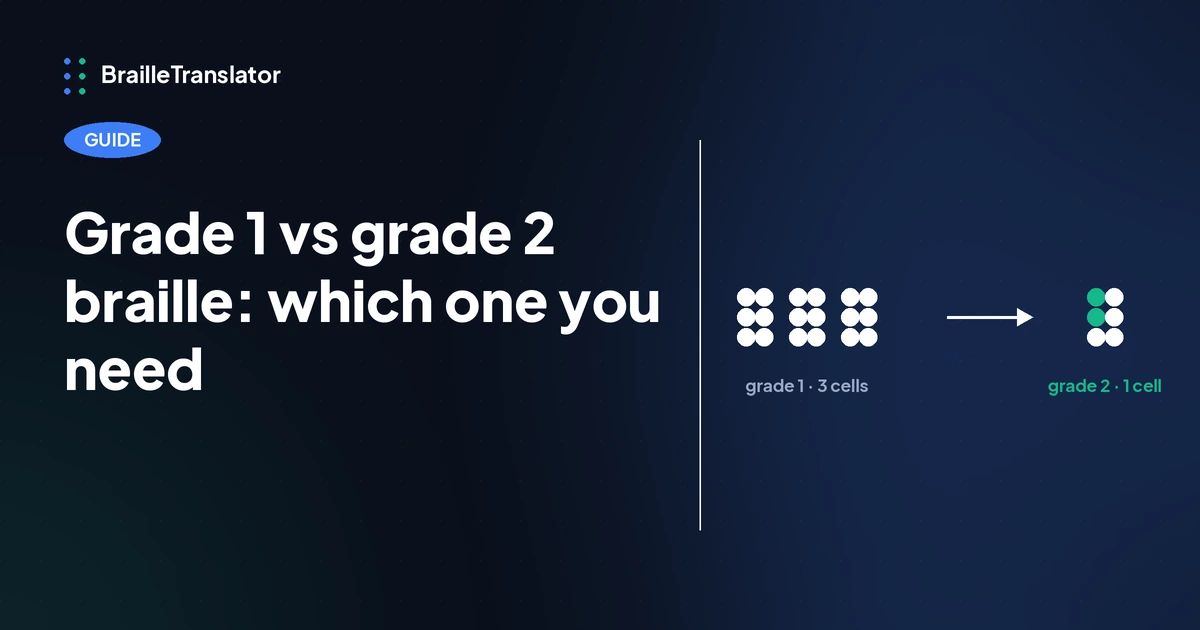
Grade 1 vs grade 2 braille: which one do you need
Grade 1 braille spells every letter, number, and punctuation mark out in full, with no shortcuts. This is uncontracted braille. Grade 2 braille adds a layer of contractions on top of that same alphabet, so common letter groups and whole words compress into fewer cells. This is contracted braille. If you’re transcribing something where exact spelling matters, a password, a legal document, a name, grade 1 is the right call. If you’re producing something meant to be read at length by a fluent reader, a book, a letter, classroom material, grade 2 is standard. The rest of this guide covers what actually changes at the cell level and where each grade fits in practice.
What actually changes at the cell level
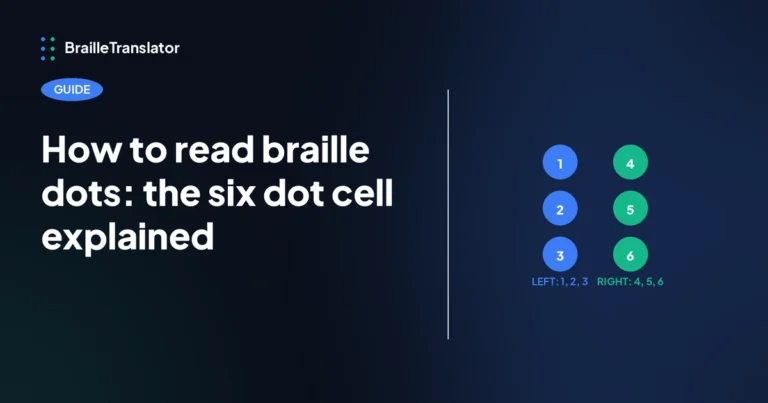
Both grades use the same six-dot cell and the same 26-letter alphabet. Nothing about the physical dot positions changes between grade 1 and grade 2. What changes is how much of the meaning is packed into each cell.
In grade 1, one cell equals one character. The word “cat” is 3 cells: c, a, t, each spelled out individually. There’s no ambiguity and no shorthand to learn beyond the base alphabet, which is exactly why it’s called uncontracted braille.
In grade 2, a single cell or a short cell sequence can stand in for an entire word or a common letter group. Three contraction types do most of the work:
- Wordsigns: one cell represents a whole common word by itself.
- Groupsigns: a cell represents a recurring letter group inside a longer word.
- Short form words: a shortened cell sequence, more than one cell but fewer than the full spelling, replaces a longer word.
See every example of each type in our complete grade 2 contractions reference, all 181 of them.
If you want a refresher on how the dot positions themselves map to individual letters before getting into contractions, our guide to reading braille dots covers that groundwork.
Grade 2 is not a different alphabet
This is the most common point of confusion for anyone new to comparing the two grades. Grade 2 doesn’t hand you a second alphabet to memorize. It reuses the exact same 26 letters and the same six-dot cell you’d use in grade 1, and reassigns meaning to certain cells and cell sequences based on where they sit in a word.
Grade 1 never has this problem, since every cell always means exactly one thing regardless of position.
That reuse is also why context matters so much in grade 2. The same single cell can mean different things depending on position. A cell that works as a groupsign in the middle of a word can be invalid in that same role at the start or end of a different word, and some cells are genuinely ambiguous on their own, resolved only by looking at what surrounds them. That predictability is part of why grade 1 is the safer default anywhere ambiguity would be a real problem, not just an inconvenience.
Before and after: the same words in each grade
Seeing the same word rendered both ways makes the size difference concrete. These are pulled directly from the translation engine’s own letter and contraction tables, not approximated.
Whole-word wordsign
Groupsign (“st”) plus strong wordsign (“and”)
Short form word
“But” drops from 3 cells to 1 because it has a dedicated wordsign. “Stand” drops from 5 cells to 2 because it combines a groupsign for “st” with the strong wordsign for “and”, both valid in that position. “About” drops from 5 cells to 2 through a short form, a shortened cell sequence rather than a single-cell wordsign. Same word, same meaning, genuinely different cell count depending on which grade you’re transcribing into.
Real world scenarios for each grade
Grade 1 scenarios, uncontracted braille
- Passwords and technical strings. Anywhere exact character sequence matters more than reading speed, contraction is a liability, not a convenience.
- Legal documents. Clauses and defined terms often depend on exact wording. Introducing contractions adds a layer of interpretation a legal transcript shouldn’t have.
- Classroom spelling instruction. Early literacy work is often specifically about teaching letter-by-letter spelling, which grade 2’s contractions would work against.
- Names. Personal and place names don’t reliably follow standard contraction rules, so grade 1 avoids guessing wrong.
Grade 2 scenarios, contracted braille
- Published books. Most braille publishing uses grade 2 by default, since contraction reduces both page count and reading time for fluent readers.
- Personal note-taking. A fluent braille reader taking their own notes benefits from the same speed advantage a shorthand system gives a sighted note-taker.
- Letters and general correspondence. Standard, everyday reading material is the core use case grade 2 contractions were built for.
- Any long-form text meant to be read start to finish rather than referenced character by character.
Using a UEB braille translator for either grade
A UEB braille translator built for this comparison should let you switch between grade 1 and grade 2 output for the same input text and see exactly what changes, rather than forcing you to guess which grade you’re looking at. Our tool works as both a braille translator grade 1 setup and a braille translator grade 2 setup from the same input box, with the grade selectable per translation rather than fixed.
Try it directlyFrequently asked questions
Grade 1 spells every character out individually with no contractions. Grade 2 uses the same alphabet and cell system but adds wordsigns, groupsigns, and short form words that let common words and letter patterns take fewer cells.
Not for a reader who already knows the contraction rules. Grade 2 is generally faster to read for fluent braille users, since fewer cells are needed per word. It has a steeper learning curve upfront than grade 1, which is why grade 1 is often used first in spelling instruction.
Grade 1 is generally the safer choice for legal and other exact-wording material, since contractions in grade 2 introduce a layer of interpretation that isn’t appropriate where precise wording matters.
Yes, a properly built translator applies the two rule sets to the same input text and switches output on demand, without needing separate tools or a page reload.
Effectively yes. Grade 1, uncontracted braille, is the letter-by-letter alphabet with no shorthand layered on top. Grade 2 uses that same alphabet as its foundation and adds contractions on top of it.