Why every medicine box in Europe carries braille, and what the law actually specifies
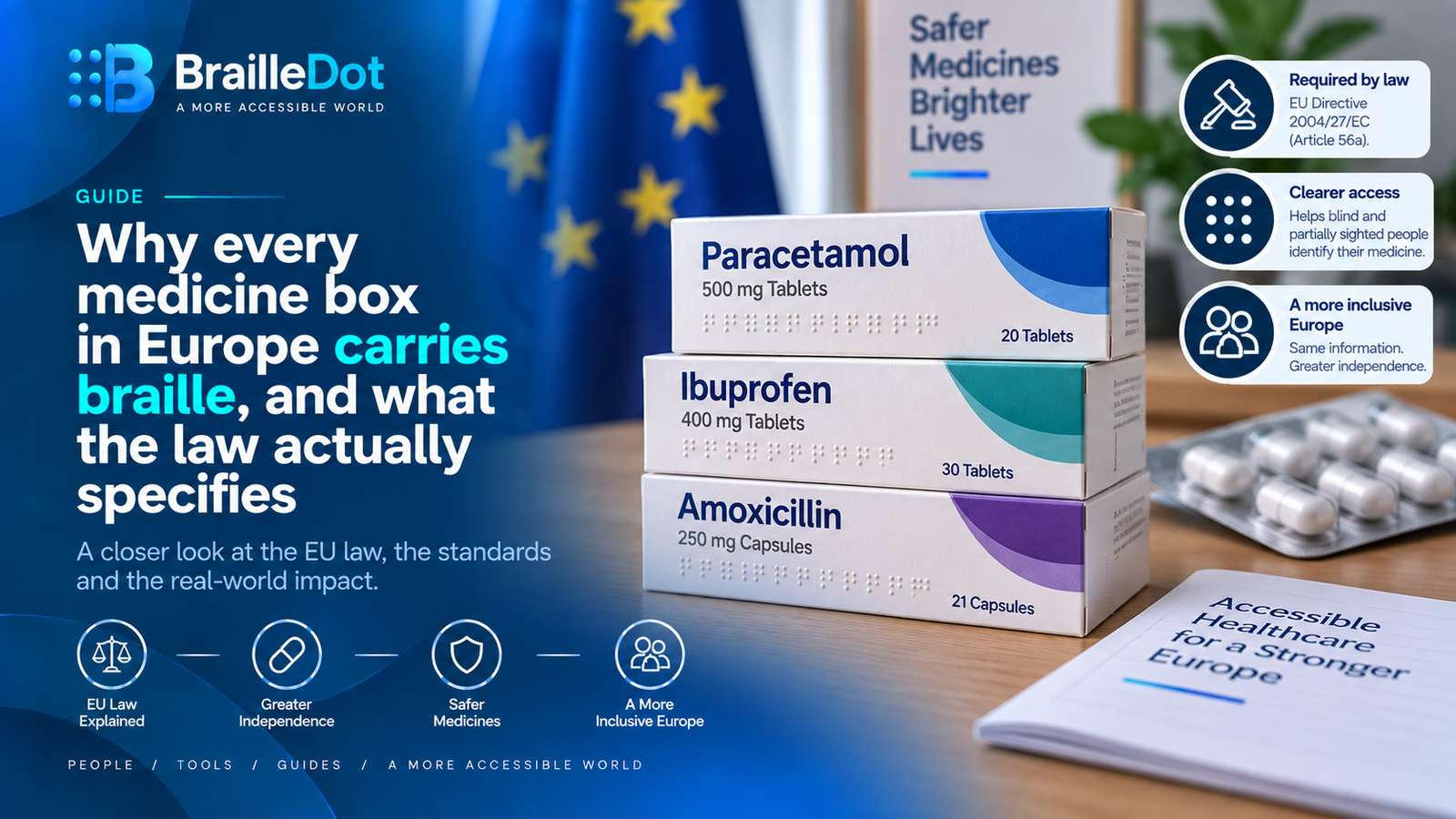
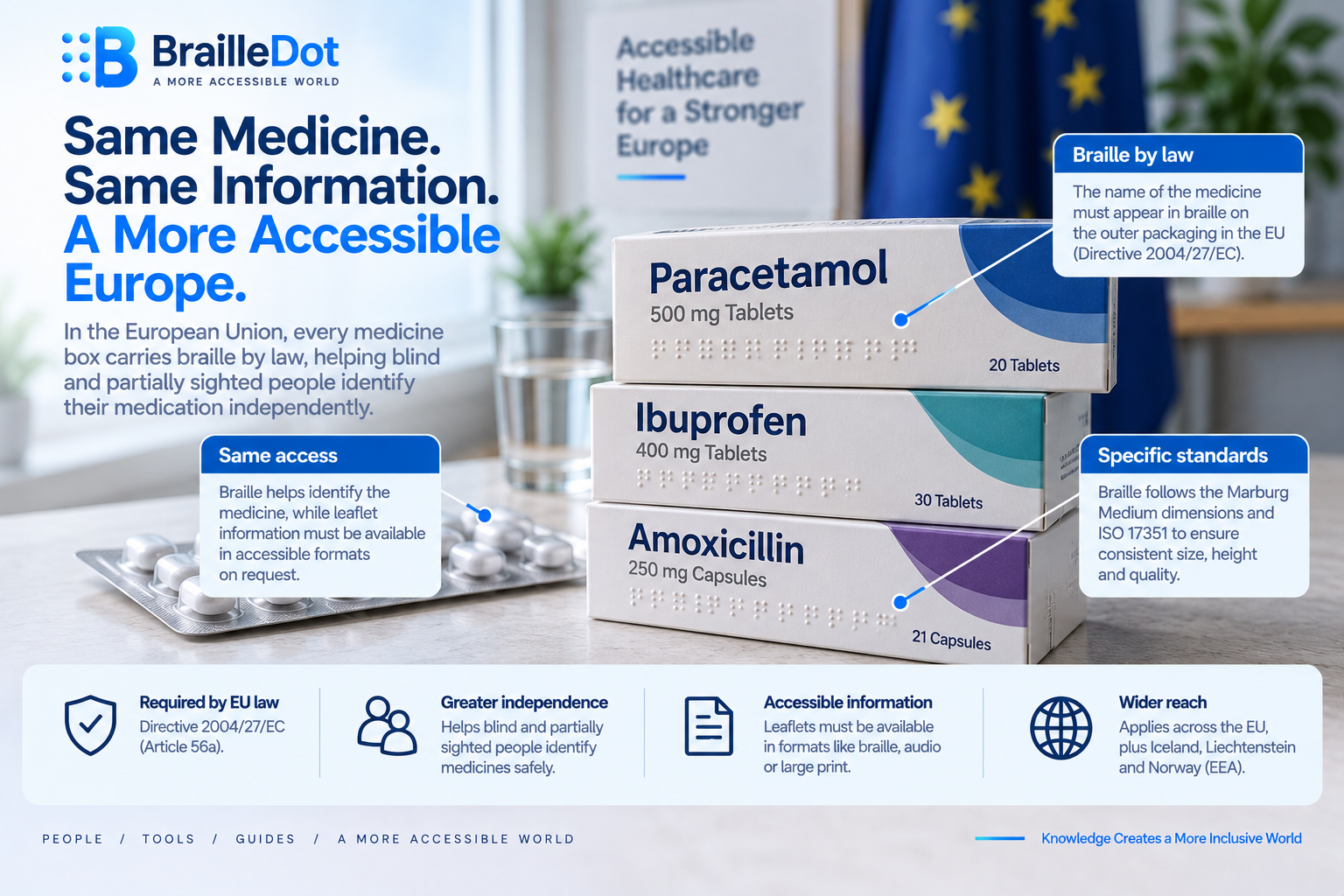
Across the European Union, the name of a medicinal product has to appear in braille on its outer packaging. That requirement comes from Directive 2004/27/EC, which amended the EU’s existing medicines directive by adding Article 56a, and it has applied to every new marketing authorisation granted since 30 October 2005. The obligation extends past the EU itself, reaching Iceland, Liechtenstein, and Norway through the European Economic Area agreement, which means a substantial share of the world’s pharmaceutical packaging carries embossed braille by law rather than by manufacturer choice.
The law actually creates 2 separate obligations
The braille requirement covers the medicine’s name, and where relevant its strength and pharmaceutical form. Member states are permitted to extend the requirement to additional information beyond that baseline, and some have chosen to. Responsibility sits with the marketing authorisation holder, the company that holds the licence to sell the product, rather than with the packaging supplier.
Sitting alongside that carton requirement is a second, separate duty that gets less attention. The same law requires the marketing authorisation holder to make the package information leaflet available on request, through patients’ organisations, in formats appropriate for blind and partially sighted people. The braille on the box handles identification, telling someone which medicine they’re holding. The leaflet obligation handles everything else, the dosage instructions, warnings, and side effects that won’t fit on a carton in any format.
The directive itself doesn’t specify the dots
The law mandates that braille appear without defining what that braille should physically measure, which technology should produce it, or how it should be tested. Those details live in a separate recommended specification known as Marburg Medium, reinforced by an international standard, ISO 17351, covering braille on packaging for medicinal products specifically.
The Marburg Medium dimensions are precise. Dots measure 1.3 to 1.6 millimeters in diameter and rise 0.20 to 0.50 millimeters above the carton surface. Dots within a single cell sit 2.5 millimeters apart, adjacent cells are spaced 6.0 millimeters apart, and lines of braille are separated by 10.0 millimeters. ISO 17351 adds a verification requirement on top, dot height specifically has to be measured and confirmed rather than assumed, and dedicated measurement systems exist for exactly this purpose, capturing 3D profiles of individual dots to check height, diameter, alignment, and symmetry against specification.
Those tolerances exist because both directions fail
The dimensional range isn’t arbitrary caution. Dots below that height become difficult to read for exactly the population most likely to need them, older patients whose touch sensitivity has declined alongside their vision. Dots above that range create a different problem entirely, they’re more likely to be crushed, flattened, or damaged during printing, stacking, shipping, and handling before the box ever reaches a patient. A carton that arrived with perfect braille and left the warehouse with flattened dots satisfies nobody, which is why the verification step exists as a formal requirement rather than a best practice.
An honest tension sits underneath the whole mandate
Something worth stating plainly about this law, raised by the packaging industry itself rather than by critics of accessibility: fewer than 2% of blind and partially sighted people can actually read braille. The demographic reason behind that figure is straightforward. Roughly 88% of visual disability manifests after age 60, compared with about 10% between ages 16 and 59 and around 2% before age 16. Most people who lose their sight do so late in life, at the point when learning an entirely new tactile reading system is least likely to happen, which leaves braille literacy concentrated among people who learned it in childhood.
That statistic could be read as an argument against the mandate. It’s better understood as the reason the leaflet obligation exists alongside it. Braille on the carton serves the minority who read braille fluently, and serves them at the single most safety-critical moment, identifying which box in a cabinet contains which medicine. The requirement to supply leaflet information in appropriate alternative formats on request covers the much larger group who can’t read braille but still can’t read standard print, through audio, large print, or digital formats instead. The 2 provisions together address a population with widely varied needs rather than assuming a single solution fits everyone with a visual impairment.
Space on the box is a real constraint
Implementation runs into a practical problem the directive doesn’t solve. Braille takes up considerably more physical room per character than printed text, and pharmaceutical cartons are frequently small, already crowded with regulatory text, batch numbers, expiry dates, and barcodes. Industry accounts describe it as often difficult and occasionally impossible to free up adequate space for the required braille characters on smaller packs, which is why braille placement and carton design have to be planned together from the start of a product launch rather than added at the end.
The industry organised its own response to this fairly quickly. The European Carton Makers Association, working through a dedicated pharmaceutical forum made up of national associations and packaging specialists, produced a European code of practice specifically covering how braille should be produced on folding cartons, filling the gap between what the law required and what carton manufacturers actually needed to know to deliver it consistently. Manufacturers also have to account for national variation on top of the shared EU baseline, since individual member states issue their own guidance and templates through their national medicines agencies, meaning a product sold across multiple countries can face somewhat different local expectations while still complying with the same underlying directive.
Explore braille conversion and accessibility
Convert English text into Grade 1 or Grade 2 UEB with our braille translator. Understanding the structure of braille helps connect text conversion with the wider accessibility systems that make information usable.
Open the translator