How the US built a national library for blind readers, starting with a man who transcribed the Bible by hand
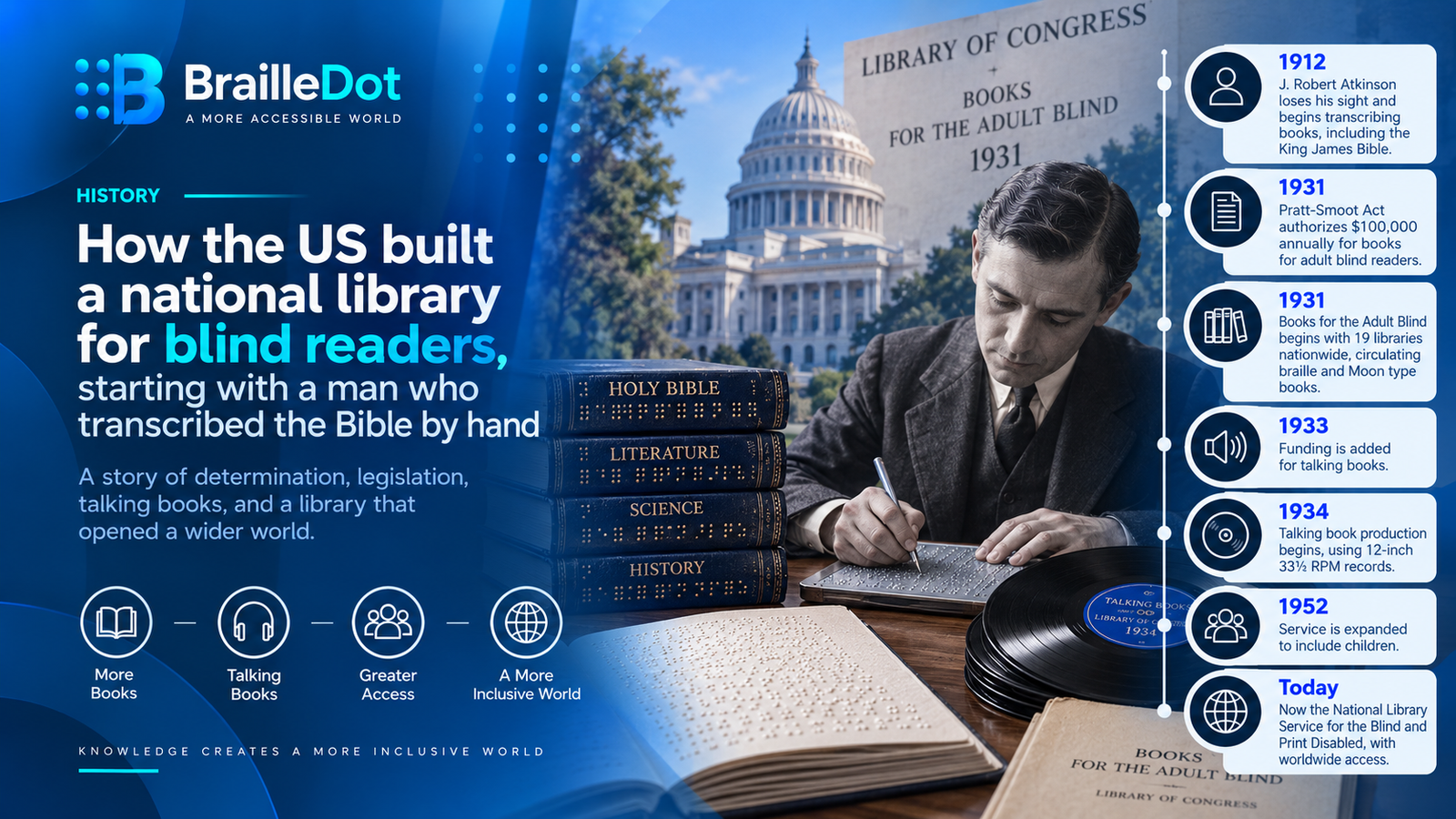
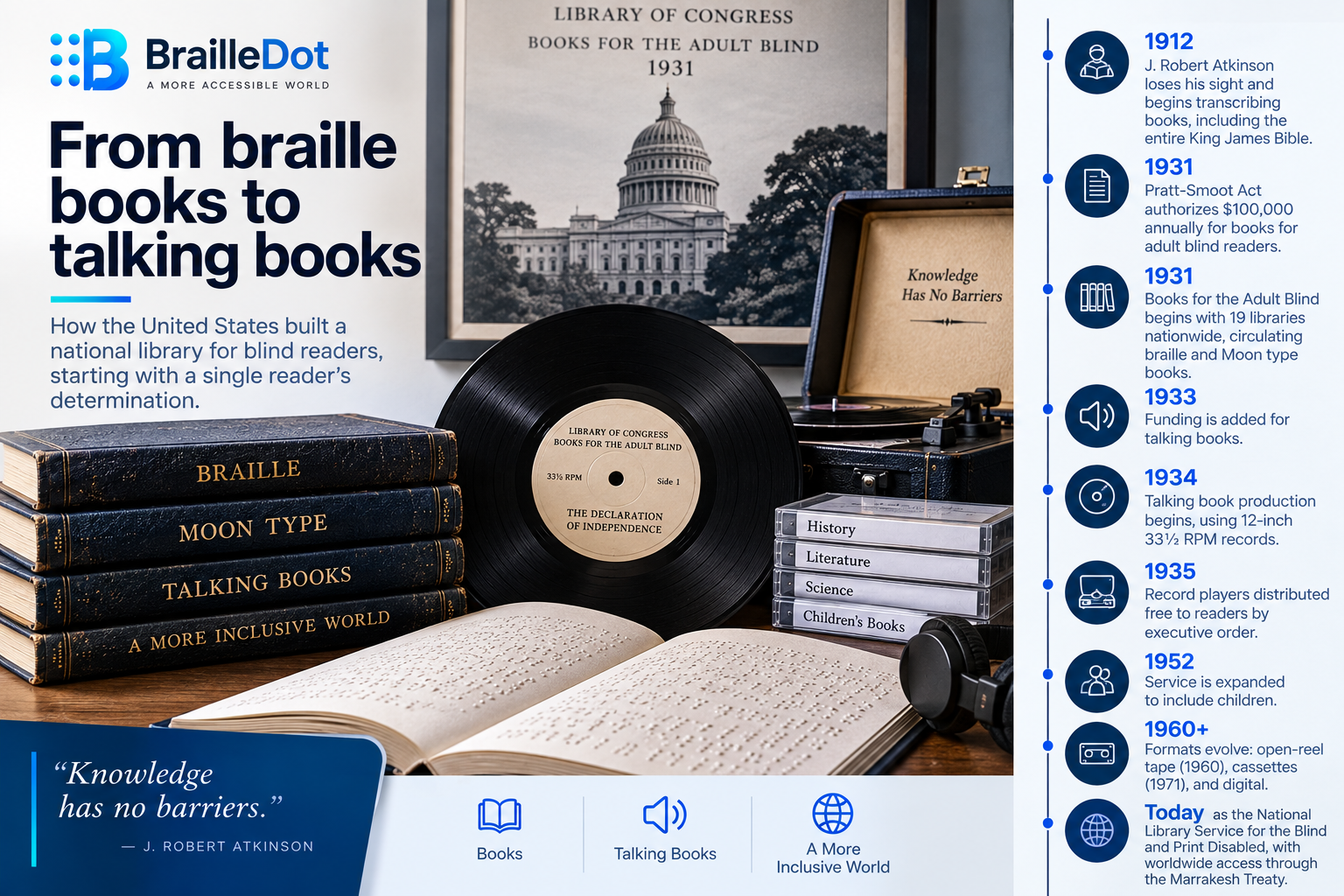
J. Robert Atkinson was shot by accident in 1912 and lost his sight. He had been a reader before that, and after learning braille he ran into the problem that defined blind literacy for most of the century, almost nothing he wanted to read existed in a format he could read. His response was to have friends and family read books aloud while he transcribed them into braille himself, one page at a time. Among the things he transcribed by hand was the entire King James Bible. That work turned into a career, then into a company producing braille books, and eventually into the organization known today as the Braille Institute of America. It also turned him into a lobbyist, and his pressure on Congress is a substantial part of why a national library service for blind readers exists in the United States at all.
The law itself was short, and specific about who came first
The Pratt-Smoot Act, introduced by Representative Ruth Baker Pratt and Senator Reed Smoot, was signed into law by President Herbert Hoover on March 3, 1931. It authorized $100,000 annually to the Library of Congress, on top of the Library’s existing appropriations, specifically to provide books for adult blind residents of the United States and its territories. It also authorized the Librarian of Congress to arrange with other libraries to act as local or regional distribution centers.
Buried in the act’s short text is a priority clause worth noting, the law directed that in lending these books, preference should always be given to blind people who had been honorably discharged from US military or naval service. Blinded veterans were written into the statute as a first-priority population from the start, in 1931, well before the wave of blinded servicemen returning from the Second World War would make that provision far more heavily used than Congress likely anticipated when passing it.
What the program actually looked like when it opened
The project began operating on July 1, 1931, under the name Books for the Adult Blind. 18 regional libraries were selected across the country to circulate the books, which alongside the Library of Congress itself made 19 participating institutions, spread from Honolulu to Watertown, Massachusetts. The early collection was embossed rather than recorded, produced in braille or in Moon type, the alternative tactile system covered in our piece on the tactile alphabets that came before braille . Moon type was still in active use in a federal library program in 1931, decades after braille had supposedly won.
Talking books existed because most blind adults couldn’t read braille
The reason recorded books entered the picture quickly is blunt and worth stating directly. At the time, close to 80% of the blind population in the United States could not read braille or Moon type at all. Most people who lose their sight do so later in life, which is exactly the point at which learning a new tactile reading system becomes least likely, so an embossed-only library served a minority of the people it was meant to reach.
Robert B. Irwin, the American Foundation for the Blind executive who appears in our account of the war over competing braille codes , pushed directly on this. In April 1932 he wrote to H. H. B. Meyer at the Library of Congress asking the Library to consider producing books on records. AFB lobbied Congress alongside that effort, and on March 3, 1933, exactly 2 years after the original act, legislation set aside $10,000 of the Library’s $100,000 allocation specifically for talking books. Production began in 1934.
Blind readers got long-playing vinyl years before the public did
The technical choice made for talking books is a genuine piece of audio history that rarely gets credited. The first format to go into general use was a 12-inch record running at 33⅓ RPM, at a point when the commercial record market was still built around 78 RPM shellac discs. The slower speed fit far more audio onto a single disc, which mattered enormously when the content was an entire book rather than a 3-minute song. Blind readers were among the earliest regular users of long-playing vinyl, well ahead of its mainstream adoption.
The first titles chosen have a distinct character to them, the Declaration of Independence, the Constitution, Washington’s Farewell Address, and Lincoln’s Gettysburg Address, alongside Shakespeare’s As You Like It, The Merchant of Venice, and Hamlet, Kipling’s Brushwood Boy, and Wodehouse’s Very Good Jeeves. Founding documents and entertainment, selected together.
The Depression nearly killed it before it started
A recorded book requires a record player, and the program initially expected blind readers to buy their own. This was 1934. Few blind individuals during the Great Depression could afford a record player, which left a federally funded library of recorded books that a large share of its intended audience had no way to play. President Franklin Roosevelt resolved it by executive order in 1935, authorizing the Library of Congress to build and distribute record players free of charge to people who needed them. The lending program and the playback hardware became a single package rather than 2 separate problems for a reader to solve independently.
The program kept changing shape for the next 70 years
The first Conference on Library Services for the Blind convened in November 1951 and recommended extending the service to children, who the original act had excluded by its own wording. On July 3, 1952, Congress amended the Pratt-Smoot Act to strike the word “adult,” and by 1954 roughly 20% of the braille and talking books being produced were for children. Formats shifted repeatedly after that, open-reel magnetic tape joined records and braille in 1960, cassette books arrived in 1971, and digital recording eventually replaced both.
What began as $100,000 and 18 libraries circulating embossed books now operates as the National Library Service for the Blind and Print Disabled, and it reaches beyond US borders in ways the 1931 Congress had no framework for, sourcing accessible titles produced in other countries through the international exchange system described in our piece on the Marrakesh Treaty . Atkinson transcribing the King James Bible by hand and a modern library requesting a finished accessible file from abroad are the same problem being solved roughly a century apart.
Explore the wider history: The development of accessible reading has involved embossed alphabets, braille printing, talking books, and international book-sharing agreements. Each stage addressed a different barrier between readers and the books they wanted to access.
Explore accessible reading with BrailleDot
Discover more about braille, accessible reading technology, tactile systems, and the tools that help make written information available to more people.
Explore BrailleDot