
The war of the dots: how America spent decades fighting over which braille to use
For decades, American schools and institutions struggled to agree on a single braille system. The dispute shaped education, publishing, international communication, and the contraction rules still used in braille translation today.
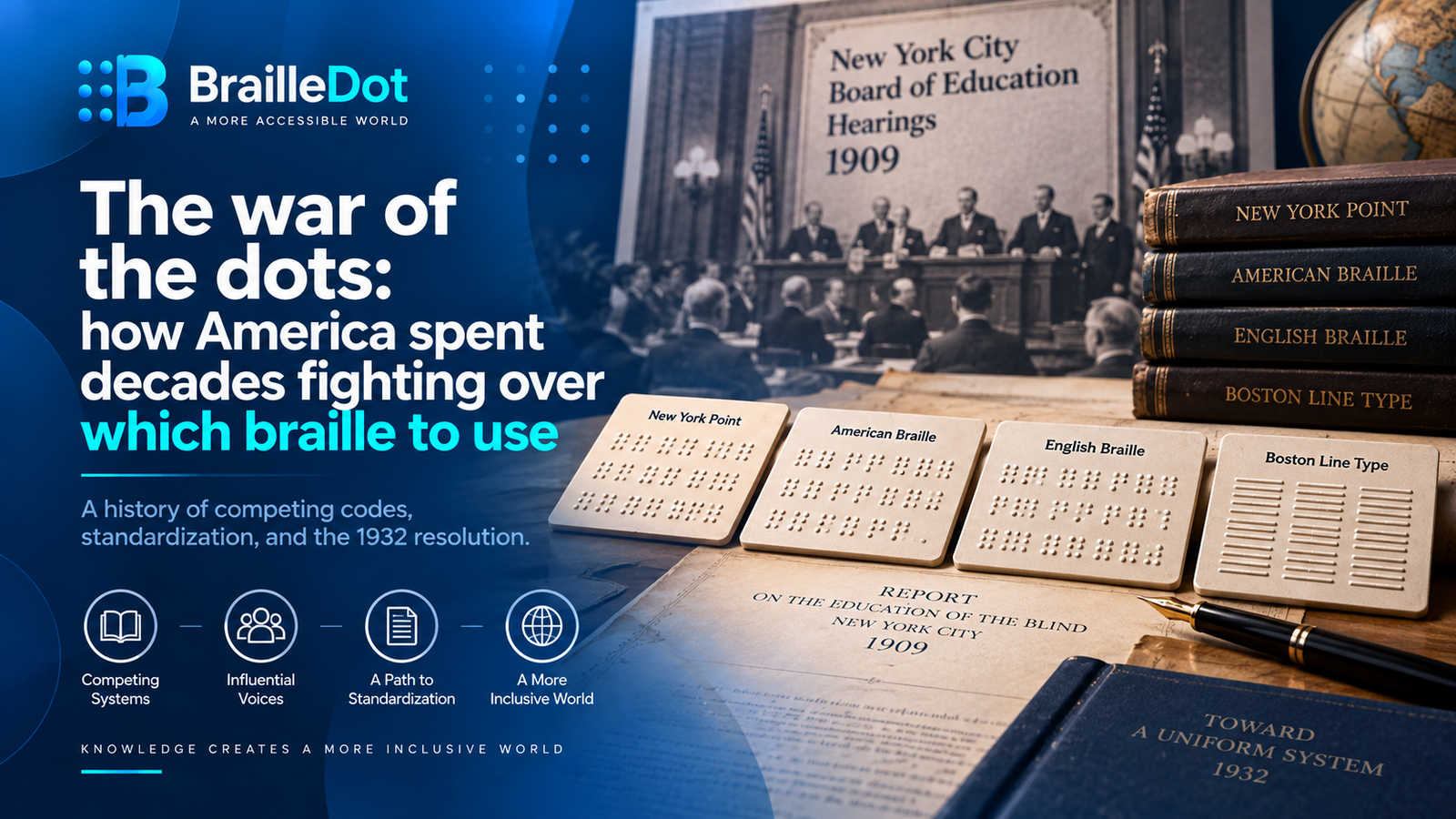
In 1909, the New York City Board of Education held hearings to settle which system of raised dots blind children in the city’s day classes would actually learn to read. That such a hearing was necessary at all says something about the state of things. By that point, American schools for blind students had spent roughly 4 decades unable to agree on a single code, and the decision about which one would win was being made largely by sighted educators and administrators on behalf of readers who were blind.
What was actually competing
New York Point had been formally endorsed back in 1871 by an association of teachers of the blind, a body made up mostly of sighted people. Boston Line Type, an embossed Roman letter system, was fading by 1900 as schools moved toward dot-based codes. Joel Smith developed American Braille, a modified version of Louis Braille’s system. English Braille, the British adaptation, existed alongside all of them. None of these were compatible with each other.
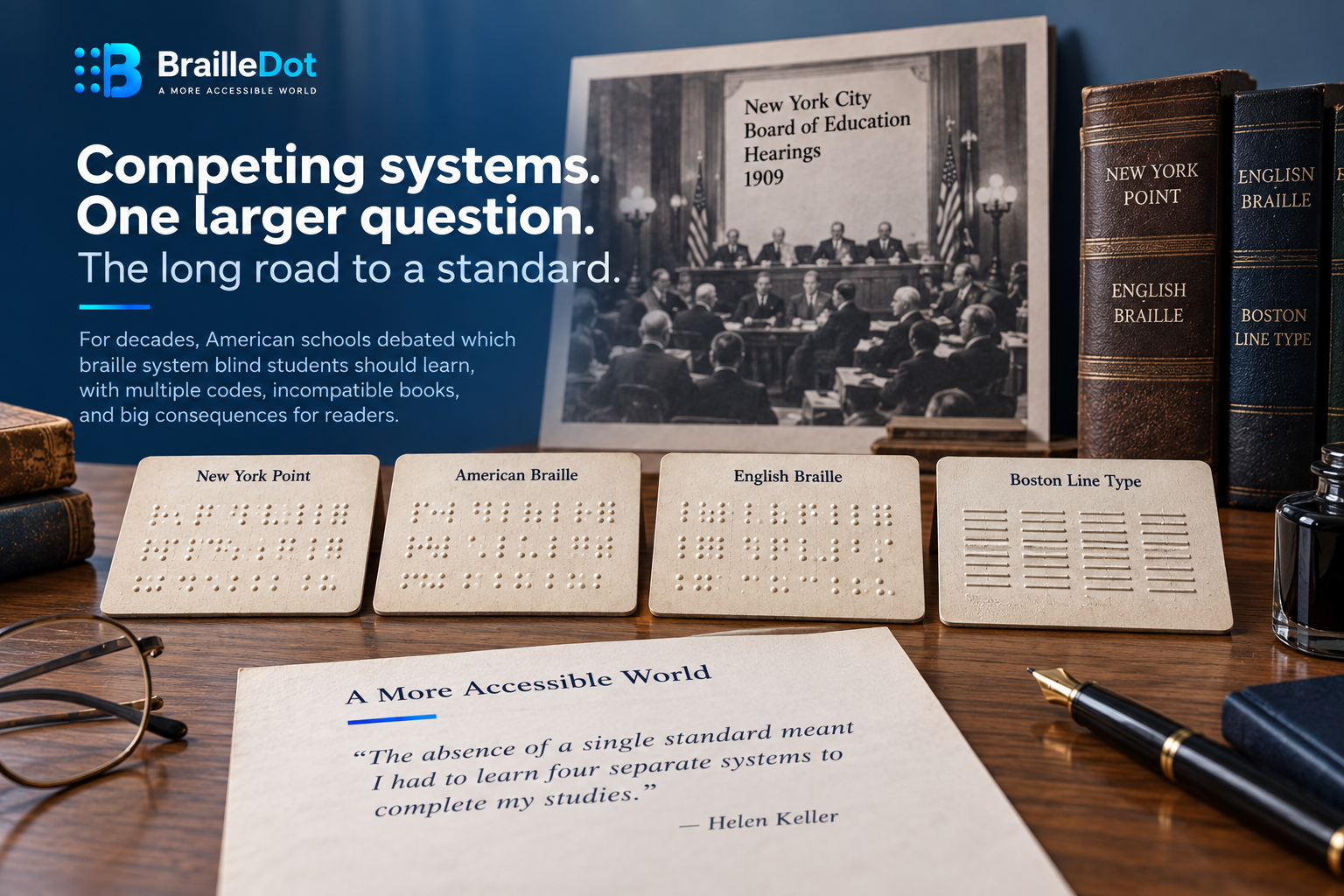
The cost of that fragmentation fell on readers directly. Helen Keller, born in 1880 and educated during the height of this period, protested publicly that the absence of a single standard meant she had to learn 4 separate systems to complete her studies. She became the first deafblind person to earn a bachelor’s degree while reading fluently across all of them, which was an achievement partly of scholarship and partly of sheer redundant effort nobody should have needed to expend.
Helen Keller’s letter did real work without her attending
Keller made a deliberate choice not to appear at the hearings in person. By the account of the American Foundation for the Blind, she generally avoided inserting herself into controversies likely to turn acrimonious. She wrote a letter instead, and its arguments were specific rather than sentimental. She held that New York Point failed on 4 concrete counts, capitalization, punctuation, legibility, and the physical ease of reading it. She also made a practical argument that had nothing to do with the dots themselves, calling New York Point a provincialism within the wider world of blind readers, since the machines to write it were manufactured only in New York and produced nothing else, while braille writers were being made in Germany, France, England, and America, which let her correspond with people across the world. She added a plain observation from her own mail, that of the letters reaching her in both systems, a noticeably larger share of the well-written ones arrived in American braille.
The exhibit that did the most damage
Winifred Holt persuaded Frank H. Hall to travel to New York and testify, a notable recruitment given Hall had invented the braillewriter covered in our piece on the Perkins Brailler and had long since left work for the blind. He appeared alongside several other figures from the field, including George W. Jones, superintendent of the Illinois School’s braille printing department, Olin H. Burritt of the Pennsylvania Institution for the Instruction of the Blind, and John B. Curtis, a blind supervisor of classes for blind students in the Chicago public schools. Edward E. Allen, then directing Perkins, was traveling in Europe and missed it.
Hall’s most effective contribution wasn’t testimony at all. He presented an exhibit consisting of 2 copies of a book’s title page, both printed in ordinary ink type that the sighted board members could read directly. One was set correctly with capital letters, representing what American braille would produce. The other was set entirely without capitals, representing what New York Point would produce. He showed a second exhibit with apostrophes and hyphens stripped out. The effect was immediate and hard to argue with, sighted decision-makers could see for themselves what New York Point actually did to written English, which fed directly into the charge circulating at the time that New York Point books amounted to poor models of English to hand to blind children.
Winning the hearing settled less than it should have
The Board voted for braille. What followed was messier. At the next annual meeting of the American Printing House for the Blind, the board decided to split its production between New York Point and Modified American Braille, hedging rather than committing. The Uniform Type Committee then tried engineering a compromise code called Standard Dot, built to combine the strengths of all 3 competing systems, and it generated essentially no enthusiasm anywhere outside the United States.
In 1917, the Committee adopted Braille Grade One and a Half, which was the British code carrying only 44 contractions. That produced an asymmetry nobody had intended. British readers could read the American code without much difficulty, while American readers could not read the British one, so the compromise designed to unify English-speaking braille left the traffic running in only 1 direction.
The 1932 resolution still shapes how contractions work today
The war ended at the London Type Conference in 1932, where delegates from across the English-speaking world approved a single uniform system. Standard English Braille was fundamentally the British code, adopted with 1 significant concession to the Americans, contractions would not break across syllables.
That concession is worth sitting with, because it never went away. The rule that a contraction shouldn’t span a genuine boundary between meaningful parts of a word is the direct ancestor of the morpheme-boundary exceptions still implemented in modern translation engines, the reason a word like “rawhide” blocks a contraction that would otherwise apply, covered in our piece on contraction exceptions and the broader position rules governing where contractions may appear. A diplomatic compromise struck in a London conference room in 1932 is still sitting inside the logic of software translating text into braille today.
Who wrote the history matters too
The definitive account of all this came from Robert B. Irwin, who was blind himself and served as executive director of the American Foundation for the Blind from 1929 to 1949, after joining as its director of research and education in 1923. His book on the subject remains the standard history. Irwin’s own contributions went well beyond documenting the fight, he developed an interpoint braille printing machine that made books meaningfully more compact to produce, and he pushed for the creation of the talking book. The person who recorded how sighted committees spent 4 decades deciding what blind readers should use was, fittingly, a blind man who spent his career building things those readers could actually use.
Explore braille beyond the dots
Explore BrailleDot’s guides to braille systems, contraction rules, accessibility, and the technology that helps make written language more accessible.
Explore BrailleDot

3 Comments