How someone actually becomes a certified braille transcriber
From a 1918 volunteer program to today’s Library of Congress credential, here’s how literary braille transcribers are trained, tested, and certified.
Gertrude Rider, manager of the Library of Congress Reading Room for the Blind, started a volunteer braille transcription program in 1918. That happens to be the same year the United States finally settled on a single standard six-dot system, the resolution to the decades-long conflict covered in our piece on the war of the dots. Rider worked with another organization that same year to formalize the effort, and together they published the first braille transcription manual. The certification program built from that original effort marked its own 100th anniversary in recent years and is still running today, and it works differently than most professional credentials do.
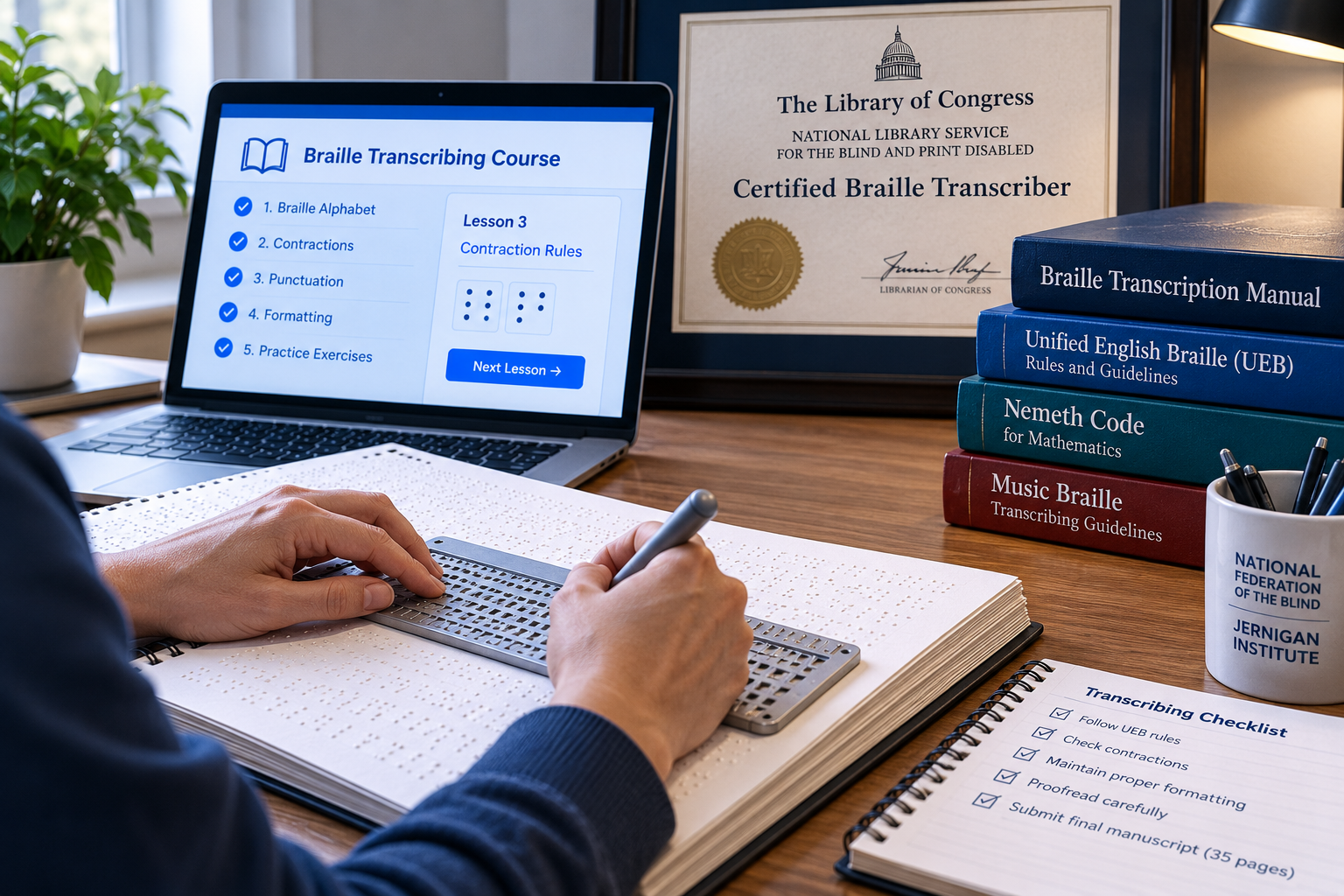
2 organizations split the job of running it
The actual certificate a transcriber earns comes from the Library of Congress, issued through the National Library Service for the Blind and Print Disabled. The coursework itself, though, is administered by a separate organization, the National Federation of the Blind’s Jernigan Institute, which holds a contract with NLS to teach the course and grade the final exam. A student enrolls with NFB, works through NFB’s material, and gets graded by NFB, but the credential that comes out the other end is a federal one issued by the Library of Congress, not an NFB certificate.
The National Federation of the Blind provides the course and grading, while the Library of Congress issues the resulting certification through the National Library Service.
The course itself runs through 20 lessons
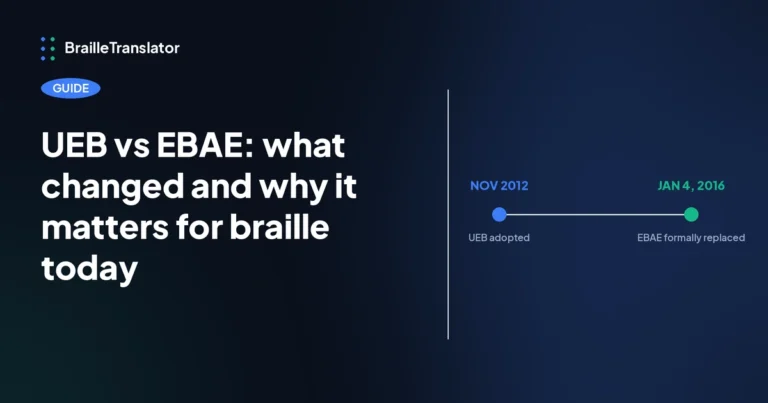
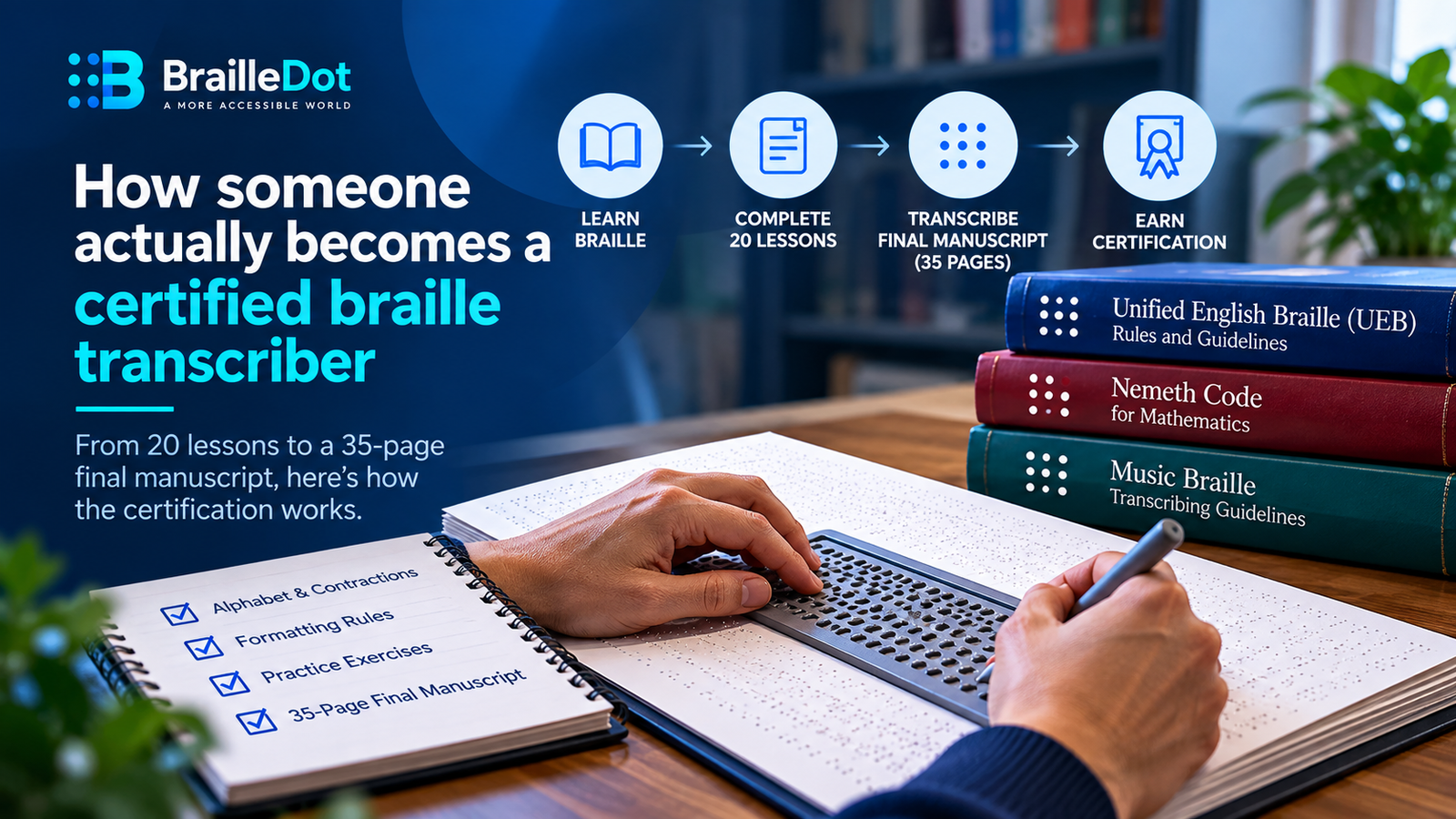
The literary braille transcribing course consists of 20 lessons, covering the braille alphabet, contraction rules, and formatting conventions in depth. Students can work through it 2 ways, enrolled in a locally sponsored braille class taught by an already-certified transcriber, or independently through correspondence directly with the Jernigan Institute. The instructional material itself has been kept current with the underlying code, editions specifically updated for UEB exist, reflecting the same transition covered in our piece on UEB replacing EBAE, so a modern student is trained on the code actually in use today rather than a retired one.
Literary certification comes first by design. Only after completing it and accumulating 6 months of real transcribing experience can someone enroll in the specialized follow-on courses, mathematics braille transcribing covering the Nemeth code, covered in our own piece on Nemeth versus UEB, music braille transcribing, or a separate proofreading certification. Nobody starts with the specialized codes. Literary braille is the foundation every other credential in the system sits on top of.
Literary braille
The foundational certification covering the braille code, contractions, and formatting needed for literary transcription.
Specialized certification
After literary certification and 6 months of experience, transcribers can move into mathematics, music, or proofreading.
The final exam is a real 35-page manuscript, not a multiple-choice test
Lesson 20, the course’s final exercise, requires a trial manuscript of 35 braille pages, transcribed from print material the student chooses themselves, usually a section of an actual book rather than a prepared exercise. It has to be submitted in hard copy braille, not a digital file, and it gets sent to NFB for scoring against a specific and exacting grading framework. A candidate needs 80 points or above to pass, and gets up to 3 separate attempts at producing an acceptable manuscript before the process ends unsuccessfully. Most students take somewhere between 9 months and 2 years to reach this point, depending heavily on their own pace and how much time they can give it alongside everything else in their life.
35 pages of real braille transcription
The final manuscript is produced in hard-copy braille and graded against a defined standard. Candidates need 80 points or above to pass and have up to 3 attempts to produce an acceptable manuscript.
NLS provides all of this free, which matters more than it sounds
Both the instructional materials and the certification itself are supplied by NLS at no cost. That detail has a specific, real consequence worth knowing about. Because there’s no fee standing in the way, this certification has been made available inside at least 1 US prison, sparing incarcerated students the cost associated with commercially issued credentials in other fields. One woman completed both her literary and Nemeth braille certifications while incarcerated, calling Nemeth her favorite of the codes she learned. She was released in 2011 and now works full time as a braille transcriber, and has since gone on to train 3 additional transcribers herself using the same NLS program that trained her. A credential built to be free rather than gatekept by cost ended up reaching someone in a setting most professional certifications never touch at all, and then multiplied through the people she went on to teach.
The NLS program supplies its instructional materials and certification without a fee, removing the direct credential cost that can otherwise prevent people from entering specialized professional training.
Certification isn’t the finish line
Passing the trial manuscript earns the literary credential, but transcribers who want to keep working professionally are expected to keep building on it rather than treating the certificate as a permanent, one-time qualification. Braille codes themselves change over time, the UEB transition already mentioned being the clearest recent example, so transcribers who want to stay current pursue continuing education, workshops, and further specialization long after their initial certification. Someone can hold literary certification alone, or add mathematics, music, or proofreading credentials on top of it depending on what kind of transcription work they actually want to do, a general literary transcriber and a music transcriber end up with meaningfully different skill sets built on the same starting foundation.
Even trained education professionals find it difficult
The rigor of the exam isn’t theoretical. One transcriber’s own published account described enrolling in the distance course while already working full time as a teacher of the visually impaired and studying part time toward a doctorate, and still needing 18 months and a mentor’s direct help to pass after an initial manuscript failure. What kept her going through that, by her own account, was the depth of UEB knowledge the course itself forced her to build along the way, treating the failure as part of the actual learning rather than simply an obstacle to clear. A credential this specific and this exacting isn’t handed out for general familiarity with braille, it’s testing whether someone can produce a correct, publication-ready transcription end to end, under real grading standards, with no partial credit for close enough.
What the certification actually proves
Literary braille certification is built around demonstrated transcription ability rather than basic familiarity with braille. The pathway starts with literary braille, requires a substantial final manuscript, and can lead into specialized credentials in mathematics, music, and proofreading.