How picture books actually get adapted into braille for children
A French teacher named Claudet spent 20 years working out what actually makes a tactile picture readable by a child’s fingers rather than just present on a page, and in 1994 he founded a nonprofit, Les Doigts Qui Rêvent, meaning Dreaming Fingers, specifically to put that expertise into mass-produced children’s books. His own framing of the problem is worth starting with, because it corrects an assumption that seems reasonable at first. A tactile illustration in a picture book isn’t the same kind of object as a tactile graphic, the maps and diagrams covered in our piece on how blind readers read maps and diagrams. A map exists to convey precise spatial information. A picture book illustration exists to build a feeling, a connection, a moment in a story, and adapting one for touch means solving a fundamentally different design problem than adapting the other.
The twin-vision format exists so reading stays shared
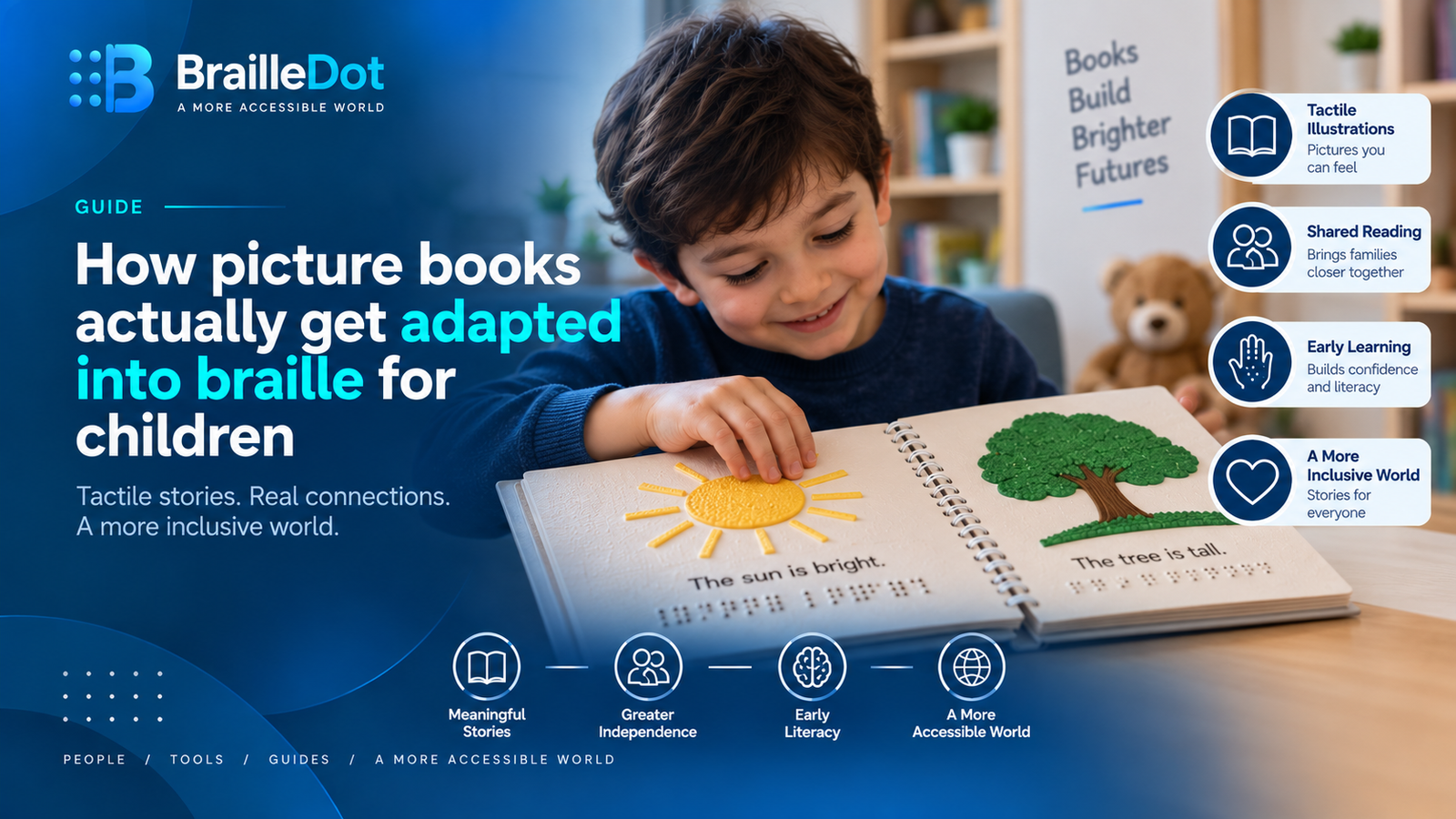
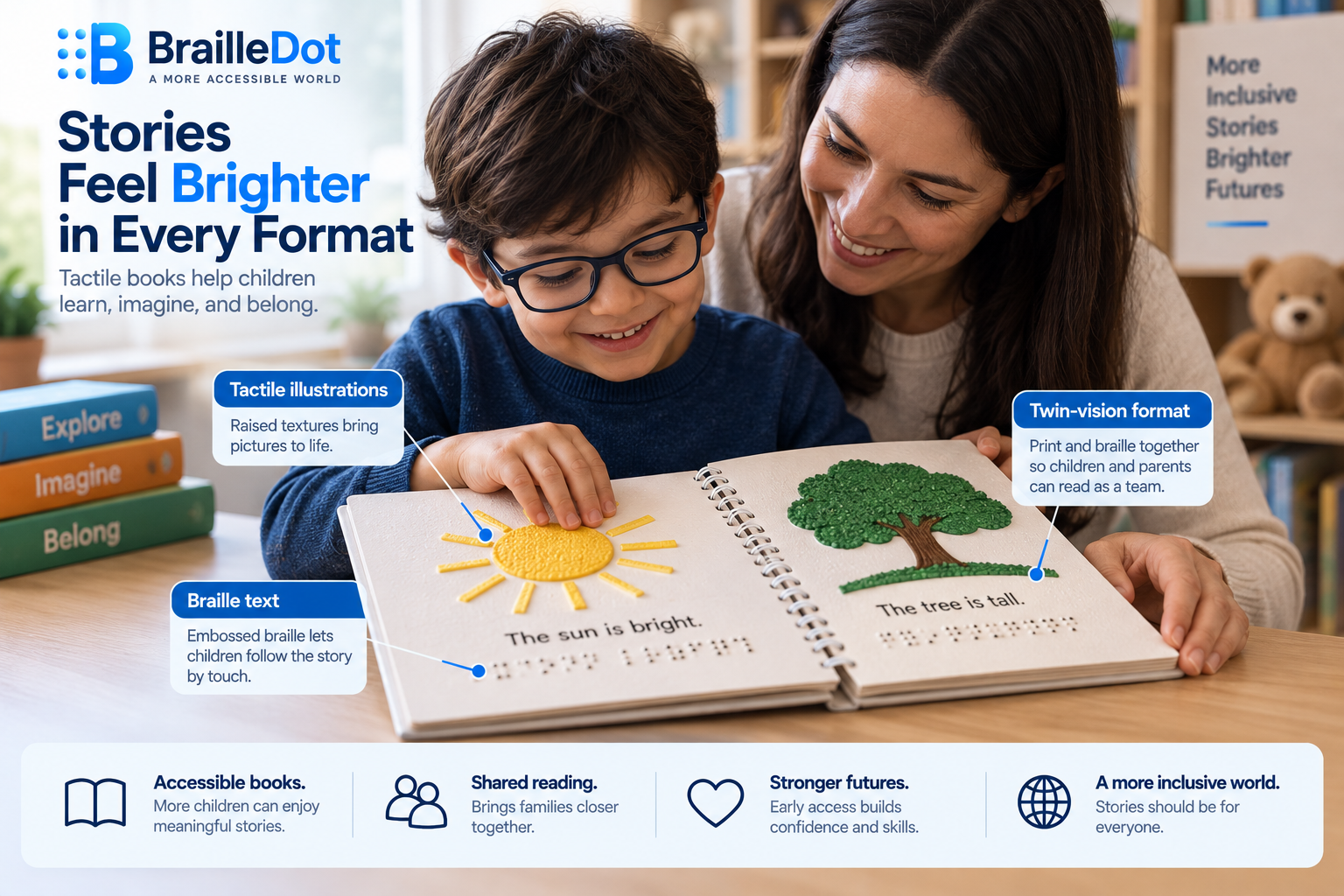
Children’s braille material is commonly produced as what’s called twin-vision or print-braille, ordinary ink text and embossed braille dots appearing together on the same page rather than braille alone. The reason is practical and immediate, most parents of a blind child can see, and a book that only a blind child could read on their own would cut a sighted parent out of story time entirely. Twin-vision books let a parent read the printed words aloud while the child follows the braille beneath their fingers, the same shared reading experience a sighted family already has, just with 2 parallel channels of text on the same page instead of 1.
Two very different production philosophies exist side by side
There’s no single standard method for actually producing the tactile illustrations themselves, and 2 real examples show how differently this gets approached. A UK charity called Living Paintings produces books it calls Touch to See, and the illustrations in them are entirely handmade, a craftsperson named Webb carves each image with a chisel before smoothing the surface with fine sandpaper, paired with recorded audio description that guides a child’s fingers across the raised picture while narrating what they’re feeling. That’s a fundamentally artisanal process, closer to sculpture than printing, and it’s currently reaching more than 5,000 blind and visually impaired children in the UK through a free lending library.
Les Doigts Qui Rêvent takes the opposite approach by design, building illustrated books specifically for mass production rather than individual handcrafting, since a nonprofit aiming to put books into many children’s hands at once needs a repeatable process rather than a craftsperson recreating each image by hand. Neither approach is more correct than the other, they’re solving the same underlying problem, getting a real tactile illustration in front of a child, at very different scales with very different tradeoffs between craftsmanship and reach.
Why this matters before a child can read at all
The actual justification for including tactile illustrations isn’t decorative. Research on the practice has found that a tactile illustration works best when it triggers a genuine connection to something the child has already encountered in ordinary daily life through touch, a texture or shape they recognize from experience, layered onto the story being read aloud. That connection does real work even for a child who can’t yet read independently. Long before formal literacy instruction begins, a young child hearing braille read aloud while feeling the dots under their own fingers starts to grasp that the braille itself is what’s carrying the story, and children have been observed imitating the hand movements of braille reading well before they can actually decode a single word. That’s the same pre-literacy groundwork covered in our piece on how braille is actually taught, showing up here in a specifically bookish, read-aloud form rather than a classroom exercise.
Parents can build a version of this at home with ordinary materials
Formal publishing programs aren’t the only route into this. Guidance from the American Foundation for the Blind walks parents through building simple tactile books using materials already sitting around a house. One suggested counting book uses specific, escalating materials for each number, a single jar lid for 1, 2 fuzzy triangles, 3 squares, 4 pieces of masking tape, 5 paper fasteners, 6 large paper clips slipped over the page’s edge, 7 staples, 8 stick-on stars, 9 holes punched with a hole puncher, and 10 scissor cuts along 1 edge of the page, with the matching braille numeral attached to each. A separate texture book pairs a single distinct material per page with the braille word describing it, and a point book gathers small, distinct everyday objects, a fork, a toothpick, a pushpin, a paper clip, onto separate pages the same way a texture book gathers materials. The same guidance encourages letting a young child press random keys on a brailler to “write” their own line on a page their parent is building, the tactile equivalent of letting a sighted toddler scribble with crayons long before they can form actual letters, valuable groundwork rather than meaningless noise. Once the pages are finished, parents are encouraged to number them in braille together with the child and decide on page order as a shared activity, treating the book’s assembly itself as part of the learning rather than something finished before the child gets involved.
Not every reader in this category has the same needs
It’s worth remembering that “blind or visually impaired” covers a real range of vision levels, not a single uniform category, even within children’s books specifically. Guidance aimed at low vision readers, children with some functional sight rather than none, warns against illustrations that seem reasonable in isolation but fail in practice, a multicolored image against a similarly multicolored or low-contrast background can be quite difficult for a low vision reader to make out, even though the same page might work perfectly well for a fully blind child reading by touch alone. Designing for this population well means designing for more than 1 kind of reader at once, not treating “accessible” as though it describes a single fixed set of needs.
Where braille translation fits into the picture
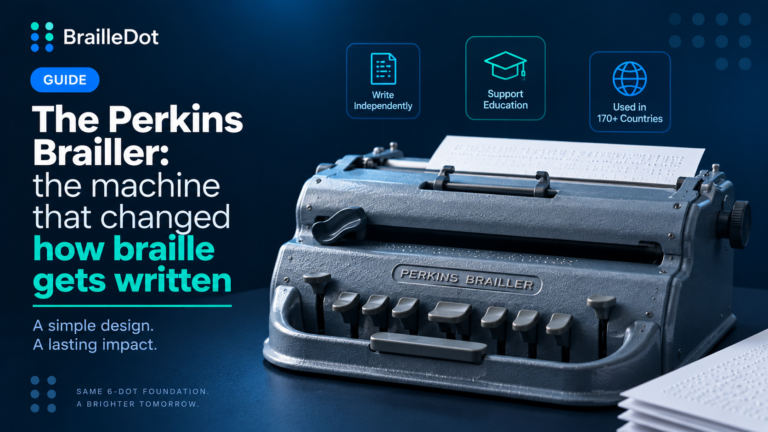
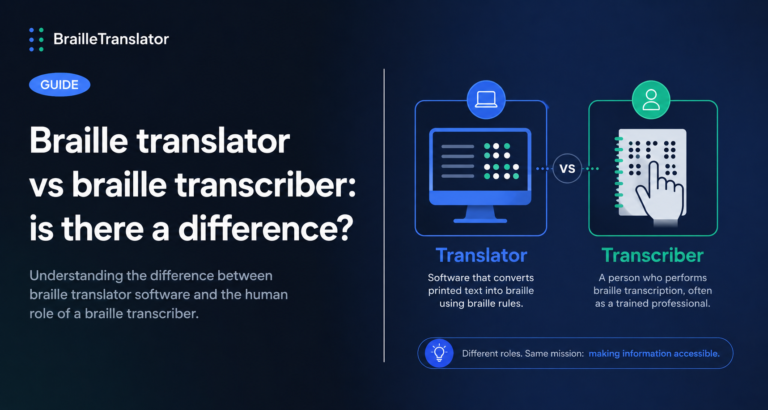
The braille text in a children’s book is only 1 part of the overall production process. Tactile illustrations require their own design and production methods, while the accompanying English text can be translated into literary UEB braille separately. Our braille translator handles English text in Grade 1 or Grade 2 UEB, making it useful for the text component of accessible materials while the tactile artwork remains a separate production task.
Translate the text for accessible reading
Convert English text into Grade 1 or Grade 2 UEB with our braille translator, then combine the translated text with the appropriate tactile materials.
Open the translator