How chess, cards, and other games actually get adapted for blind players
In most adaptive sports, players get grouped into classifications based on the type or severity of their impairment before competition even starts. Chess skips that step entirely. A blind player and a sighted player can sit down at a board and compete head to head under identical rules, with equipment and a handful of procedural adjustments doing all the work of leveling the game rather than any formal classification system. That’s been true at an organized international level since 1958, when the International Braille Chess Association formed and became affiliated with FIDE, the same governing body that oversees mainstream international chess. IBCA later became a unit within the broader International Blind Sports Association, and its reach today extends across North America, South America, Europe, Asia, and Africa, with national-level groups like the Braille Chess Association in the UK and the United States Braille Chess Association operating underneath that international structure.
The board itself does most of the heavy lifting
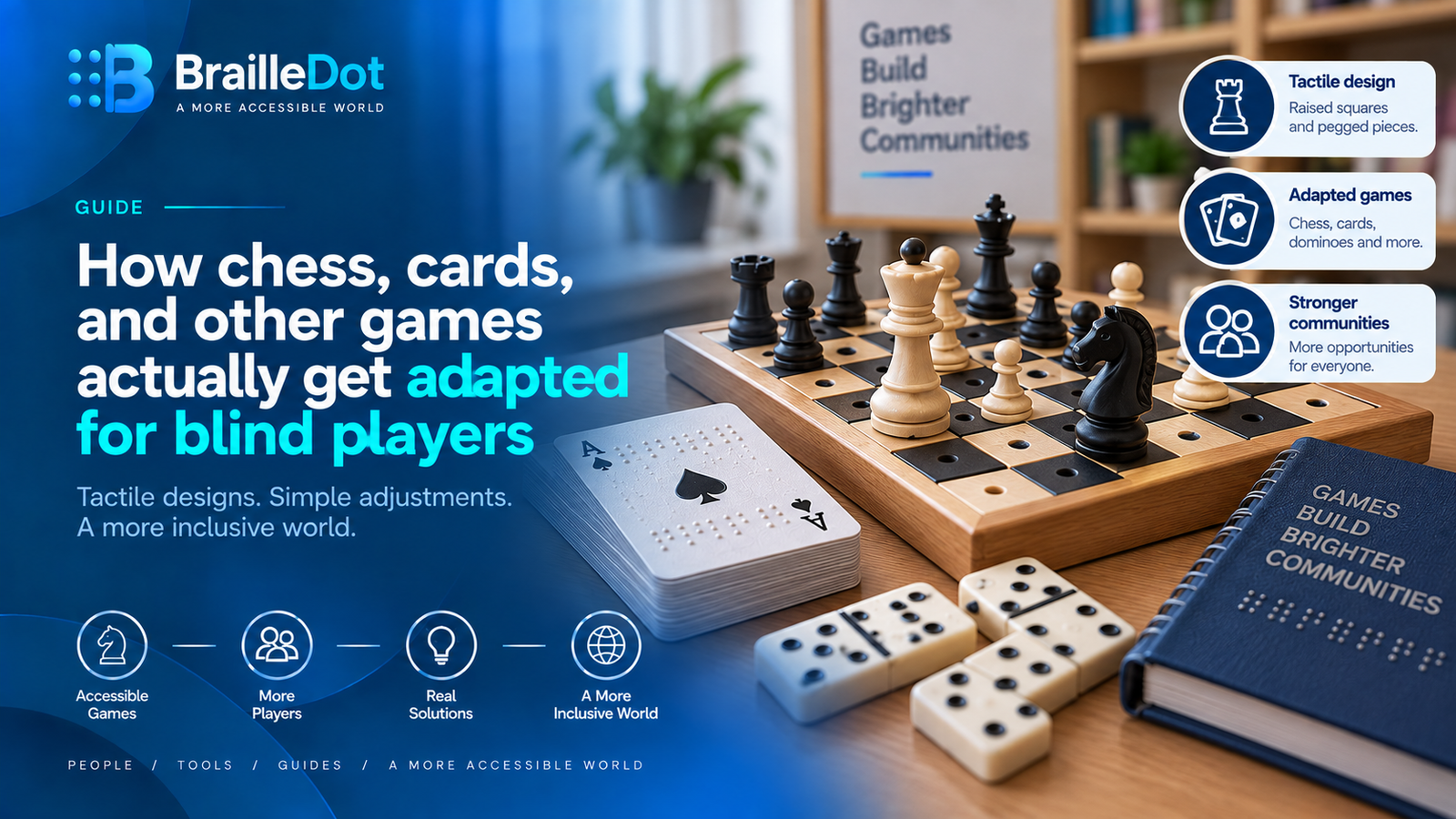
An adapted chessboard used in competition has to meet specific physical standards, at least 20 by 20 centimeters, with the black squares raised 3 to 4 millimeters above the white ones. That height difference is enough for a player to identify a square’s color by touch alone, without needing to see it. Every square also has a small hole drilled into its center, matched by a peg fitted to the base of each piece, so pieces stay physically locked in place rather than sliding or getting knocked over mid-game, a problem an ordinary flat board would create constantly for a player reading the position by touch.

The pieces themselves are built to be told apart blind
Beyond fitting into the pegged holes, the pieces carry their own distinguishing features. White pieces typically have a small raised point or pin fixed to the top, giving a player an immediate tactile way to tell white from black without needing to feel for any other cue. Each piece type is also shaped distinctly enough that a pawn, knight, rook, and king all feel different from each other under a fingertip, the same functional goal a sighted player accomplishes visually just by glancing at the board.
The rules themselves change too, beyond the equipment
Competitive play between blind and visually impaired players layers several procedural rules on top of the standard game. A player has to announce their move out loud immediately after making it, so their opponent knows what’s changed on the board without needing to look or feel for it themselves. Pawn promotion specifically has to be announced too, stating exactly what the pawn becomes rather than leaving it to be discovered later. Ordinary chess enforces a strict touch-move rule, touching a piece obligates a player to move it, which creates an obvious problem for a player who needs to touch pieces just to know what’s currently on the board, so competitive rules account for that difference directly rather than applying the sighted convention unchanged.
Score-keeping shifts too, a visually impaired player records their moves in braille, in longhand if they have some usable vision, or onto a tape recorder, instead of writing algebraic notation onto a printed scoresheet the way a sighted player would. Standard digital chess clocks get replaced with talking or tactile clocks specifically, ones that announce the time aloud or let a player feel the position of the hands directly.
These adaptations follow the same broader principle seen throughout accessible technology and tactile design, the information itself stays intact while the physical or procedural method used to access it changes. That distinction is important because accessibility doesn’t always mean adding braille. Sometimes raised shapes, sound, positioning, or a procedural adjustment solves the actual access problem more directly.
Mixed games between sighted and blind players use 2 boards at once
When a blind player competes against a sighted opponent, either player can request that 2 separate boards be used simultaneously, an ordinary board for the sighted player and an adapted one for the blind player, kept in sync move by move throughout the game. Tournament rules also typically allow additional time per move for a visually impaired player specifically to examine the board and pieces by touch, time a sighted player doesn’t need to spend just confirming what’s currently in front of them.
Partially sighted players sit in a middle category of their own
Not every visually impaired chess player is fully blind, and the accommodations reflect that range rather than treating vision loss as a single fixed state. A player with some usable vision might rely on the raised squares and pegged pieces less than a fully blind player would, using them as a backup rather than a primary source of information, and record their moves in ordinary longhand instead of braille or tape.
Tournament organizers are generally given real discretion to adjust specific rules to fit whichever players and equipment are actually available locally, rather than following one single rigid rulebook applied identically everywhere, since a small regional tournament and a major international one don’t always have access to the same level of specialized equipment or experienced arbiters familiar with these adaptations.
Chess isn’t the only game built this way
The same underlying approach, tactile distinctions replacing visual ones, shows up across plenty of other games beyond chess. Braille and tactile playing cards exist, including an officially licensed braille edition of UNO built specifically for blind and low vision players. Tactile dominoes use raised dots the same way standard dominoes use printed pips, just embossed high enough to read by touch.
Checkers sets built for blind players commonly use the identical pegged-hole-and-raised-square system chess relies on, worth noting specifically because a checkers set built this way often doesn’t need braille text anywhere on it at all. Tactile distinction alone, without any braille characters involved, is enough to make the game fully playable. That is a useful reminder that “accessible” and “braille” aren’t automatically the same requirement for every adapted product.
The principle is similar to the one behind tactile graphics, where raised lines, textures, shapes, and spatial relationships can communicate information without converting every element into braille text. The medium changes according to the information that needs to be understood.
Real organizations keep this ecosystem running
National groups exist specifically to support this community beyond just selling equipment. The Braille Chess Association in the United Kingdom runs both in-person and postal correspondence tournaments and maintains its own library of chess books and study material produced in both braille and audio tape formats, real, ongoing infrastructure built to keep visually impaired players improving and competing long after they’ve learned the basic adapted rules.
Chess is a useful example of a much broader accessibility principle. The goal isn’t necessarily to recreate the sighted experience in exactly the same physical form. It’s to preserve the information and rules that matter while changing the interface enough that a blind player can independently understand and participate in the same activity.
Explore how braille turns information into touch
From game notation and tactile materials to everyday English text, our braille translator converts English into grade 1 or grade 2 UEB for accessible reading and writing.
Open the translator