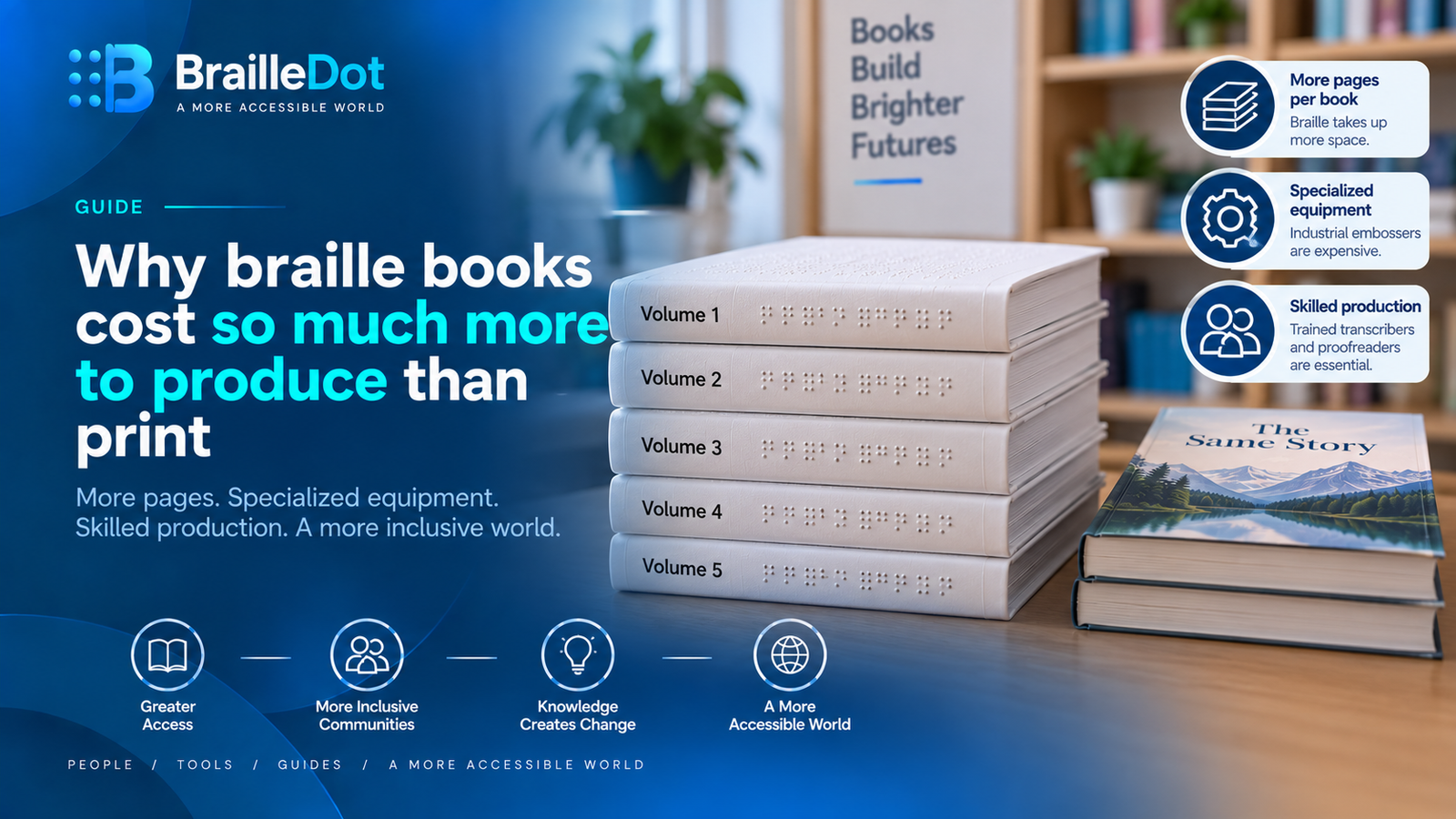
Why braille books cost so much more to produce than print
National Braille Press has stated plainly that producing a book in braille costs 3 to 4 times more than producing the same book in print, and then sells its own titles at ordinary print prices anyway, absorbing the difference by cross-subsidizing from an entirely separate side of its business. In 2021 alone, that side of the operation produced 35,000 large-print and braille menus for Starbucks. The book publishing arm loses money on purpose so a blind reader never pays more than a sighted one would for the same title. Understanding why braille costs that much more in the first place means looking at several separate cost drivers stacked on top of each other, not 1 single obvious culprit.
The size problem has old roots
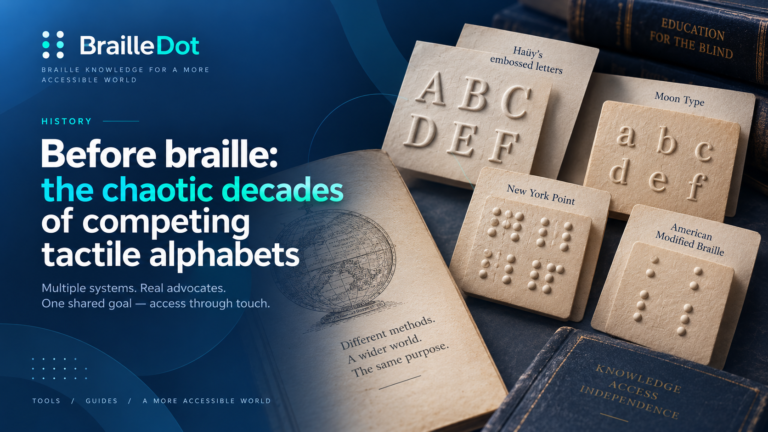
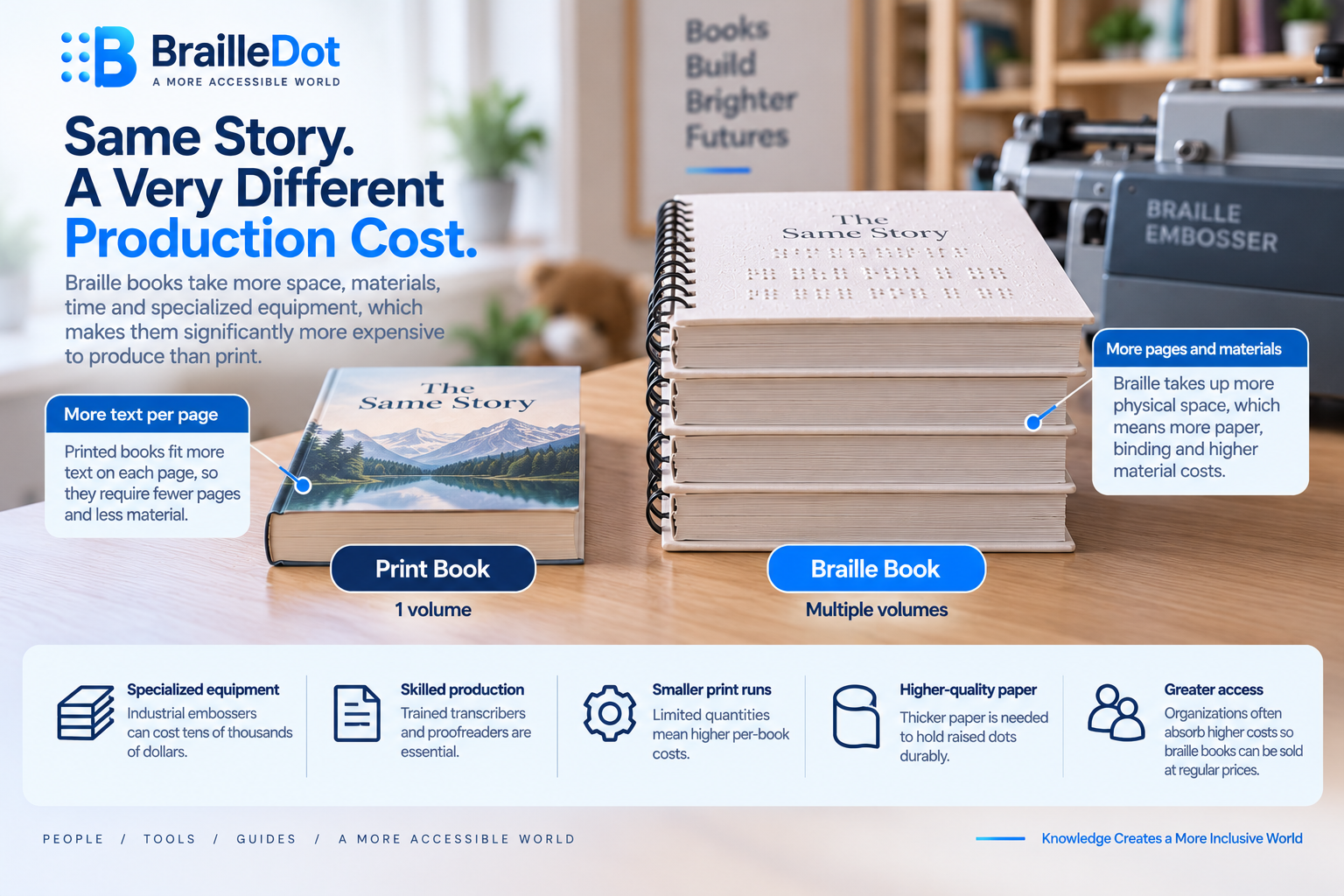
Braille takes up more physical space per character than printed text does, which is exactly the problem that made Valentin Haüy’s original embossed-letter system, covered in our piece on the tactile alphabets that came before braille, so impractical at scale, a single sentence could take up an entire page, and a full volume might contain only a few paragraphs of actual content. Braille’s 6-dot cell solved that specific problem dramatically compared to full embossed letters, but it didn’t eliminate the underlying issue entirely. A braille page still holds meaningfully less text than a printed page of the same size, which means a novel that fits in 1 printed volume routinely spreads across several separate braille volumes, more paper, more binding, more physical bulk for the exact same content.
What actually drives the added cost
Embossing equipment sits at the center of the cost gap. A specific industrial embosser called the NV Interpoint 55, launched in 1991 at a price of $92,000, could output up to 800 braille characters per second using a dedicated air compressor to drive the embossing head, and adoption was so slow at first that by the year 2000 only 3 of these machines existed in the entire United States. By 2008, that number had grown to more than 60 worldwide, still a tiny fleet of specialized machines compared to how many ordinary printing presses exist. On top of the equipment itself, braille requires thicker, higher-quality paper capable of holding raised dots without collapsing over time, skilled transcribers and proofreaders trained specifically for the work, and print runs far smaller than a mainstream publisher would ever consider viable, which means none of the usual economies of scale that make mass-market books cheap apply here at all.
Real bids show how much the price actually varies
A 1985 industry report compiled by the National Federation of the Blind laid out actual competing bids for producing the same material for the National Library Service, and the spread is striking. For brailling a single issue of Fortune magazine, the American Printing House for the Blind quoted $18.61 per copy, while National Braille Press quoted $7.73 for identical work, with 2 other producers landing in between at $8.90 and $10.12. On a larger book contract that same year, Associated Services for the Blind won a 200-book job for $789,063 total, while APH’s bid for the identical volume of work would have come to $954,766.23. Different organizations, doing the same specialized, low-volume work, arrived at meaningfully different costs, which says as much about how specialized and inconsistent this production niche is as any single number does on its own.
A midnight release that needed an armed guard
The scale of effort behind a single high-profile title shows up clearly in how National Braille Press handled Harry Potter and the Deathly Hallows in 2007. Scholastic sent the manuscript to NBP early specifically so it could be transcribed in time, and for the length of that process, staff covered the office windows and brought in an armed guard to protect what was, at that moment, one of the most closely guarded unpublished manuscripts in the world. Staff then worked around the clock to have finished braille volumes ready in time for a genuine midnight release party, mirroring the print edition’s own release-night hype for a readership that publishing, by its own admission within the industry, doesn’t usually build around.
Contractions are part of the actual fix, beyond just being a reading shortcut
Grade 2 contractions, covered in depth in our grade 1 vs grade 2 guide and complete contractions reference, do real, measurable work against this exact size problem, beyond making reading faster for someone who already knows braille. A language’s braille code without a mature contraction system stays noticeably bulkier as a direct result. Sinhala braille is a documented example, its own governing code currently lacks an efficient standard set of contractions, and sources describing the system point to that gap directly as a reason Sinhala braille books remain especially large and multi-volume compared to languages with well-developed contraction rules. Every contraction that shrinks a common word or letter pattern down to a single cell is, among other things, 1 more small reduction in the total paper a finished book requires.
Where the newest technology sits on price
Modern tactile display technology hasn’t solved the cost problem so much as moved it somewhere new. A German-made tactile e-book device released in 2018 cost €13,800. Graphiti, a device built by Orbit Research together with the American Printing House for the Blind, uses 2,400 individually adjustable tactile points to render full graphics and maps, the same underlying pin-based technology covered in our piece on how refreshable braille displays work, and costs $24,666. A more recent tablet-style alternative from a different manufacturer brought that down considerably to around $4,400, showing the price is dropping but still sits far above what any comparable sighted reading device costs. Some newer, more experimental approaches are trying to cut costs from the other direction entirely, 1 open-source project produces 3D-printed embossing molds for around $250 per 250-page book, trading speed for a dramatically lower material cost, a sign that the decades-old economics of braille production are still being actively reworked rather than settled.
Where a braille translator fits into the production process
Translation is only 1 part of producing a finished braille book. A translator can convert English text into grade 1 or grade 2 UEB, but producing a physical book still requires transcription workflows, proofreading, specialized paper, embossing equipment, binding, and quality control. Our braille translator handles the text-conversion stage, while the larger production process is what turns that translated material into a physical braille book a reader can use.
Translate the text behind accessible braille
Convert English text into grade 1 or grade 2 UEB with our braille translator, then use the translated content as part of a larger braille production workflow.
Open the translator