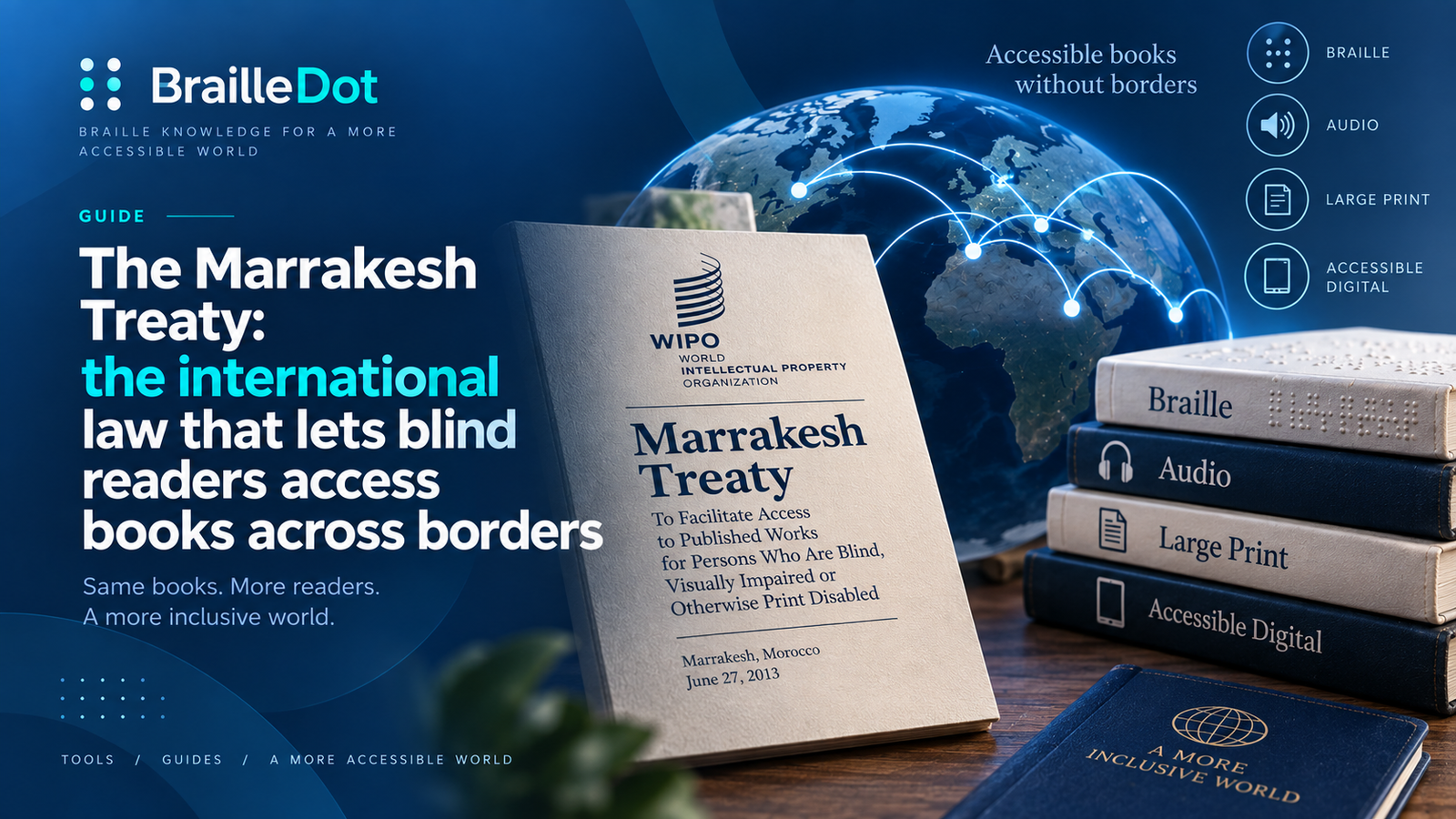
The Marrakesh Treaty: the international law that lets blind readers access books across borders
On June 27, 2013, delegates meeting in Marrakesh, Morocco signed a treaty that broke a pattern nearly as old as copyright law itself. Almost every prior international copyright treaty exists to strengthen protections for rights holders. This one did the opposite, built entirely around a copyright exception rather than a new protection, making it the first treaty of its kind in international law. What it addresses is sometimes called the book famine, the fact that only a small fraction of published books ever get produced in a format a blind or print-disabled reader can actually use, and the problem gets worse, not better, once a book has to cross a national border to reach the reader who needs it. The treaty is administered by the World Intellectual Property Organization, the same UN agency responsible for most major international copyright agreements, which is itself notable given how much of that agency’s usual work runs in the opposite direction, expanding what copyright protects rather than carving out where it doesn’t apply.
What the treaty actually requires countries to do
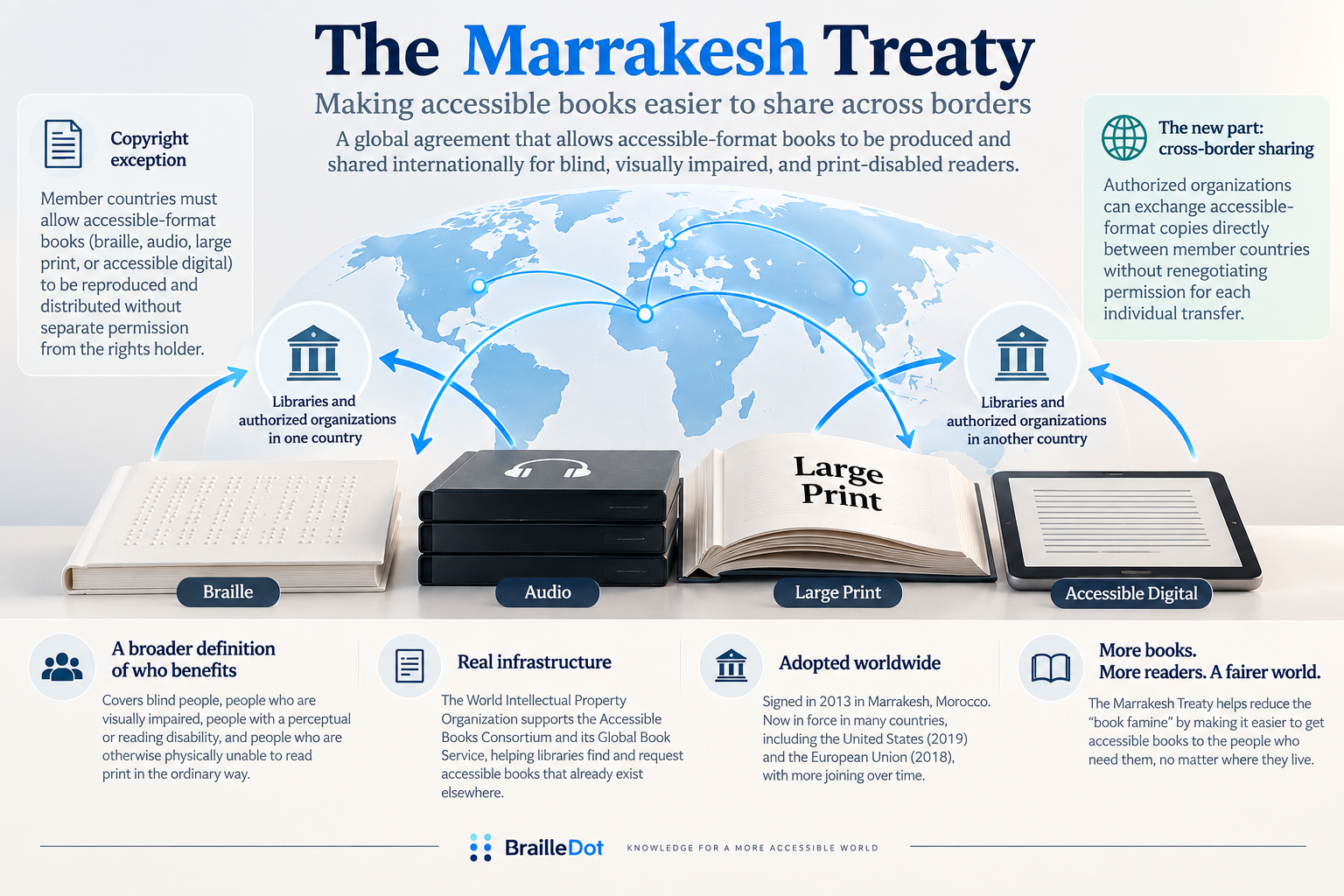
Member countries have to build a specific copyright exception into their own domestic law, one that allows accessible-format copies of a book, braille, audio, large print, or accessible digital formats, to be reproduced, distributed, and made available for blind, visually impaired, and print-disabled readers without needing separate permission from the book’s rights holder every time. Before an exception like this exists, producing a braille edition of a book, technically, requires the same kind of copyright clearance a foreign-language translation would, even though the goal is giving the exact same content to a reader who simply can’t access the print original.
The part that was actually new: sending copies across borders
Plenty of countries already had some version of a domestic accessible-format exception before this treaty existed. What none of them had was a clean way to share copies with each other. Without the treaty, a braille edition legally produced in 1 country under its own domestic exception still couldn’t simply be sent to a reader or library in a different country, since that receiving country’s copyright law hadn’t granted any exception covering an import from somewhere else. The same book might then need to be independently re-transcribed into braille separately in every single country that wanted a copy, a duplicated effort with no real benefit to anyone. The treaty’s actual innovation is letting authorized entities, generally libraries and organizations serving blind and print-disabled readers, exchange accessible-format copies directly across borders between member countries, without renegotiating permission for each individual transfer.
That international sharing mechanism is part of the larger story of how braille became useful beyond a single school, country, or production system. The history of braille itself involved decades of competing tactile alphabets before a common standard emerged, as discussed in our history of the tactile alphabets that came before braille.
Real infrastructure exists to make this work in practice
This isn’t just treaty language sitting unused. The World Intellectual Property Organization, which administers the treaty, backs a public-private partnership called the Accessible Books Consortium, which maintains a shared catalog called the Global Book Service specifically so libraries in different countries can find and request accessible-format titles that already exist elsewhere rather than producing their own copy from scratch. Libraries like the United States’s own National Library Service use this system in practice, which is the entire point, the treaty only matters if organizations actually use the cross-border mechanism it created rather than continuing to work in isolation.
The definition of who benefits is broader than just blindness
The treaty’s language covers more than blindness specifically. It extends to people who are visually impaired, people with a perceptual or reading disability, and people who are otherwise physically unable to hold a book or focus and move their eyes normally to read in the ordinary way. That’s a meaningfully wider group than “blind readers” alone, and it matters for anyone assuming this framework applies to a narrower population than it actually does.
Where the United States fits into the timeline
The US had its own domestic version of this kind of exception well before the treaty existed, the Chafee Amendment, part of US copyright law since 1996, which already allowed authorized entities to reproduce copyrighted works in accessible formats domestically. The US signed the Marrakesh Treaty in 2013, the same year it was adopted, but formal ratification took considerably longer. The US became the treaty’s 50th member country on February 8, 2019, and the treaty entered into force in the United States on May 8, 2019, nearly 6 years after it was first signed. The European Union moved on its own separate timeline too, implementing the treaty’s requirements through its own directive and regulation, with the framework entering into force across EU member states in 2018, ahead of the US despite the US having signed the original treaty years earlier. The gap in each case reflects how treaty ratification and domestic legal alignment often move on their own separate timelines, even when a country or bloc already substantially complies with a treaty’s underlying goals before formally joining it.
What this means alongside everyday translation work
This translator produces English text in UEB braille directly, which is a different piece of the overall picture than what this treaty governs. The treaty is about moving already-produced accessible-format books across borders without re-clearing rights in every country, not about the mechanics of producing braille text in the first place. The 2 pieces are complementary rather than overlapping, producing accessible content is 1 problem, and getting existing accessible content to the people who need it internationally, without needless duplication, is a separate one this treaty was built specifically to solve.
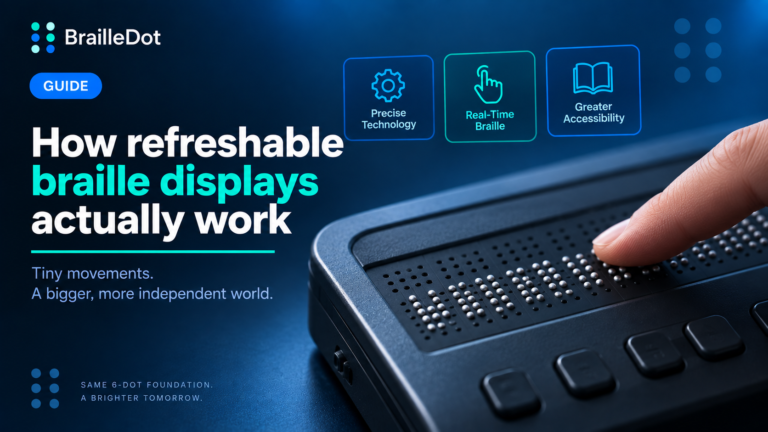
If you want to understand the technology behind turning ordinary English text into tactile output, you can also read how refreshable braille displays actually work, including the hardware and software pipeline that turns translated braille into something a reader can feel beneath their fingertips.
Translate English text into UEB braille
Convert English text into grade 1 or grade 2 UEB with our braille translator, then use the resulting braille content with the appropriate accessible reading tools and hardware.
Open the translator