Nemeth code vs UEB
Nemeth code vs UEB: why math braille is separate
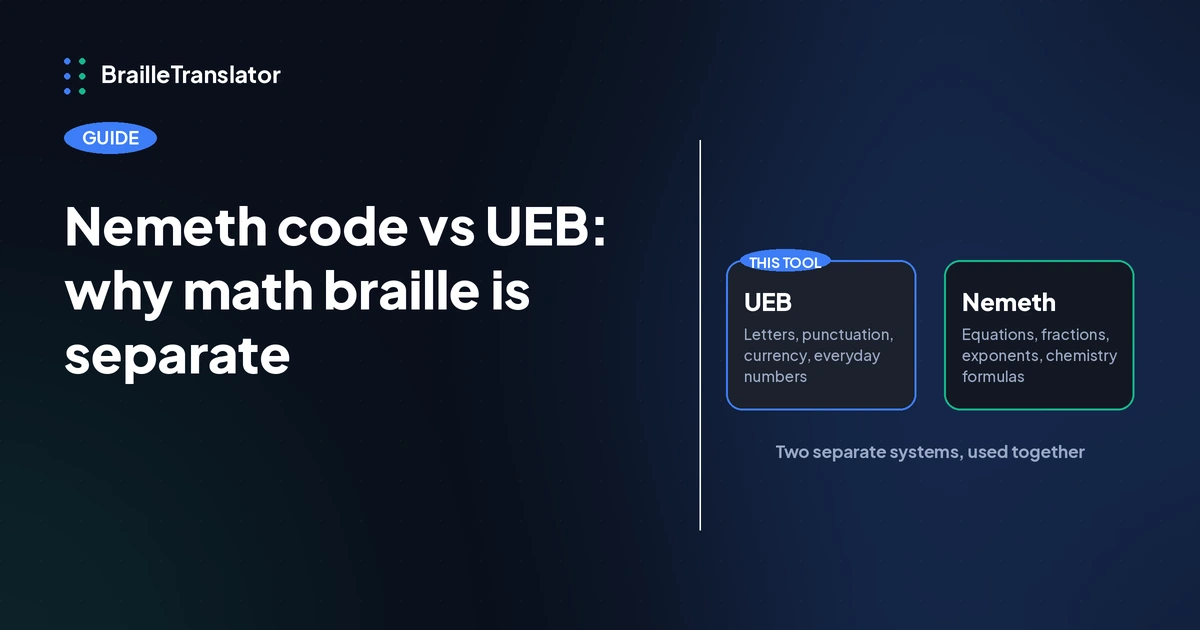
Nemeth code is a separate braille system built specifically for math and science notation, created by Abraham Nemeth in 1946 and adopted by the Braille Authority of North America as the standard for technical material in 1952. It isn’t an older system UEB replaced. Both are still officially recognized today, and Nemeth is still the code used for full mathematical and scientific notation, equations, fractions, chemistry formulas, even within otherwise UEB text. This translator implements UEB for literary text, not Nemeth, which is worth understanding clearly rather than assuming the two overlap.
Literary text: letters, contractions, punctuation, currency, everyday numbers
Equations, fractions, exponents, radicals, matrices, chemistry formulas
A quick history
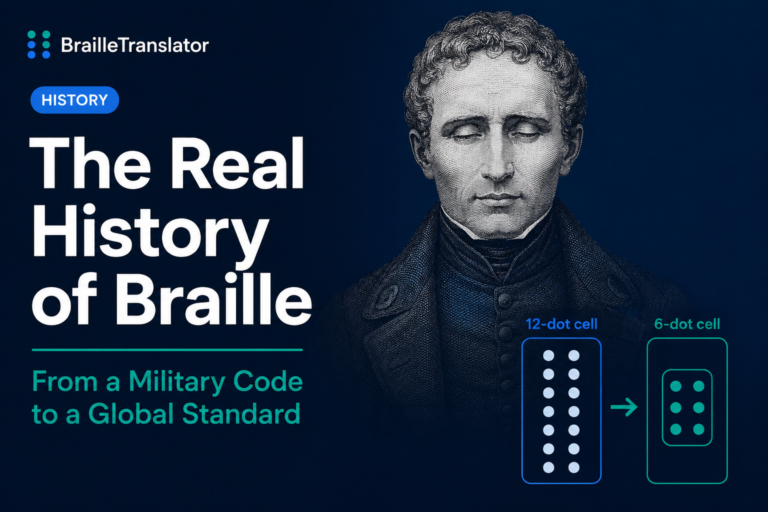
Nemeth code has a specific origin story. Abraham Nemeth was blind and studying mathematics at the doctoral level, and existing braille math notation at the time wasn’t built to handle the complexity of what he needed to write. He developed his own system in 1946 to solve that problem directly, and BANA adopted it as the official standard for math and science braille in 1952. The code has been revised several times since, most notably in 1965, 1972, and again in a full 2022 revision that modernized it and clarified how it works alongside UEB specifically.
What Nemeth code covers that UEB doesn’t
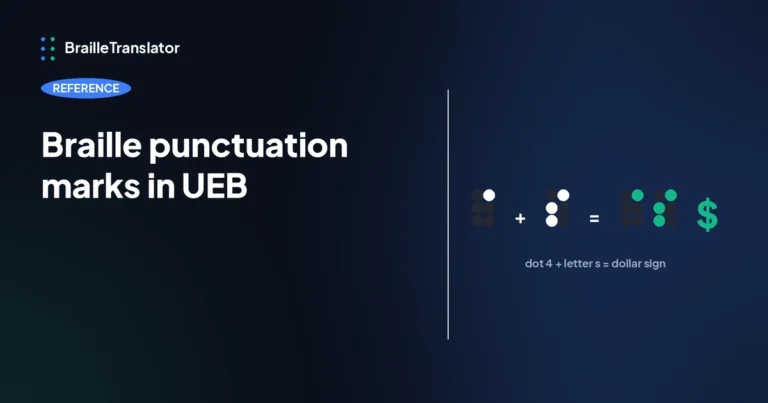
UEB has its own number indicator and handles digits, currency, and everyday arithmetic correctly on its own, that part is already covered in our braille punctuation guide. What UEB wasn’t built to do is represent the full range of mathematical and scientific notation on a single line the way it appears in print: nested fractions, exponents, radicals, matrices, chemical formulas, and the dense symbolic layout found in higher math and science texts. Nemeth code exists specifically to linearize that complexity into a consistent, readable braille sequence, which is a fundamentally different problem than transcribing prose.
Nemeth and UEB today, not a replaced system
This is the part that gets flattened in a lot of quick explanations. When UEB officially replaced EBAE as the literary braille standard, Nemeth didn’t get replaced along with it, because Nemeth was never a literary code to begin with. BANA’s own guidance addresses this directly: technical material can be written using UEB’s own math and science notation, or using Nemeth code embedded within surrounding UEB text, with code switching indicators marking where the notation shifts from one system to the other so a reader isn’t left guessing which rules apply to a given passage.
Which approach gets used for a given document or a given student isn’t fixed by a single universal rule either. BANA has stated plainly that the choice between UEB math notation and Nemeth code within UEB context should be based on the individual braille reader’s needs, not a single mandated standard applied everywhere. That’s a meaningfully different situation than the UEB and EBAE transition, where one code formally and completely replaced the other on a set date. Nemeth and UEB coexist by design.
What this means for a UEB translator
Being specific here matters more than sounding comprehensive. This translator implements literary UEB, grade 1 and grade 2, including UEB’s own number indicator, punctuation, and currency symbols. It doesn’t implement Nemeth code. That means straightforward numbers, prices, and everyday arithmetic embedded in ordinary text translate correctly, but a full equation, a chemistry formula, or dense mathematical notation is outside what this tool is built to handle, since that’s a genuinely separate code with its own extensive rule set, not an extension of the literary alphabet this translator already covers thoroughly.
For exactly how that everyday number handling works, digit sequences, decimals, and the letter indicator, see how braille numbers actually work.
Try it for what it actually covers
If you’re working with straightforward text, including numbers, punctuation, and everyday symbols, our braille translator handles that accurately in both grade 1 and grade 2. For dense math or science notation specifically, that’s Nemeth code territory, a different system with its own dedicated resources.
Open the translatorFrequently asked questions
Nemeth code is a braille system built specifically for mathematical and scientific notation, created by Abraham Nemeth in 1946 and adopted by BANA as the standard for technical material in 1952.
No. UEB is the literary braille code used for general text, and it has its own basic number handling. Nemeth code is a separate, more extensive system built specifically for full mathematical and scientific notation, and it’s still used today, embedded within UEB text where needed.
No. This translator implements literary UEB, grade 1 and grade 2, including UEB’s own numbers, punctuation, and currency symbols. It doesn’t translate Nemeth code notation like equations or chemistry formulas.
UEB handles basic numbers, arithmetic, and everyday numeric content within ordinary text on its own. For full mathematical and scientific notation, BANA’s guidance allows either UEB’s own math notation or Nemeth code embedded within UEB text, chosen based on the individual reader’s needs.
Yes. BANA has stated that Nemeth code remains integral to braille in the United States, and it continues to be used for math and science material alongside UEB rather than being replaced by it.