
Lesson 7: Capital Letters in Braille — Names and Initials
Watch Lesson 7: Braille Capital Letters and Initials
Watch the guided demonstration, pause to practise, then continue with the written lesson and exercises below.
Look at the name Maya. In print, the uppercase M tells you that a name has begun. In Unified English Braille (UEB), the letter m keeps its usual dots. An extra cell before it supplies the capital information:
Maya → ⠠⠍⠁⠽⠁
That small leading sign, ⠠, contains dot 6. It tells the reader to capitalize the letter immediately after it. This is a new kind of cell: an indicator. It changes how another symbol is read, rather than representing a letter itself.
You already practiced reading ordinary lowercase words in Lesson 6. Today the letter patterns remain familiar; you are learning to notice the sign that changes their capitalization.
One capital letter needs one leading indicator
The following two words use the same four letter cells. Only the initial capital indicator differs:
| Braille | Reading | |
|---|---|---|
| rose | ⠗⠕⠎⠑ | Lowercase word |
| Rose | ⠠⠗⠕⠎⠑ | Name with a capital R |
To form Leo, place ⠠ before the l cell. Then write the remaining letters in lowercase:
⠠ + ⠇⠑⠕ = ⠠⠇⠑⠕
Do not put ⠠ before every subsequent letter. A single capital indicator applies to the next letter, not to the whole word.
Two names, two starting capitals
Consider Maya Lee:
⠠⠍⠁⠽⠁ ⠠⠇⠑⠑
The blank word gap separates the first name from the surname. Each word has its own capital indicator because each begins with an uppercase letter. If you omit the second ⠠, the Braille no longer communicates the same capitalization as the print name.
You can proofread names in two passes. First read the letters and check their spelling. Then look only at the beginnings of the words: where does the print use an uppercase letter, and is its indicator present?
An initial is not quite the same as a name
A standalone letter used as a person’s initial has a special consideration in UEB, depending on whether contractions are being used. In material written entirely in uncontracted Braille, as in these lessons, a standalone capital initial ordinarily uses just ⠠ before the letter. A separate grade 1 indicator is not normally needed unless another rule calls for it.
| Printed initial, standing alone | Entirely uncontracted UEB | How to read the signs |
|---|---|---|
| M | ⠠⠍ | Capital sign, m |
| B | ⠠⠃ | Capital sign, b |
| A | ⠠⠁ | Capital sign, a |
| I | ⠠⠊ | Capital sign, i |
| O | ⠠⠕ | Capital sign, o |
When contractions are permitted, the rule can differ. Many standalone initials can be mistaken for contracted words, so a grade 1 symbol indicator, ⠰ (dots 5-6), is placed before the capital indicator: for example, M → ⠰⠠⠍ or B → ⠰⠠⠃ in that context. A, I and O do not need that extra sign when used as standalone initials. These are context-dependent rules within the same UEB code, not two separate alphabets. Punctuation after initials is covered in Lesson 9; today’s practice omits full stops.
Here is the difference in a name written as M Lee:
⠠⠍ ⠠⠇⠑⠑
In this entirely uncontracted example, the isolated M and the L beginning Lee both use a capital indicator only. In a text allowing contractions, the isolated M could instead require ⠰ before ⠠.
What if the whole word is uppercase?
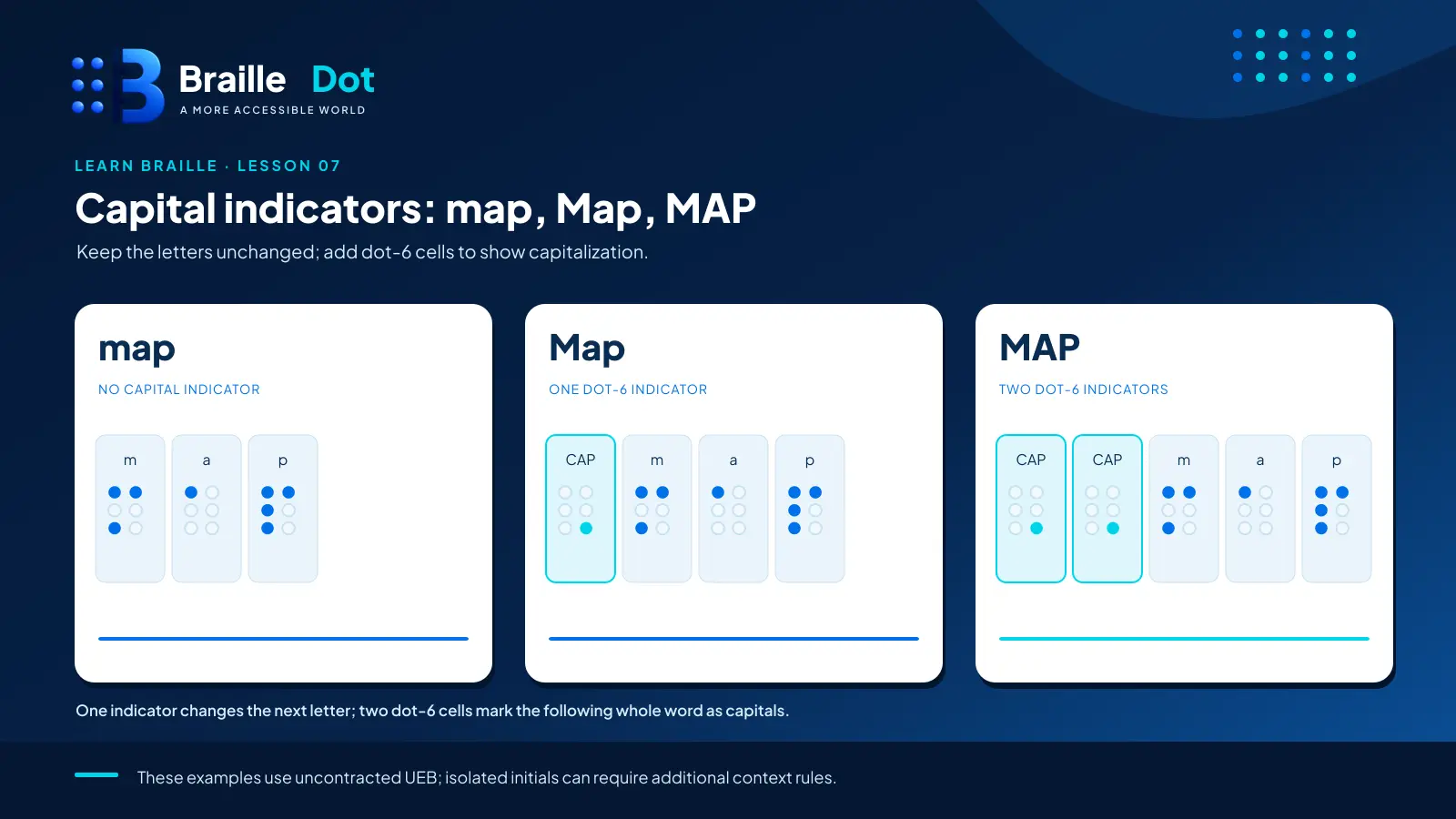
UEB uses two consecutive dot-6 cells to tell the reader that the following word is written in capitals. You will often hear this called the capital word indicator.
MAP → ⠠⠠⠍⠁⠏
Compare it with Map → ⠠⠍⠁⠏ and map → ⠍⠁⠏. The three spellings use exactly the same letters; their indicators communicate the difference. The capital word indicator lasts through that word and ends at the word space. Long passages of capital letters have additional rules that you do not need for this exercise.
Read independently: where are the capitals?
In this first set, read each Braille sequence into print with matching capitalization. None of the names below was used in the worked examples.
- ⠠⠧⠊⠕⠇⠑⠞
- ⠠⠓⠑⠝⠗⠽
- ⠠⠗⠕⠎⠁ ⠠⠅⠊⠍
- ⠠⠅ (a standalone initial in this uncontracted exercise)
- ⠠⠠⠎⠥⠝
Reveal the five readings and why they are capitalized
- Violet — a single initial capital.
- Henry — a single initial capital.
- Rosa Kim — each name begins with a capital.
- K — a standalone capital initial; in this fully uncontracted exercise, the capital indicator is sufficient.
- SUN — both dot-6 cells mark an uppercase word.
Write independently: names and single initials
This time start with the print and supply all necessary indicators yourself.
| Task | Print to write | Your Braille |
|---|---|---|
| A | Tara | ______ |
| B | Felix | ______ |
| C | Ava Cole | ______ |
| D | D (a standalone initial) | ______ |
| E | A Finn (A is a standalone initial) | ______ |
Pause before checking. In this fully uncontracted exercise, ask whether D and the initial A in A Finn need the same capitalization indicator.
Check your five written answers
- Tara: ⠠⠞⠁⠗⠁
- Felix: ⠠⠋⠑⠇⠊⠭
- Ava Cole: ⠠⠁⠧⠁ ⠠⠉⠕⠇⠑
- D as an initial: ⠠⠙
- A Finn: ⠠⠁ ⠠⠋⠊⠝⠝
Both D and A need ⠠ for capitalization. Neither needs an additional ⠰ in this entirely uncontracted exercise. In writing that permits contractions, some isolated initials—including D—may need ⠰ to make the letter meaning clear.
Three readings, one spelling
Decide which of these Braille lines means river, River, and RIVER. Write each label beside the correct line.
| Line | Braille | Your label |
|---|---|---|
| 1 | ⠠⠠⠗⠊⠧⠑⠗ | ______ |
| 2 | ⠗⠊⠧⠑⠗ | ______ |
| 3 | ⠠⠗⠊⠧⠑⠗ | ______ |
Reveal the capitalization comparison
- RIVER — capital word indicator.
- river — no capital indicator.
- River — one capital letter indicator.
The BrailleDot translator can provide additional name examples for you to read back, but write your own answer first and compare it afterward. When you are satisfied that you can distinguish an ordinary name, an isolated initial and an all-capital word, you are ready to add numbers to your reading.
Rule reference: Braille Authority of North America, The ABCs of UEB, sections on capitals and grade 1 indicators.
Written by Marcus Wren.