Lesson 13: Your First Braille Contractions — Common Wordsigns
Watch Lesson 13: Your First Braille Contractions — Common Wordsigns
Watch the guided demonstration, pause to practise, then continue with the written lesson and exercises below.
You already know how to write the letter by letter: ⠞⠓⠑. Now meet a much shorter way to read it in contracted Unified English Braille (UEB): ⠮.
The word has not changed. The Braille spelling has. A contraction lets one cell represent more than one letter, sometimes an entire word. That is why a passage in contracted Braille may have fewer cells than the same passage in uncontracted Braille, which you practiced in Lesson 12.
This lesson introduces five common strong contractions, used as complete words in our exercises. You do not need to memorize the entire contraction system to start recognizing them.
Five words you can read in one cell
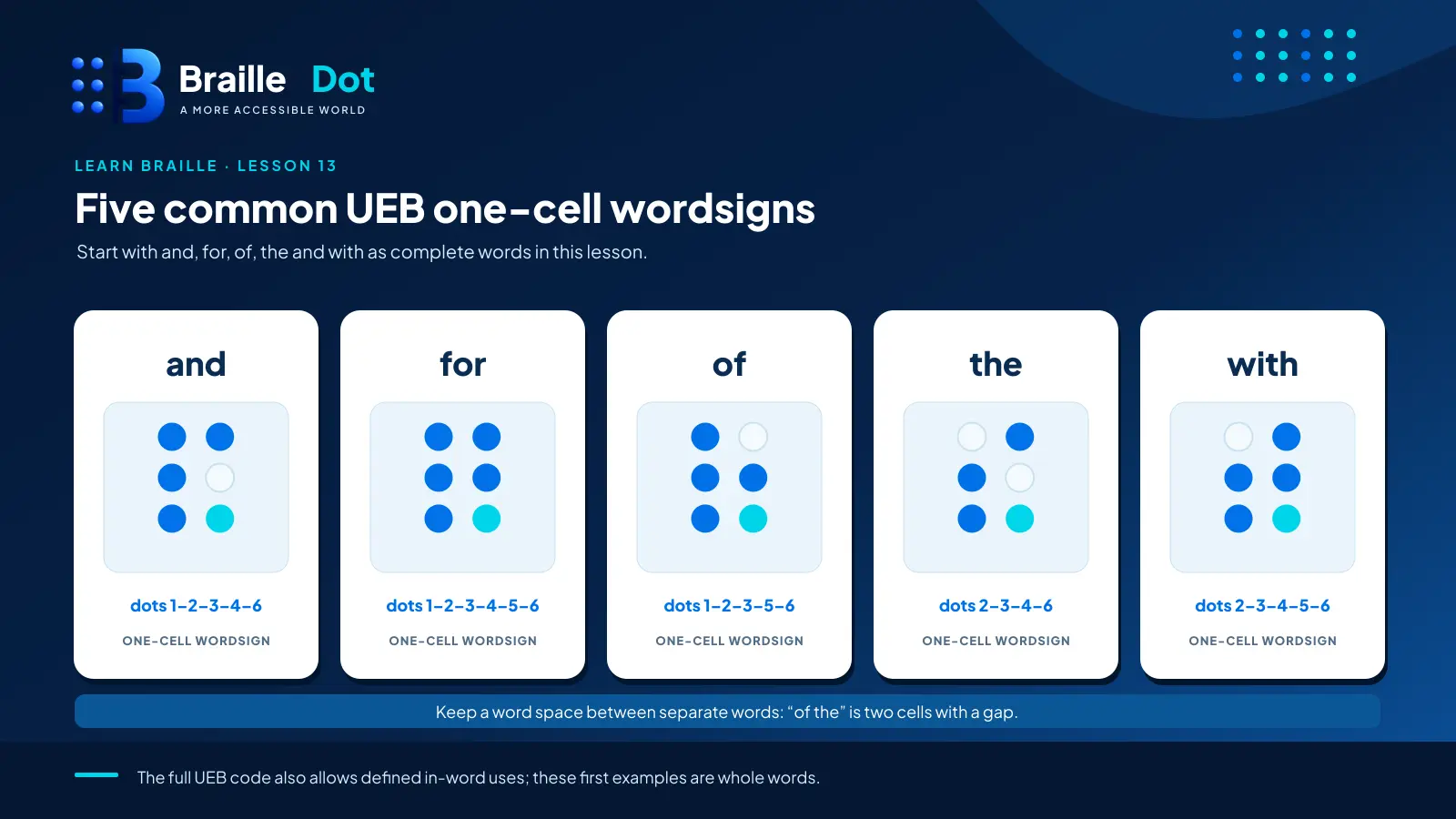
| Whole print word | Contracted UEB cell | Raised dots | Uncontracted spelling |
|---|---|---|---|
| and | ⠯ | 1-2-3-4-6 | ⠁⠝⠙ |
| for | ⠿ | 1-2-3-4-5-6 | ⠋⠕⠗ |
| of | ⠷ | 1-2-3-5-6 | ⠕⠋ |
| the | ⠮ | 2-3-4-6 | ⠞⠓⠑ |
| with | ⠾ | 2-3-4-5-6 | ⠺⠊⠞⠓ |
Try noticing how the last four patterns differ. ⠿ fills all six dot positions; ⠯ leaves dot 5 empty. ⠮ has dots 2-3-4-6, while ⠾ adds dot 5. You can use those differences to check your answer without relying on the visual shape alone.
There is no extra contraction indicator before these signs. A Braille word gap still separates one printed word from the next. Capital letters and punctuation use the indicators you learned earlier.
Read them in ordinary phrases
Start with the small cup:
⠮ ⠎⠍⠁⠇⠇ ⠉⠥⠏
The first cell represents the. After the gap, the remaining letters spell small cup as before.
Now try a box of pins:
⠁ ⠃⠕⠭ ⠷ ⠏⠊⠝⠎
You are looking for one-cell of between two familiar words. If you accidentally read ⠷ as the letters o-f in two cells, slow down and count: there is only one raised-dot pattern there.
Two more short messages show capitalization and a different wordsign:
- tea for Leo → ⠞⠑⠁ ⠿ ⠠⠇⠑⠕
- run with Mia → ⠗⠥⠝ ⠾ ⠠⠍⠊⠁
And Tom and Eva becomes ⠠⠞⠕⠍ ⠯ ⠠⠑⠧⠁. The name indicators stay on the names, not on the lowercase word and between them.
A wordsign is not a substitute for a word space
You may be tempted to squeeze everything together now that the words are shorter. Resist that habit. For the sun, the correct spacing in this exercise is ⠮ ⠎⠥⠝. Writing ⠮⠎⠥⠝ removes the space and no longer represents those two separate printed words.
One useful distinction for later: these five signs are called strong contractions in UEB, and the full code can also use them inside certain words. We are beginning with their complete-word use because it makes the reading task clear. Do not assume that every contraction follows exactly the same placement rules.
Your first independent reading round
Read all four phrases into print. You have not seen any of these complete phrases in the demonstrations.
- ⠠⠁⠧⠁ ⠯ ⠠⠍⠁⠭
- ⠮ ⠗⠑⠙ ⠎⠕⠉⠅
- ⠁ ⠃⠁⠛ ⠷ ⠗⠊⠉⠑
- ⠎⠊⠞ ⠾ ⠠⠵⠕⠑
Reveal the four readings
- Ava and Max — ⠯ means and.
- the red sock — ⠮ means the.
- a bag of rice — ⠷ means of.
- sit with Zoe — ⠾ means with, followed by the capitalized name.
Write without copying the chart
Write each phrase using the five contractions where they occur as whole words. Spell the other words letter by letter, as taught earlier.
| Prompt | Your Braille |
|---|---|
| A. for Sam | __________ |
| B. the blue lamp | __________ |
| C. Kim and Ben | __________ |
| D. of the moon | __________ |
Check the four written phrases
- A. for Sam — ⠿ ⠠⠎⠁⠍
- B. the blue lamp — ⠮ ⠃⠇⠥⠑ ⠇⠁⠍⠏
- C. Kim and Ben — ⠠⠅⠊⠍ ⠯ ⠠⠃⠑⠝
- D. of the moon — ⠷ ⠮ ⠍⠕⠕⠝
In D, of and the are two words and therefore two separate cells with a word space between them. A correct cell without the correct boundary is not a correct phrase.
A two-minute recognition check
Cover the table. Say what each sign means: ⠾, ⠷, ⠿, ⠯, ⠮. Then name the raised dots for ⠮ and ⠾. If you confuse the two, feel or reconstruct their dot positions: with adds dot 5 to the pattern used for the.
These exercises intentionally use only the contractions taught here; other words remain spelled out. They are stepping-stones toward reading contracted UEB, not examples claiming to contain every contraction a professional transcription might use. You can compare extra self-made phrases with the BrailleDot translator after attempting them yourself, keeping the selected-contraction scope in mind.
Next you will meet signs that stand for letter groups inside a word, a different reading problem from spotting whole words separated by spaces.
UEB source: International Council on English Braille, Rules of Unified English Braille, Section 10.3.
Written by Marcus Wren.