Lesson 4: Learn Braille Letters U–Z
Watch Lesson 4: Learn Braille Letters U–Z
Watch the guided demonstration, pause to practise, then continue with the written lesson and exercises below.
Six letters remain: u, v, w, x, y, z. Five follow a familiar pattern, and one needs special attention. Once you know these six, you will have met every letter in the English Braille alphabet.
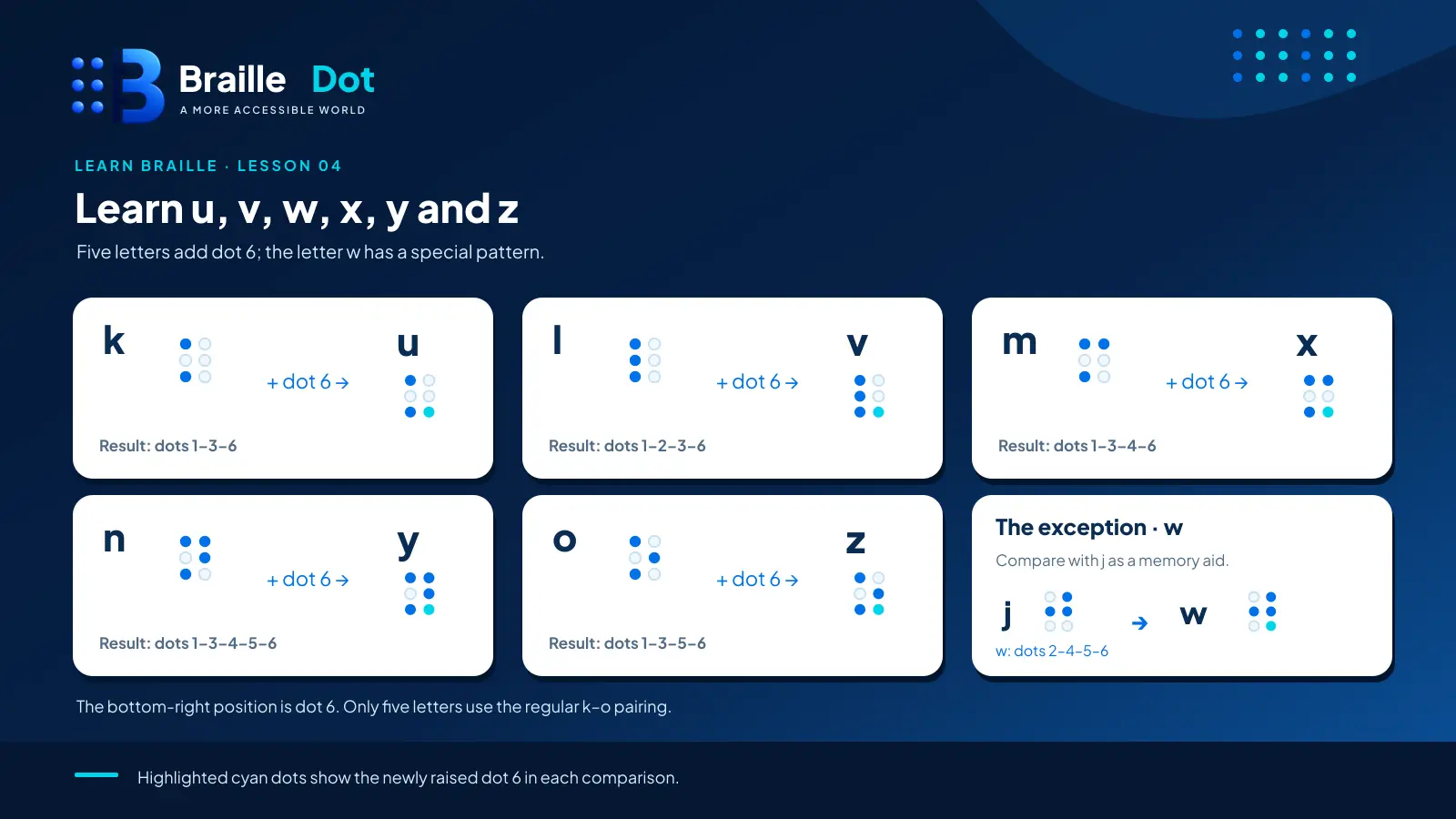
In Lesson 3, the letters k through t came from adding dot 3 to the first ten letters. This time, you will add dot 6, the lower-right position, to five letters from the second group.
Five letters follow the dot-6 rule
| Starting letter | Add dot 6 | Result | Raised dots of result |
|---|---|---|---|
| k ⠅ | +6 | u ⠥ | 1-3-6 |
| l ⠇ | +6 | v ⠧ | 1-2-3-6 |
| m ⠍ | +6 | x ⠭ | 1-3-4-6 |
| n ⠝ | +6 | y ⠽ | 1-3-4-5-6 |
| o ⠕ | +6 | z ⠵ | 1-3-5-6 |
Read the first pair aloud: k becomes u when dot 6 is raised. The third pair is m and x, not m and w. That odd-looking jump brings us to the final letter.
The special case: w
w = ⠺ = dots 2-4-5-6.
It does not come from adding dot 6 to the same sequence used for u, v, x, y, and z. The historical Braille alphabet was developed for French; the English letter w was assigned a separate pattern when it was incorporated. This is why the regular sequence goes u, v, x, y, z while w sits between v and x in ordinary alphabetical order.
To help recognize w, compare it with j (⠚) from Lesson 2:
- j: dots 2-4-5, ⠚.
- w: dots 2-4-5-6, ⠺.
One extra lower-right dot turns the older j pattern into w. This comparison is useful as a memory aid even though it is separate from the five-letter dot-6 sequence above.
Read new words without reaching for the chart
Try these four words first. All are written in uncontracted Braille, using the letters you have studied.
⠺⠁⠧⠑
The first cell is the new w. Read the remaining three from left to right. The word is wave.
⠞⠁⠭⠊
You know t, a, and i. The new third cell is x. The word is taxi.
⠟⠥⠊⠵
Look carefully at the first and last letters. They are q and z. The word is quiz.
⠽⠑⠇⠇⠕⠺
Read each cell steadily. You should find yellow, beginning with y and ending with w.
If one letter stalls you, return to its dots. For example, x is 1-3-4-6; y has those same four raised positions plus dot 5.
Mix the entire alphabet
You now need practice that does not tell you which group a letter belongs to. The following exercise mixes familiar letters from all four lessons.
Part A: read the Braille
Write the lowercase English word represented by each line.
| Question | Uncontracted Braille | Your answer |
|---|---|---|
| 1 | ⠵⠕⠕ | ______ |
| 2 | ⠺⠁⠭ | ______ |
| 3 | ⠧⠊⠧⠊⠙ | ______ |
| 4 | ⠵⠊⠝⠉ | ______ |
| 5 | ⠋⠥⠵⠵⠽ | ______ |
Reveal the five reading answers
- zoo
- wax
- vivid
- zinc
- fuzzy
Part B: write the Braille
Translate each lowercase word into uncontracted Braille. You may write the letters separately on paper before combining the cells.
-
box = ______
-
you = ______
-
zebra = ______
-
quick = ______
-
vex = ______
Reveal the five writing answers
- box = ⠃⠕⠭
- you = ⠽⠕⠥
- zebra = ⠵⠑⠃⠗⠁
- quick = ⠟⠥⠊⠉⠅
- vex = ⠧⠑⠭
Notice that you in question 7 is written with three letter cells. The course is still using uncontracted Braille. Contracted wordsigns and other shorthand conventions are introduced later in the course.
An alphabet checkpoint you can repeat
Set aside the tables and answer these questions from memory. The check now draws on all three alphabet groups, not only the six letters from this lesson.
- Which two letters differ only by dot 6: ⠇ and ⠧?
- Which letter from the first ten is ⠚?
- Which letter from the next ten is ⠞?
- Which letter is ⠺?
- Read this mixed-alphabet word: ⠉⠇⠕⠥⠙.
- Write the word brown in uncontracted Braille.
- If you remove dot 6 from z (⠵), which earlier letter remains?
Show the alphabet checkpoint answers
- l and v.
- j.
- t.
- w.
- cloud.
- brown = ⠃⠗⠕⠺⠝.
- o (⠕).
You can return to this check tomorrow and again a few days later. Recognizing letters after a break is more informative than identifying them only while the chart is open.
If you’d like a larger reference while practicing, our guide to reading Braille dots provides a broader overview. For new words to decode, you can also generate short uncontracted examples with the BrailleDot translator.
What comes after the alphabet?
You have learned the shapes of all twenty-six English Braille letters. In the next module, the task changes: you will put those cells together into complete words, practice word spacing, and gradually become less dependent on a reference chart. Capital letters, numbers, punctuation, and contractions have their own later lessons; they do not have to be mastered before you start reading basic lowercase words.
Alphabet reference: Perkins School for the Blind, How the Braille Alphabet Works. The spelling and dot configurations are also checked against ICEB’s 2024 UEB rulebook.
Written by Marcus Wren.