Lesson 9: Punctuation in Braille Sentences
Watch Lesson 9: Punctuation in Braille Sentences
Watch the guided demonstration, pause to practise, then continue with the written lesson and exercises below.
Read these two lines. Their letters are identical, but their endings give them different meanings:
⠠⠊⠞ ⠊⠎ ⠺⠁⠗⠍⠲ — It is warm.
⠠⠊⠞ ⠊⠎ ⠺⠁⠗⠍⠦ — It is warm?
The first line makes a statement; the second asks a question. The last cell is doing real reading work. In Lesson 8 you learned to recognize number indicators. Now you will learn punctuation signs that attach to words and help sentences carry their intended meaning.
Seven signs to recognize
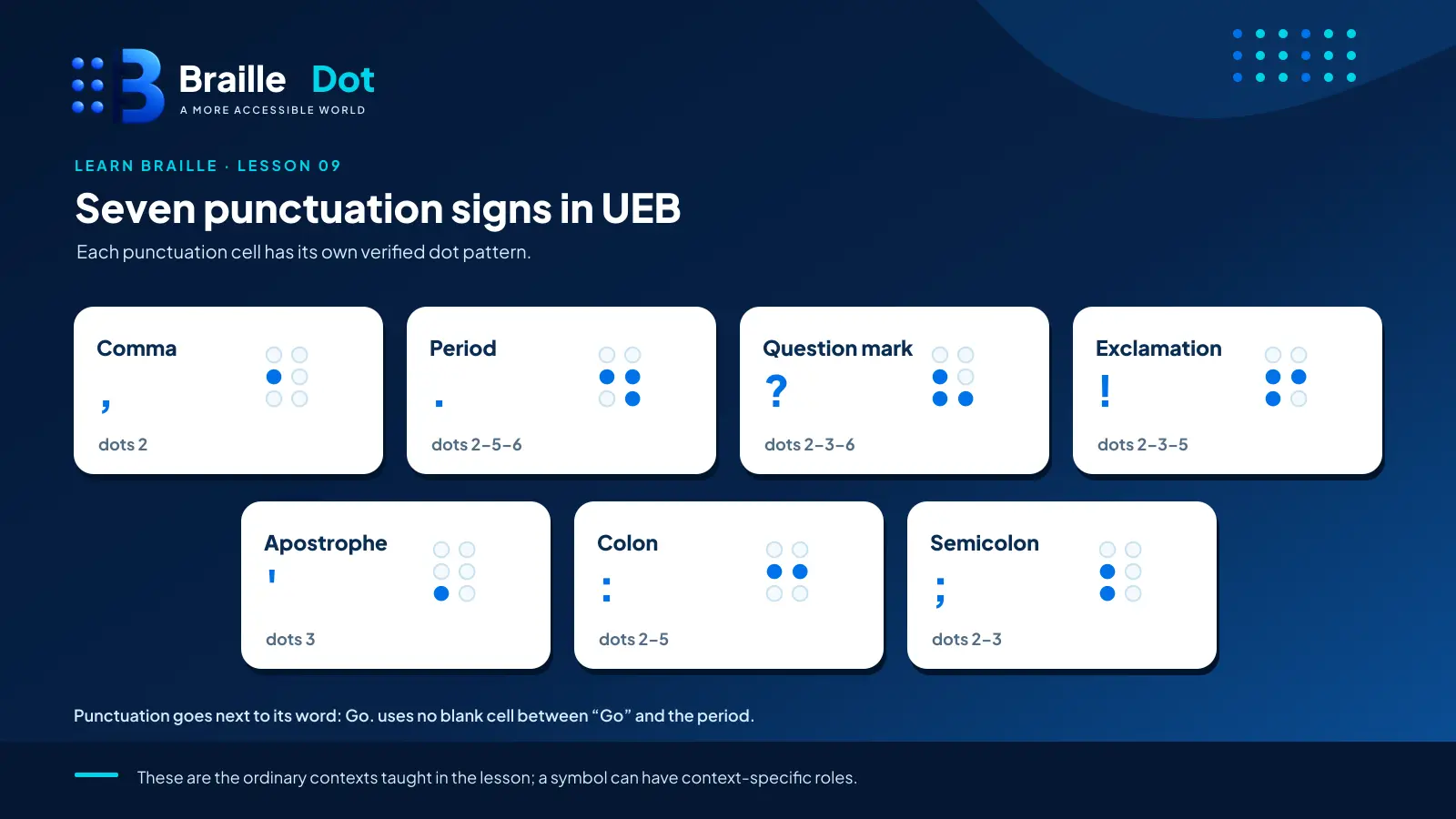
These are Unified English Braille (UEB) punctuation marks. Notice that several occupy just the lower part of a Braille cell, so dot positions matter as much as they did for letters.
| Print mark | Braille | Dot numbers | Everyday role |
|---|---|---|---|
Comma , |
⠂ | 2 | Brief separation inside a sentence or list |
Period . |
⠲ | 2-5-6 | Ends a statement |
Question mark ? |
⠦ | 2-3-6 | Ends a direct question |
Exclamation mark ! |
⠖ | 2-3-5 | Marks emphasis or an exclamation |
Apostrophe ' |
⠄ | 3 | Marks a missing letter or possession |
Colon : |
⠒ | 2-5 | Introduces something, such as a list |
Semicolon ; |
⠆ | 2-3 | Separates closely related parts of a sentence |
The question-mark cell can have another function in quotation contexts; here we use it at the end of an unquoted question. We will keep this first punctuation exercise to straightforward print sentences.
Punctuation belongs next to the word
Start with a two-letter command: Go. Its Braille is ⠠⠛⠕⠲.
There is no blank cell between go and the period. Likewise, a question mark is placed immediately after the word that ends the question:
Can we go? → ⠠⠉⠁⠝ ⠺⠑ ⠛⠕⠦
An exclamation mark follows the same spacing principle:
Wait! → ⠠⠺⠁⠊⠞⠖
The letters within a word still sit side by side. A space comes after punctuation when the next word begins, if the printed sentence has that space. It does not normally come between a word and its comma, full stop, question mark or exclamation mark.
The comma is part of the first word group
Consider Yes, Mia.
⠠⠽⠑⠎⠂ ⠠⠍⠊⠁⠲
Read the first group as Yes, including the comma. Cross the blank word gap, then read the name Mia and its ending period. Keeping the comma attached to Yes helps the reader see where the pause belongs.
An apostrophe stays within the word
Dad’s hat becomes ⠠⠙⠁⠙⠄⠎ ⠓⠁⠞.
The ⠄ appears between Dad and s. It is not a space and it is not another letter of the alphabet. The word remains one uninterrupted group, followed by a space before hat.
Two marks that organize more information
You will also meet the colon and semicolon in ordinary prose. Their cells look similar, but ⠒ (2-5) and ⠆ (2-3) mean different things.
List: pen, ink → ⠠⠇⠊⠎⠞⠒ ⠏⠑⠝⠂ ⠊⠝⠅
The colon follows List. The comma follows pen. Each is attached to the printed word before it, and the word gaps remain visible.
It rained; we ran. → ⠠⠊⠞ ⠗⠁⠊⠝⠑⠙⠆ ⠺⠑ ⠗⠁⠝⠲
The semicolon separates two related parts of the sentence. It is not another form of a comma. You do not have to memorize a grammar textbook today; just learn to recognize the sign and its position.
Independent writing: supply the marks yourself
Cover the sign table. Translate each complete print sentence into uncontracted Braille, preserving its capital letter, word gaps and punctuation. These sentences are new; none was completed for you in the guided examples.
- Run.
- Stop!
- Is it hot?
- No, Vera.
- Sam’s cup.
- Plan: read, rest.
- It is warm; sit down.
Reveal the seven writing answers
- Run. — ⠠⠗⠥⠝⠲
- Stop! — ⠠⠎⠞⠕⠏⠖
- Is it hot? — ⠠⠊⠎ ⠊⠞ ⠓⠕⠞⠦
- No, Vera. — ⠠⠝⠕⠂ ⠠⠧⠑⠗⠁⠲
- Sam’s cup. — ⠠⠎⠁⠍⠄⠎ ⠉⠥⠏⠲
- Plan: read, rest. — ⠠⠏⠇⠁⠝⠒ ⠗⠑⠁⠙⠂ ⠗⠑⠎⠞⠲
- It is warm; sit down. — ⠠⠊⠞ ⠊⠎ ⠺⠁⠗⠍⠆ ⠎⠊⠞ ⠙⠕⠺⠝⠲
If the letters were right but the punctuation was not, correct only the mark or its placement. That lets you see exactly which new skill needs practice.
Independent reading: do not ignore the last cell
Read these lines aloud or transcribe them into print. Pay special attention to the ending marks.
A. ⠠⠊⠞ ⠊⠎ ⠗⠁⠊⠝⠽⠲
B. ⠠⠉⠕⠍⠑ ⠓⠑⠗⠑⠖
Reveal the two readings
- A: It is rainy.
- B: Come here!
Repair one word gap
Someone wrote ⠠⠇⠕⠕⠅⠂⠠⠍⠁⠭⠲ for Look, Max. All the Braille cells are present and correctly formed, but there is no gap after the comma. Add one word space in the proper position.
Show the repaired sentence
⠠⠇⠕⠕⠅⠂ ⠠⠍⠁⠭⠲
Punctuation should make a sentence easier to read, not force you to decode an extra mystery word. The BrailleDot translator is useful for generating further short practice lines; first decide what the print punctuation requires, then compare the result. The next lesson builds on these marks by asking you to understand whole sentences, not just identify their individual characters.
Reference: International Council on English Braille, Rules of Unified English Braille, Third Edition, Section 7.
Written by Marcus Wren.