Lesson 10: Read Your First Complete Braille Sentences
Watch Lesson 10: Read Complete Braille Sentences
Watch the guided demonstration, pause to practise, then continue with the written lesson and exercises below.
Knowing every character is not the same as understanding a sentence. You could decode the cells for has, two and mugs correctly and still overlook who has the mugs. Good reading keeps track of the message as well as the individual symbols.
You now know lowercase letters, capitals, numbers and the punctuation introduced in Lesson 9. In this lesson, those skills come together in short, uncontracted sentences. The aim is to read a whole thought accurately and answer a simple question about it.
Read one sentence in three passes
Try this line before looking at the explanation:
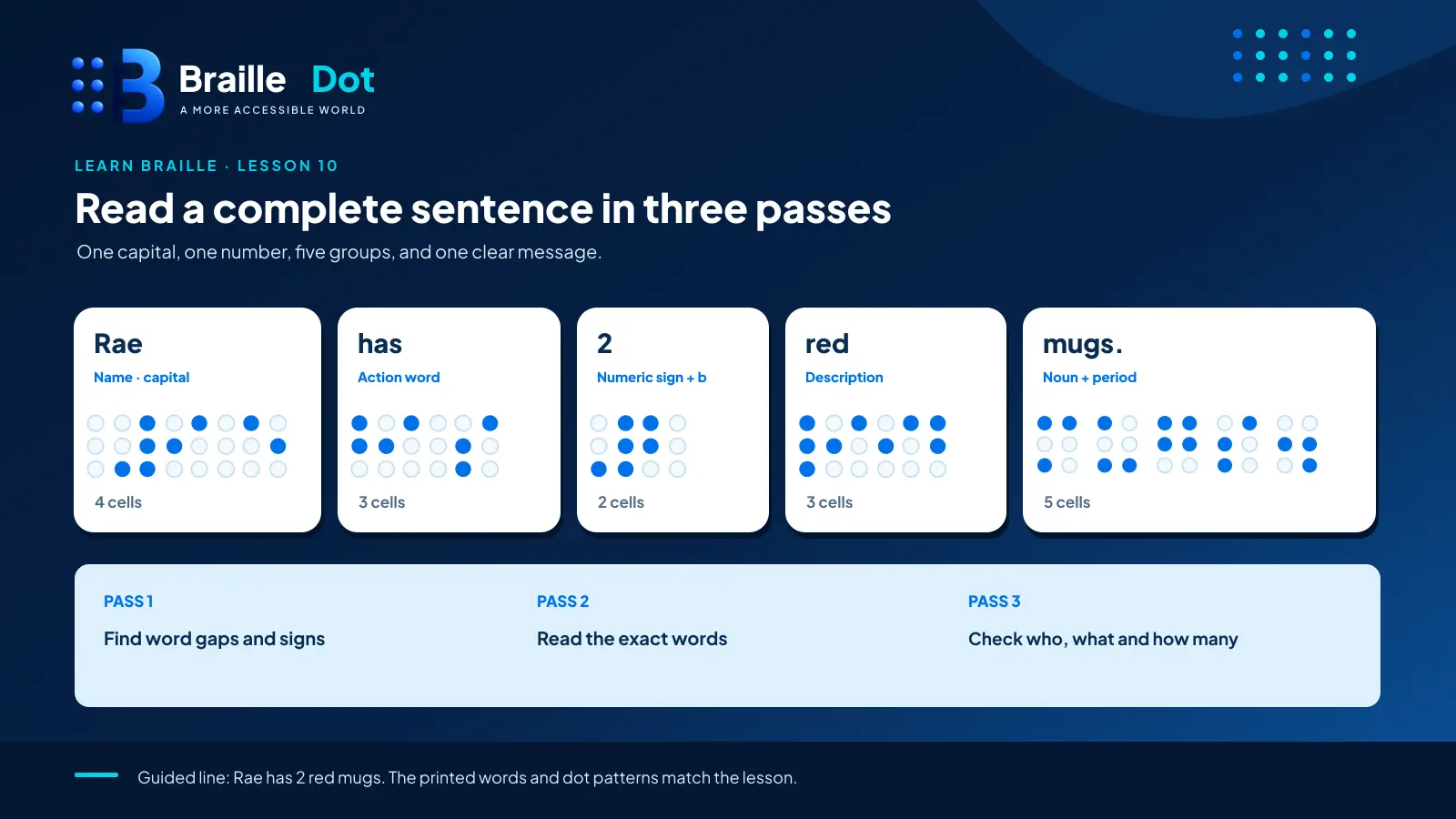
⠠⠗⠁⠑ ⠓⠁⠎ ⠼⠃ ⠗⠑⠙ ⠍⠥⠛⠎⠲
Pass 1: Locate the groups. There are five word/number groups. The first begins with a capital indicator, the third begins with a numeric indicator, and the last ends with a period.
Pass 2: Recover the exact words. Read the cells in each group without jumping ahead: Rae / has / 2 / red / mugs.
Pass 3: Understand the statement. The sentence is Rae has 2 red mugs. The person is Rae, the quantity is two, and the things are red mugs.
The third pass matters. If someone asks, “What color are the mugs?” you should be able to answer red without decoding the entire line again.
Recognize the sentence’s job
Now read:
⠠⠉⠁⠝ ⠠⠥⠍⠁ ⠗⠥⠝⠦
The first capital tells you a sentence has begun. The second marks the name Uma. The last cell is a question mark. Together the print reading is Can Uma run?
The sentence is asking something; it is not announcing that Uma ran. Punctuation gives a clue about the writer’s purpose, while the words give the content of the question.
A quiet reading routine
When practicing on paper or a Braille display, move along the line without guessing the next word from its first letter. Pause briefly at each blank word gap. At the end, take a moment to ask yourself:
- Who or what was the sentence about?
- Did it state something, ask a question, or give an instruction?
- Was there an important quantity, description or action?
For tactile practice, use a suitable embossed line and tracking technique. Reading dot patterns on a screen can reinforce symbol recognition, while raised-dot reading adds the finger-based skill that printed examples alone do not provide. Give yourself enough time to check unfamiliar cells.
Read first, then answer from memory
For each line below, write the whole print sentence before answering its comprehension question. The lines are all new and are not repeated from the guided examples.
Line A
⠠⠙⠁⠝ ⠓⠁⠎ ⠼⠉ ⠉⠥⠏⠎⠲
- Print sentence: __________________
- Question: How many cups are there? __________________
Line B
⠠⠍⠊⠁ ⠇⠊⠅⠑⠎ ⠃⠇⠥⠑ ⠓⠁⠞⠎⠲
- Print sentence: __________________
- Question: What color are the hats? __________________
Line C
⠠⠺⠊⠇⠇ ⠠⠍⠁⠭ ⠗⠑⠁⠙⠦
- Print sentence: __________________
- Question: What action is being asked about? __________________
Line D
⠠⠞⠓⠑ ⠙⠕⠛ ⠎⠇⠑⠑⠏⠎⠲
- Print sentence: __________________
- Question: Who is sleeping? __________________
Line E
⠠⠽⠑⠎⠂ ⠞⠓⠑ ⠃⠥⠎ ⠊⠎ ⠇⠁⠞⠑⠲
- Print sentence: __________________
- Question: What do we learn about the bus? __________________
Line F
⠠⠎⠞⠕⠏ ⠁⠞ ⠞⠓⠑ ⠏⠁⠗⠅⠖
- Print sentence: __________________
- Question: Is this a statement, question or instruction? __________________
Reveal the six readings and meaning checks
A. Dan has 3 cups. There are 3 cups. The numeric indicator ⠼ makes ⠉ represent the digit 3.
B. Mia likes blue hats. The hats are blue. The capital indicator belongs to Mia.
C. Will Max read? The action is reading. The final ⠦ marks a question.
D. The dog sleeps. The dog sleeps. Do not substitute a more familiar word for the printed subject.
E. Yes, the bus is late. The bus is late. The comma follows Yes directly.
F. Stop at the park! This is an instruction. The exclamation mark gives it emphasis.
If you identified all the cells but answered the question incorrectly, practice recalling the meaning after reading. If the meaning was correct but your transcription omitted a capital or punctuation mark, practice exact transcription as a separate skill.
Now reverse the direction: write two sentences
You have been reading Braille into print. To check how securely you understand the signs, turn two new printed sentences into Braille:
- Eva has 5 maps.
- Can you jump?
Both use material you have already learned. Preserve the first capital, the number indicator where required, all spaces and the final mark.
Reveal the two written sentences
- Eva has 5 maps. — ⠠⠑⠧⠁ ⠓⠁⠎ ⠼⠑ ⠍⠁⠏⠎⠲
- Can you jump? — ⠠⠉⠁⠝ ⠽⠕⠥ ⠚⠥⠍⠏⠦
Check accuracy before trying to read faster
Take one line you missed and separate the errors into three categories: symbol recognition (a letter, number or punctuation sign), word boundary (an overlooked or misplaced space), or meaning (an inaccurate answer despite correct decoding). Fixing the particular error is more effective than repeatedly rereading the whole page without noticing what went wrong.
For an additional independent set, choose a short original sentence and use the BrailleDot translator to prepare the Braille line. Keep the print hidden until you have completed both transcription and a meaning question. You are ready for the next kind of practice when you can recover not just the words, but the message.
Further learning: Perkins School for the Blind, How the Braille Alphabet Works.
Written by Marcus Wren.