Lesson 12: Uncontracted Braille Practice Test
Watch Lesson 12: Uncontracted Braille Practice Test
Watch the guided demonstration, pause to practise, then continue with the written lesson and exercises below.
Here is your first chance to use the course skills without a worked example beside each question. There are 25 items. Some begin with Braille and ask for print; others start with print or dot keys and ask you to produce Braille. All are drawn from the material taught in Lessons 1–11, including the six-key practice in Lesson 11.
This is a learning checkpoint, not a professional Braille certification or a test of contracted literary Braille. The purpose is to find out what you can do independently and which specific skill would benefit from another practice session.
How to take the test
- Choose a quiet time and try all 25 questions before opening any answer section.
- Keep your alphabet chart closed for the first attempt. If you need it, mark the question for review rather than hiding that help from yourself.
- For reading tasks, preserve capitalization, punctuation and word spaces when they are shown.
- For writing tasks, use uncontracted UEB as taught in this course.
- Give yourself one point for each fully correct answer. Partial answers are useful notes, but do not count them as complete.
You can write answers in a notebook or use the companion worksheet after its accessible production version is available. A timer is optional; speed is not what this checkpoint measures.
Part A — Read five lowercase words (5 points)
Write the print word for each Braille sequence:
- ⠏⠇⠥⠍ = __________
- ⠋⠗⠑⠑ = __________
- ⠙⠗⠊⠋⠞ = __________
- ⠃⠇⠕⠉⠅ = __________
- ⠎⠓⠁⠗⠅ = __________
Part A answer key
- plum
- free
- drift
- block
- shark
Check the exact letter sequence. If your answer was a different real word, identify the first cell you substituted.
Part B — Build five new words or phrases (5 points)
Write these in lowercase, uncontracted Braille. Preserve a single word gap between separate words.
- glad = __________
- fresh soup = __________
- bright = __________
- small town = __________
- open gate = __________
Part B answer key
- glad — ⠛⠇⠁⠙
- fresh soup — ⠋⠗⠑⠎⠓ ⠎⠕⠥⠏
- bright — ⠃⠗⠊⠛⠓⠞
- small town — ⠎⠍⠁⠇⠇ ⠞⠕⠺⠝
- open gate — ⠕⠏⠑⠝ ⠛⠁⠞⠑
Count the cells as well as checking their dots. In questions 7, 9 and 10, a missing or extra word gap changes the answer.
Part C — Capitals, initials and numbers (5 points)
Read questions 11–14 into print exactly as shown. Write question 15 in Braille.
- ⠠⠇⠑⠝⠁ = __________
- ⠠⠞ (a standalone capital initial in this uncontracted practice test) = __________
- ⠠⠠⠃⠇⠥⠑ = __________
- ⠼⠋⠚⠃ = __________
- Write the name Sophie in Braille: __________
Part C answer key
- Lena — one capital letter indicator.
- T — the capital indicator precedes the letter. An additional grade 1 indicator is not normally needed in material entirely written in uncontracted Braille.
- BLUE — two capital indicators mark the whole word.
- 602 — one numeric indicator introduces all three digits; ⠚ represents zero here.
- Sophie — ⠠⠎⠕⠏⠓⠊⠑
If you missed question 12, revisit how the grade 1 indicator depends on whether contractions are permitted. If you read 602 as letters, revisit the number indicator.
Part D — Read and write sentences (5 points)
For 16–18, write the full sentence in print, including its punctuation. For 19–20, convert print into Braille.
- ⠠⠉⠁⠇⠍ ⠙⠕⠺⠝⠖ = __________
- ⠠⠉⠁⠝ ⠠⠵⠕⠑ ⠎⠊⠝⠛⠦ = __________
- ⠠⠁⠍⠽ ⠓⠁⠎ ⠼⠙ ⠏⠑⠁⠗⠎⠲ = __________
- Ben is here. = __________
- Max’s box is red. = __________
Part D answer key
- Calm down! — the last sign is an exclamation mark.
- Can Zoe sing? — both opening capitals matter, and the line ends in a question mark.
- Amy has 4 pears. — ⠼⠙ is the digit 4.
- Ben is here. — ⠠⠃⠑⠝ ⠊⠎ ⠓⠑⠗⠑⠲
- Max’s box is red. — ⠠⠍⠁⠭⠄⠎ ⠃⠕⠭ ⠊⠎ ⠗⠑⠙⠲
For writing questions, correct letters alone are not sufficient: the capitals, apostrophe, gaps and periods are part of the answer.
Part E — Six-key dot knowledge (5 points)
Use the practice QWERTY layout from Lesson 11: F=1, D=2, S=3, J=4, K=5, L=6. Read each group of keys as one simultaneous press.
- F + J + K makes which lowercase letter? __________
- D + S + J + K makes which lowercase letter? __________
- F + D + S + L makes which lowercase letter? __________
- At the end of an unquoted question, D + S + L produces which punctuation mark? __________
- Which single key makes the apostrophe cell ⠄? __________
Part E answer key
- d — dots 1-4-5 → ⠙
- t — dots 2-3-4-5 → ⠞
- v — dots 1-2-3-6 → ⠧
- Question mark — dots 2-3-6 → ⠦
- S — dot 3 → ⠄
The first four answers are patterns made by holding those keys simultaneously. If your answer was the sequence of ordinary keyboard letters, revisit how six-key entry forms one cell per keypress.
Record your result and choose what to practice
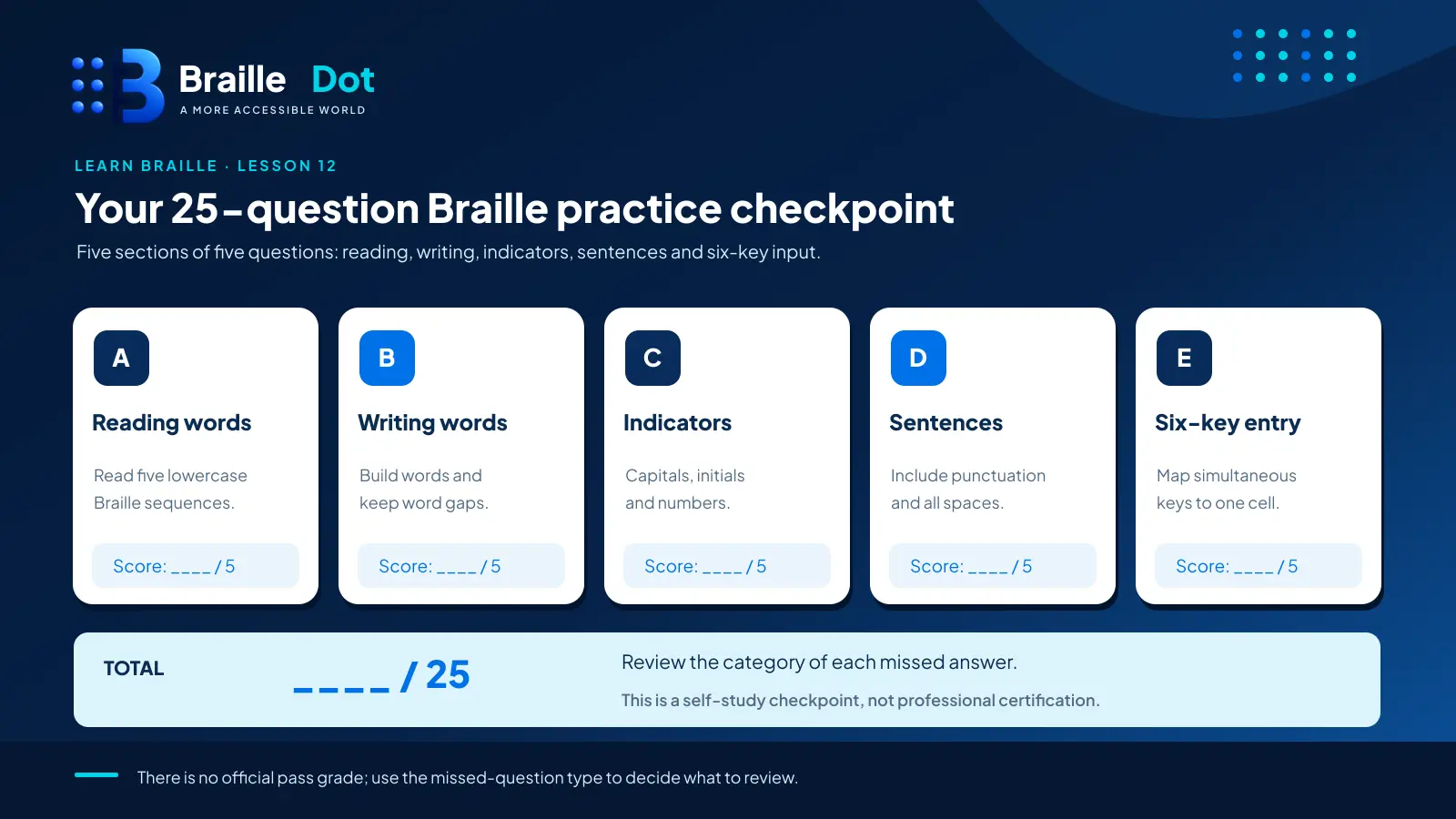
| Part | Correct answers | Your score |
|---|---|---|
| A — Reading lowercase words | 5 | ___ / 5 |
| B — Writing words and spaces | 5 | ___ / 5 |
| C — Capitals, initials and numbers | 5 | ___ / 5 |
| D — Sentences and punctuation | 5 | ___ / 5 |
| E — Six-key dot entry | 5 | ___ / 5 |
| Total | 25 | ___ / 25 |
There is no official pass grade for this practice activity. As a self-study guide, if you answered 23–25 correctly without help, try the next module while continuing to revisit unfamiliar patterns. With 18–22, review the part where you lost the most points and retry that skill with new examples. If you scored 17 or fewer, spend another session on the relevant lessons before attempting a fresh test. These are practical study suggestions, not standardized proficiency levels.
If you missed a symbol, state its correct dot numbers. If you missed a sentence, decide whether the error was in reading, punctuation or meaning. If you missed a six-key question, return to the physical dot mapping. The kind of mistake matters more than the total score.
You can create extra original material with the BrailleDot translator, then keep the answer hidden until you have made your own attempt. The next module introduces selected contractions, so this checkpoint gives you a reliable foundation in uncontracted Braille first.
Reference for ongoing study: International Council on English Braille, Rules of Unified English Braille.
Written by Marcus Wren.