
Lesson 2: Learn Braille Letters A–J
Watch Lesson 2: Learn Braille Letters A–J
Watch the guided demonstration, pause to practise, then continue with the written lesson and exercises below.
The first ten Braille letters are a good place to begin because they follow a visible pattern: every letter from a through j uses dots from the upper two rows of the six-dot cell. None uses dot 3 or dot 6.
You already learned the numbering in Lesson 1: the six-dot cell. Here, you will attach letters to those positions, read a few short words, and begin recognizing cells without counting every dot.
Your first ten letters
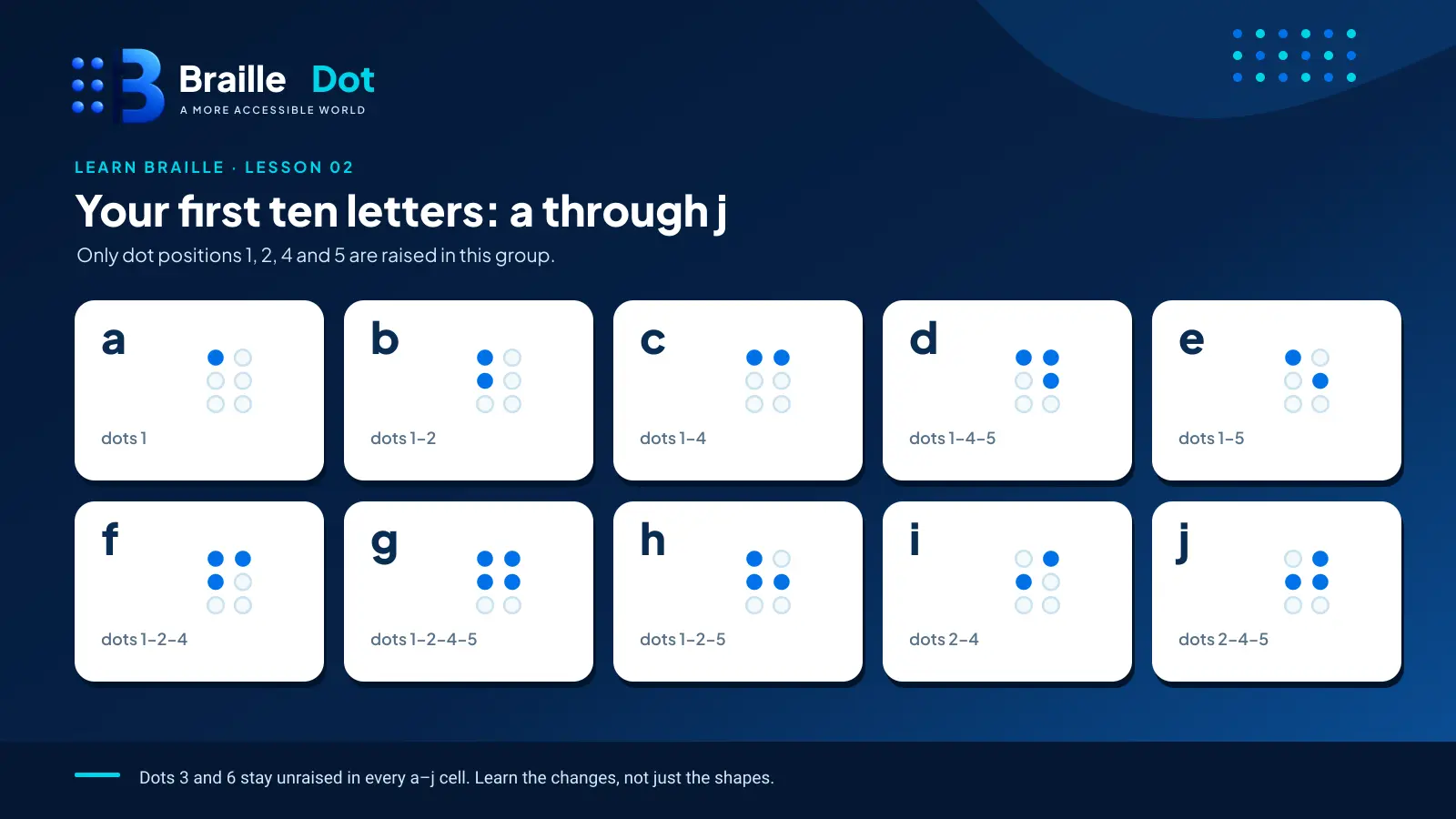
Read the chart slowly, comparing the Unicode Braille cell with its dot numbers.
| Print letter | Braille | Raised dots |
|---|---|---|
| a | ⠁ | 1 |
| b | ⠃ | 1-2 |
| c | ⠉ | 1-4 |
| d | ⠙ | 1-4-5 |
| e | ⠑ | 1-5 |
| f | ⠋ | 1-2-4 |
| g | ⠛ | 1-2-4-5 |
| h | ⠓ | 1-2-5 |
| i | ⠊ | 2-4 |
| j | ⠚ | 2-4-5 |
Find the same three positions repeatedly: dot 1, dot 2, and dot 4. Then look for dot 5. Those are the only four positions used in these ten letters. This reduces the number of places you need to check while learning them.
Notice these pairs:
- a (⠁) and b (⠃) differ by dot 2.
- c (⠉) and d (⠙) differ by dot 5.
- f (⠋) and g (⠛) differ by dot 5.
- i (⠊) and j (⠚) differ by dot 5.
Instead of memorizing ten unrelated pictures, practice noticing the one dot that changes.
Read a letter without starting from the beginning
When you see ⠓, you could count dots 1, 2 and 5 every time and then consult the chart. That works at first, but it is slow. A better practice sequence is:
- Identify the cell once using the dot numbers: ⠓ = 1-2-5 = h.
- Look away from the chart and return to ⠓ a moment later.
- Say or type h before recounting the dots.
- Check the chart only when necessary.
Do this with ⠉, ⠓, ⠊, ⠋ in a different order each time. The goal is recognition rather than always reciting the alphabet from a to j.
A small group to compare
Look at ⠉ ⠙ ⠑. All three include dot 1 and at least one dot on the right:
- ⠉, c: dot 4 alone on the right.
- ⠙, d: dots 4 and 5 on the right.
- ⠑, e: dot 5 alone on the right.
This is an effective trio for practicing differences at the top and middle of a cell.
Your first Braille words
You can already read genuine English words using only a–j. In this exercise we write them uncontracted, with one letter cell after another. There is no capitalization or punctuation yet.
| Uncontracted Braille | Read it cell by cell | |
|---|---|---|
| cab | ⠉⠁⠃ | c + a + b |
| face | ⠋⠁⠉⠑ | f + a + c + e |
| hide | ⠓⠊⠙⠑ | h + i + d + e |
| bead | ⠃⠑⠁⠙ | b + e + a + d |
At this stage, do not worry about reading quickly. Follow each cell from left to right, identify its letter, then join the sounds into a word.
Take face as an example. The first cell ⠋ has dots 1-2-4, so it is f. The second cell ⠁ is a. The third ⠉ is c, and the fourth ⠑ is e. Put the letters together: face.
Reading practice: write the word
Try these without looking at the word table. You may use the a–j letter chart above.
- ⠃⠁⠙ = ______
- ⠁⠛⠑ = ______
- ⠉⠁⠛⠑ = ______
- ⠚⠊⠛ = ______
- ⠋⠊⠛ = ______
Reveal the reading answers
- bad
- age
- cage
- jig
- fig
Writing practice: convert the word into cells
For each print word, first write its letters separately. Then replace each letter with a Braille cell.
| Word | Your Braille |
|---|---|
| dad | ______ |
| jade | ______ |
| badge | ______ |
| each | ______ |
Reveal the writing answers
| Word | Correct uncontracted Braille |
|---|---|
| dad | ⠙⠁⠙ |
| jade | ⠚⠁⠙⠑ |
| badge | ⠃⠁⠙⠛⠑ |
| each | ⠑⠁⠉⠓ |
If a word looks wrong, check the first cell where your answer differs. It is more useful to identify the single letter that caused the mistake than to start the whole word again.
A quick recognition check
Without the chart, name these cells in order:
⠚ ⠉ ⠓ ⠁ ⠛ ⠊ ⠙ ⠋ ⠑ ⠃
Check the ten letters
j, c, h, a, g, i, d, f, e, b.
You are ready to move on when you can identify most of these immediately and correct the rest by checking their dot positions. Full speed will come with later reading practice.
If you’d like to compare an uncontracted word you built with digital output, enter it into the BrailleDot translator with Grade 1 selected. In Lesson 3, you will discover why the next ten letters are particularly easy to learn: each builds on a letter you already know by adding one dot.
Reference: ICEB, Rules of Unified English Braille, Third Edition.
Written by Marcus Wren.