Lesson 16: Beginner Braille Reading Challenge
Watch Lesson 16: Beginner Braille Reading Challenge
Watch the guided demonstration, pause to practise, then continue with the written lesson and exercises below.
You can identify the alphabet. You can read numbers and punctuation. You have learned a first set of contractions, letter-group signs, and shortforms. Now put those skills together without stopping at each individual cell.
The challenge contains 20 points. Its heart is three short messages. You will read the message, understand its meaning, and identify a relevant Braille detail. The later questions check whether you can recognize a contraction in context and write unfamiliar phrases independently.
Complete the shortform lesson and its independent practice before beginning. This is a beginner learning challenge based on the selected UEB signs taught in Lessons 1–15, not a comprehensive contracted-Braille examination or a literacy certification.
Before opening the first message
- Read from left to right. Preserve spaces, capitals and punctuation when you transcribe.
- Use only the contraction sets introduced in Lessons 13–15. Words outside those sets may appear letter by letter even if full UEB has other contractions for them.
- Write your answers before revealing each answer section. If a sign is unfamiliar, record it as a learning gap and continue.
- Award one point per correct numbered answer. There are no partial points or time requirements.
If you read by touch, use accessible embossed or refreshable-display material prepared for this lesson. On a screen, Unicode Braille helps inspect patterns but cannot replace tactile reading practice.
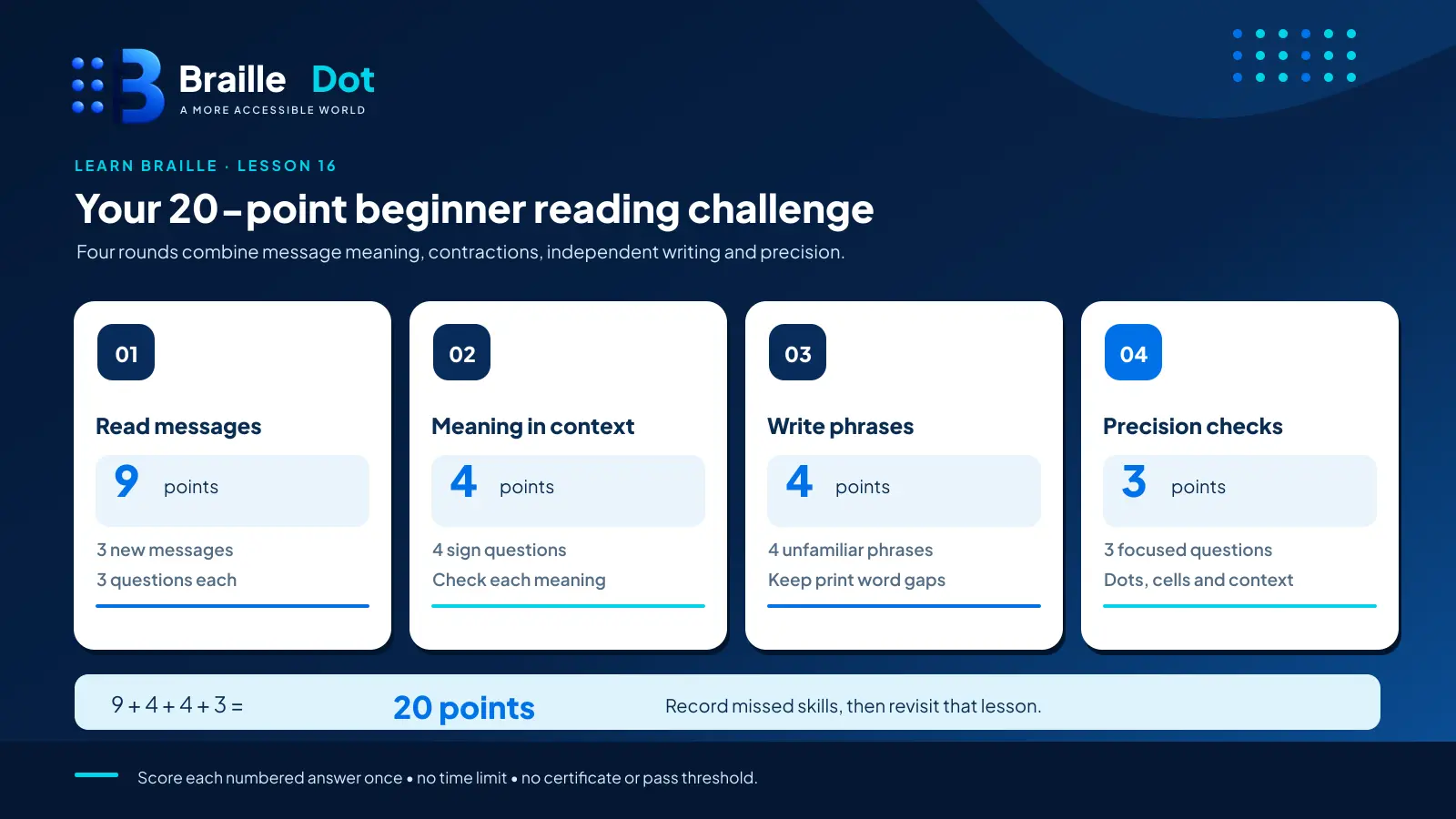
Round 1 — Three messages, nine questions (9 points)
Each message gets three questions: an accurate print transcription, a meaning question, and a code-awareness question. These are new passages, not repeats of worked examples from earlier lessons.
Message A
⠠⠎⠁⠍ ⠯ ⠠⠝⠕⠗⠁ ⠁⠗⠑ ⠁⠞ ⠮ ⠩⠕⠏⠲
- Transcribe the entire sentence into print, including the final punctuation.
- Where are the two people?
- Which one-cell sign carries the complete word and?
Message B
⠠⠍⠽ ⠋⠗ ⠓⠁⠎ ⠁ ⠍⠁⠏ ⠷ ⠮ ⠏⠁⠹⠲
- Transcribe the entire sentence.
- What does the friend have?
- In the final word, what two print letters does ⠹ represent?
Message C
⠠⠺⠑ ⠺⠊⠇⠇ ⠍⠑⠑⠞ ⠾ ⠠⠵⠕⠑ ⠞⠙⠲
- Transcribe the entire sentence.
- Who will be met?
- When will the meeting happen?
Round 1 — Answers with reasoning
- Sam and Nora are at the shop. — ⠯ gives and, ⠮ gives the, and ⠩ in shop gives sh.
- At the shop. — The place is at the end of the sentence.
- ⠯ — one cell for and.
- My friend has a map of the path. — ⠋⠗ is the shortform friend, ⠷ is of, and ⠮ is the.
- A map. — It belongs to the friend in this sentence.
- th — ⠏⠁⠹ reads p-a-th, forming path.
- We will meet with Zoe today. — ⠾ is with, and ⠞⠙ is the shortform today.
- Zoe.
- Today. — Read ⠞⠙ as a shortform, not as two isolated letters.
If you decoded a sentence correctly but missed the meaning question, practice summarizing each line aloud before answering. Accurate cell recognition and reading comprehension are related but different skills.
Round 2 — What does this sign mean here? (4 points)
For each new example, identify the specified sign or read the phrase. Do not assume that a Braille cell always has one meaning wherever it appears.
- In ⠡⠑⠉⠅ (check), what print letter group does ⠡ represent?
- Read ⠿ ⠠⠋⠊⠝⠝ into print.
- What complete word does ⠁⠇ represent as a standalone shortform in contracted UEB?
- In ⠹⠁⠝⠅ (thank), does ⠹ mean the complete word the or the letter group th?
Round 2 — Answers
- ch — the groupsign joins the first two letters of check.
- for Finn — ⠿ is for, followed by the capitalized name.
- also — the shortform uses the letter cells a-l.
- th — it is the groupsign ⠹, not the different cell ⠮ for the word the.
Round 3 — Write four new phrases (4 points)
Convert the print phrases to Braille. Apply the contractions you have learned; otherwise write letters in uncontracted form. Keep a word gap wherever the print has one.
- for the class = __________
- also read braille = __________
- with a friend = __________
- a chip and soup = __________
Round 3 — Checked Braille spellings
- for the class — ⠿ ⠮ ⠉⠇⠁⠎⠎
- also read braille — ⠁⠇ ⠗⠑⠁⠙ ⠃⠗⠇
- with a friend — ⠾ ⠁ ⠋⠗
- a chip and soup — ⠁ ⠡⠊⠏ ⠯ ⠎⠳⠏
Question 17 combines two different skills: ⠡ supplies ch inside chip, while ⠯ supplies the entire word and. ⠳ supplies ou inside soup. The same type of contraction is not being used in every position.
Round 4 — Three precision checks (3 points)
- What raised-dot numbers make the ou groupsign ⠳?
- How many Braille cells are in the contracted shortform ⠋⠗ for friend?
- In a contracted UEB passage, ⠁⠃ standing alone represents which word from Lesson 15?
Round 4 — Precision answers
- Dots 1-2-5-6.
- Two Braille cells, although friend contains six print letters.
- about. In entirely uncontracted Braille, those same cells could simply be the letters a-b; contracted context changes their reading. The grade 1 indicator can distinguish a literal letter sequence when required.
Interpret your result without treating it as a certificate
| Skill tested | Questions | Your score |
|---|---|---|
| Reading complete messages and meaning | 1–9 | ___ / 9 |
| Contraction meaning in context | 10–13 | ___ / 4 |
| Writing controlled contracted phrases | 14–17 | ___ / 4 |
| Dot patterns, cell counts and modes | 18–20 | ___ / 3 |
| Total | 1–20 | ___ / 20 |
The number is for self-review, not a standardized pass or failure. If your sentence reading was correct but the why questions were hard, return to the contraction distinctions in Lessons 13–15. If you recognized signs but lost points on capitalization or spaces, revisit Lessons 5, 7 and 9. If you missed about versus literal a-b, review how grade 1 and contracted context affect interpretation.
Try reading an unfamiliar short passage again after a day rather than immediately repeating the same answer sheet. Use the BrailleDot translator to find extra phrases for independent reading practice, then compare your interpretation. For tactile fluency, continue with supervised or accessible Braille reading materials and, where appropriate, instruction on an embossed page or refreshable display.
You have completed the beginner sequence in this course. You can now practice a selected part of contracted UEB while recognizing that the full code includes many more contractions, placement rules and literacy skills than these sixteen lessons cover.
UEB reference: International Council on English Braille, Rules of Unified English Braille.
Written by Marcus Wren.