Lesson 15: Introduction to Braille Shortform Words
Watch Lesson 15: Introduction to Braille Shortform Words
Watch the guided demonstration, pause to practise, then continue with the written lesson and exercises below.
Here is a word you now know how to spell: braille. In uncontracted Braille, its seven letters use seven cells. In contracted Unified English Braille (UEB), the word has an established three-cell shortform:
braille → ⠃⠗⠇
Read those cells as b-r-l and you can see where the shortform comes from. But the whole sequence represents the word braille when the shortform is permitted, not the literal three-letter word brl.
In Lesson 14, groupsigns replaced particular pairs of letters within words. Shortforms are different: an approved sequence of letter cells represents a longer word. You will learn six that are useful in actual sentences, then practice recognizing their full meanings.
Six shortforms, six whole words
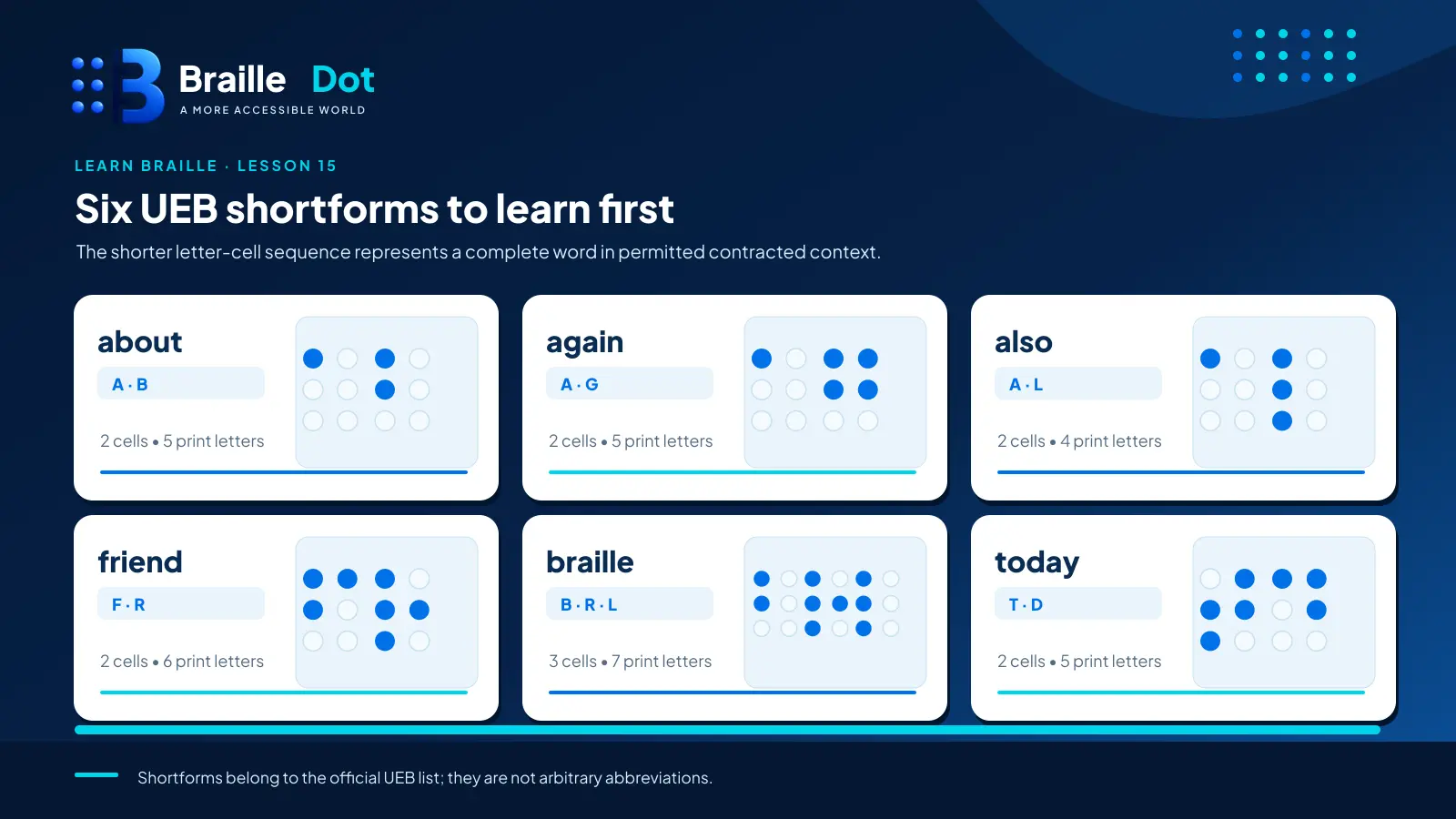
| Printed word | Shortform in contracted UEB | Letter-cell sequence | Full uncontracted spelling |
|---|---|---|---|
| about | ⠁⠃ | a-b | ⠁⠃⠕⠥⠞ |
| again | ⠁⠛ | a-g | ⠁⠛⠁⠊⠝ |
| also | ⠁⠇ | a-l | ⠁⠇⠎⠕ |
| friend | ⠋⠗ | f-r | ⠋⠗⠊⠑⠝⠙ |
| braille | ⠃⠗⠇ | b-r-l | ⠃⠗⠁⠊⠇⠇⠑ |
| today | ⠞⠙ | t-d | ⠞⠕⠙⠁⠽ |
Each mapping comes from the official UEB shortforms list. This is a small starter set, not a claim that these are the only shortforms or that their rules are all identical.
Notice two useful families: ⠁⠃, ⠁⠛, ⠁⠇ all begin with the letter a, while ⠋⠗ and ⠃⠗⠇ begin with the initial letters of the longer words. ⠞⠙ keeps the opening t and the d from today. These are memory aids; the official list, not an invented abbreviation method, determines which shortforms are valid.
Word boundaries change what the same cells mean
In an entirely uncontracted exercise, ⠁⠃ can simply be the letters a and b. In a contracted passage, the same standalone sequence can be the shortform for about.
If the intended text is the literal letters ab in a contracted UEB passage, write ⠰⠁⠃. The grade 1 symbol indicator ⠰ applies to the next Braille symbol. Here, placing it before the letter sequence prevents ab from being mistaken for the shortform about. A single grade 1 symbol indicator does not switch an entire following word or sentence into grade 1 mode. This builds on the capital and grade 1 indicators taught in Lesson 7: the surrounding context and intended text matter.
For our six shortforms, start by learning them as complete, separate words. UEB has further rules for using some shortforms within longer words, including restrictions and a defined shortform list. Do not assume that you can shorten every word merely because it contains the letters ab, fr or brl.
See shortforms in short messages
Read talk about maps:
⠞⠁⠇⠅ ⠁⠃ ⠍⠁⠏⠎
The middle word is about. It is not the letters a-b read aloud.
For try again, write ⠞⠗⠽ ⠁⠛. For read braille today, write ⠗⠑⠁⠙ ⠃⠗⠇ ⠞⠙. Your job is to recover the entire word represented by each shortform, then make sense of the whole phrase.
Capitalization still works. Today at the beginning of a sentence can start with the capital indicator before the shortform: ⠠⠞⠙. The word does not need to be written out letter by letter merely because it starts with a capital.
Read new sentences without expanding letter by letter
These lines use the six shortforms from the table. Other words are written using previously taught letter-by-letter or selected-contraction patterns; they are controlled teaching passages, not fully contracted transcriptions of every available UEB sign.
- ⠠⠍⠁⠭ ⠊⠎ ⠍⠽ ⠋⠗⠲
- ⠠⠺⠑ ⠞⠁⠇⠅ ⠁⠃ ⠎⠏⠕⠗⠞⠲
- ⠠⠇⠑⠕ ⠺⠊⠇⠇ ⠞⠗⠽ ⠁⠛⠲
- ⠠⠍⠊⠁ ⠁⠇ ⠗⠑⠁⠙⠎⠲
Write the complete print sentence for each one, including its period. Then answer: Which line says someone will repeat an attempt?
Read the four answers and comprehension check
- Max is my friend. — ⠋⠗ means the complete word friend.
- We talk about sport. — ⠁⠃ means about.
- Leo will try again. — ⠁⠛ means again.
- Mia also reads. — ⠁⠇ means also.
Comprehension: Line 3 says Leo will try again. The answer depends on understanding again, not merely spotting its two cells.
Write four unfamiliar phrases
Apply the shortforms where their full words occur. You may also use the and wordsign from Lesson 13. Otherwise spell the remaining words letter by letter so the practice stays within the taught set.
| Phrase | Your Braille |
|---|---|
| A. braille is useful | __________ |
| B. see you today | __________ |
| C. a friend and a map | __________ |
| D. also try again | __________ |
Reveal the four phrase answers
- A. braille is useful — ⠃⠗⠇ ⠊⠎ ⠥⠎⠑⠋⠥⠇
- B. see you today — ⠎⠑⠑ ⠽⠕⠥ ⠞⠙
- C. a friend and a map — ⠁ ⠋⠗ ⠯ ⠁ ⠍⠁⠏
- D. also try again — ⠁⠇ ⠞⠗⠽ ⠁⠛
Check the word spaces before comparing individual letters. The two cells ⠋⠗ are the complete word friend in C; adding uncontracted letters to that word would defeat this exercise’s purpose.
What a confident answer sounds like
If asked what ⠞⠙ represents here, do not answer simply “t and d.” Say: “They are letter cells used together as the shortform for today in contracted UEB.” You have identified the cells and their function.
For extra practice, make one personal sentence containing a shortform and read it back after a break. You can compare spellings with the BrailleDot translator as a checking aid, but the aim is to recognize the word without looking up every letter. The next lesson brings whole-word contractions, groupsigns, shortforms and earlier punctuation into a connected reading challenge.
UEB source: International Council on English Braille, Rules of Unified English Braille, Section 10.9 and Appendix 1.
Written by Marcus Wren.