
Lesson 5: Write Your First Words in Uncontracted Braille
Watch Lesson 5: Write Your First Braille Words
Watch the guided demonstration, pause to practise, then continue with the written lesson and exercises below.
Writing a Braille word begins with its spelling, not its sound. If you can spell cat, you already know which three letters you need; your job is to place the Braille cell for c beside the cell for a, followed by t. Nothing needs to be guessed from the appearance of the finished word.
In Lesson 4, you completed the lowercase alphabet. Now you will use that alphabet to write whole words, keep the cells in their proper order, and leave the right amount of space between words. These exercises use uncontracted English Braille, where each letter is written separately. Capitals, numbers, punctuation and contractions have their own lessons.
The examples in this lesson show Braille in normal reading order, from left to right, as it appears on a screen or Braille display. Writing with a traditional slate and stylus is different: the dots are punched from right to left on the reverse of the paper. This lesson focuses on forming and checking Braille words, not on that physical writing technique.
Build a word one letter at a time
Start with cat. Read its spelling aloud: c – a – t.
| Step | What you write | Why |
|---|---|---|
| 1 | ⠉ | The first letter is c (dots 1-4). |
| 2 | ⠉⠁ | Add a (dot 1) immediately after c. |
| 3 | ⠉⠁⠞ | Add t (dots 2-3-4-5). The word is complete. |
There is no space between the letters of one word. Each Braille cell still has its own six-dot area; putting the cells next to one another does not merge their dot patterns.
Try the same method with a slightly longer word, swim:
- Spell it: s – w – i – m.
- Convert each letter: ⠎ – ⠺ – ⠊ – ⠍.
- Join the four cells without spaces: ⠎⠺⠊⠍.
The letter w may slow you down. Recall that it has dots 2-4-5-6; it does not follow the same dot-6 sequence as u, v, x, y and z. If you forget a cell, revisit its dot numbers before continuing. This is useful checking, not a reason to start the whole word again.
A word gap is not a letter gap
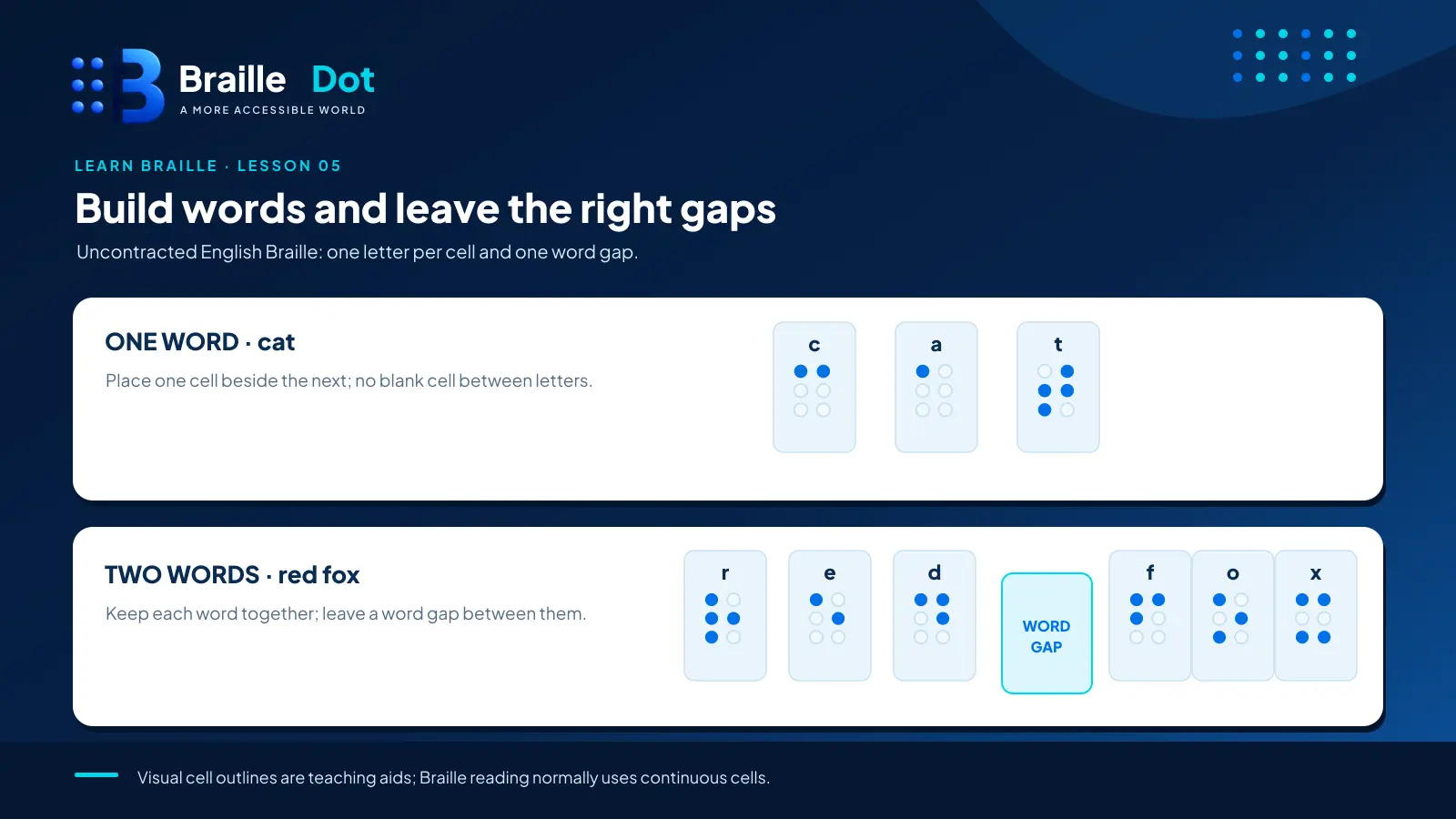
Look at two ordinary English words: red fox. They are written as two groups of Braille cells:
⠗⠑⠙ ⠋⠕⠭
The visible gap is a blank Braille cell between words. In the digital line above, a normal text space represents that gap. By contrast, the three cells in red touch one another in sequence, as do the three cells in fox.
You can see the difference by comparing these two sequences:
| Print meaning | Braille sequence | What changed? |
|---|---|---|
| red fox | ⠗⠑⠙ ⠋⠕⠭ | One word gap separates two words. |
| redfox | ⠗⠑⠙⠋⠕⠭ | No gap, so it reads as one uninterrupted sequence. |
Spaces make the structure of a phrase readable. Do not insert one between every letter, and do not remove the space between separate words.
A dependable way to check your work
Read your answer in the opposite direction from how you built it:
- Point to the first Braille cell and identify its print letter.
- Continue until you reach a blank word gap or the end of the line.
- Check that you obtained the original spelling.
- If the spelling is wrong, compare the first different cell with the alphabet chart. Correct that cell rather than rewriting everything.
For a short phrase, check the word gaps as well as the letters. A correct sequence of letters with the space in the wrong place can produce a different reading.
Guided warm-up: write sun
The word has three letters. Write s, then u, then n in their original order. The cells are ⠎, ⠥, and ⠝.
Reveal the joined word
sun = ⠎⠥⠝. There are three raised-dot cells and no spaces inside the word.
Try writing it once from memory. Then decode what you wrote without looking at the print word.
Independent writing practice
The words below have not appeared as completed examples in this lesson. Use the alphabet you learned in Module 1, but try to recall the cells before consulting a chart.
| Question | Print word or phrase | Your Braille |
|---|---|---|
| 1 | lamp | ______ |
| 2 | drum | ______ |
| 3 | paint | ______ |
| 4 | tiny bird | ______ |
| 5 | green tea | ______ |
For questions 4 and 5, decide where the blank word cell belongs before converting the letters.
Check your five written answers
- lamp — ⠇⠁⠍⠏
- drum — ⠙⠗⠥⠍
- paint — ⠏⠁⠊⠝⠞
- tiny bird — ⠞⠊⠝⠽ ⠃⠊⠗⠙
- green tea — ⠛⠗⠑⠑⠝ ⠞⠑⠁
For each mismatch, identify whether you chose the wrong letter cell, missed a letter, reversed the order, or misplaced a word gap. Those are different errors with different corrections.
Repair a spacing mistake
A learner intended to write blue sky, but produced this uninterrupted sequence:
⠃⠇⠥⠑⠎⠅⠽
Without changing any raised dots, what single edit would make the two words readable?
Show the spacing correction
Insert one blank cell after ⠑, the last letter of blue:
⠃⠇⠥⠑ ⠎⠅⠽
When you are ready to read instead of copy
Choose a new lowercase word, spell it, and write its Braille without looking at the alphabet chart. After a brief pause, read your own cells back into print. If you can recover the intended spelling and the spaces consistently, you are ready to work on recognition without a chart.
The BrailleDot translator can supply additional uncontracted practice lines. Use it to check your attempt after you write, so it does not do the recall work for you. In Lesson 6 the direction changes: you will see Braille first and work out the words.
Code reference: International Council on English Braille, Rules of Unified English Braille, Third Edition (2024).
Written by Marcus Wren.