
Lesson 8: Read and Write Braille Numbers
Watch Lesson 8: Read and Write Braille Numbers
Watch the guided demonstration, pause to practise, then continue with the written lesson and exercises below.
The Braille cell ⠙ means d when you read letters. Place the numeric indicator ⠼ immediately before that same cell, and the pair ⠼⠙ means 4. There is no new dot arrangement to memorize for the digit itself. You have already learned the first ten letter patterns; the indicator changes how you read them.
Numbers are the fourth skill in this module. You began by joining lowercase letters into words, practiced reading without a chart, and added capital indicators in Lesson 7. Now you can recognize digits and write short quantities without confusing numbers with ordinary letters.
The one sign that turns letters into digits
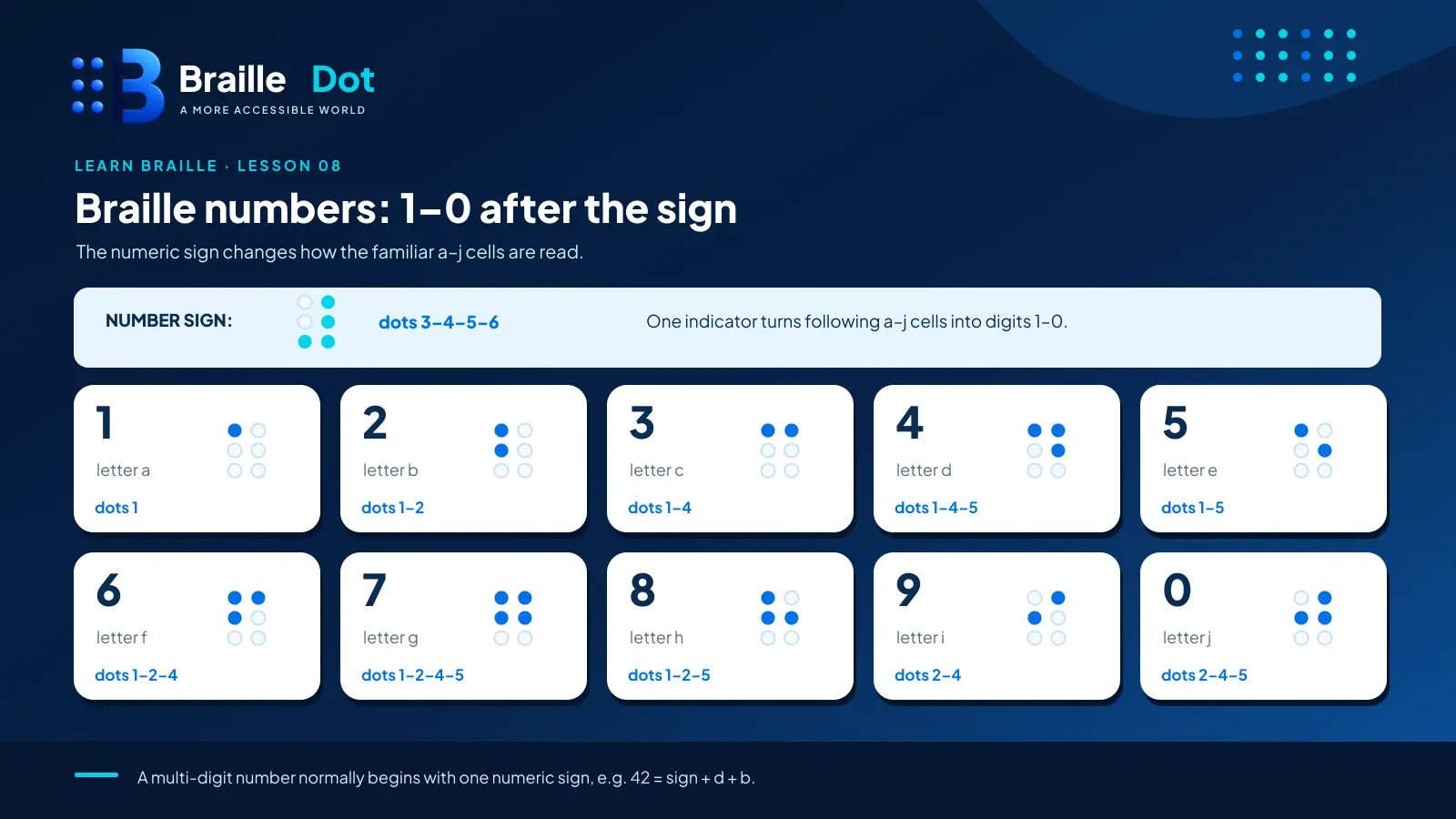
The numeric indicator is ⠼, made from dots 3-4-5-6. Following it, the cells for a through j represent the digits 1 through 0:
| Digit | Braille | Letter-shaped cell after ⠼ | Dots in the digit cell |
|---|---|---|---|
| 1 | ⠼⠁ | a | 1 |
| 2 | ⠼⠃ | b | 1-2 |
| 3 | ⠼⠉ | c | 1-4 |
| 4 | ⠼⠙ | d | 1-4-5 |
| 5 | ⠼⠑ | e | 1-5 |
| 6 | ⠼⠋ | f | 1-2-4 |
| 7 | ⠼⠛ | g | 1-2-4-5 |
| 8 | ⠼⠓ | h | 1-2-5 |
| 9 | ⠼⠊ | i | 2-4 |
| 0 | ⠼⠚ | j | 2-4-5 |
The table shows the full number for each digit. In a longer numeral, you do not repeat the numeric indicator before every digit.
One numeric indicator can introduce several digits
Take the number 42. A print reader sees two digits; a Braille reader sees the numeric sign followed by their two digit cells:
- Start the number with ⠼.
- Add ⠙ for 4.
- Add ⠃ for 2.
You get 42 = ⠼⠙⠃.
For 305, the sequence is ⠼⠉⠚⠑. Read each cell after ⠼ as a digit: 3, then 0, then 5. The zero is a meaningful part of the number; do not leave it out because its cell resembles the letter j.
Notice how different these two strings are:
| Braille | Reading | Reason |
|---|---|---|
| ⠁⠃ | ab | Two letter cells, with no numeric indicator |
| ⠼⠁⠃ | 12 | The same cells are in numeric mode |
A word space ends the numeric run. After a space, subsequent letter cells again have their ordinary letter meanings, unless another indicator appears.
A number inside a short phrase
Read room 12 as two groups: one word and one number.
⠗⠕⠕⠍ ⠼⠁⠃
The space tells you that room has finished. The ⠼ starts the following number, and the next two cells give 1 and 2. You have to recognize both the word space and the numeric indicator to recover the print phrase accurately.
Try 7 = ⠼⠛ as a quick check. Identify dots 3-4-5-6 first; then recall that the cell ⠛, normally g, represents the digit 7 in numeric mode.
Test your reading without the table
Cover the chart before trying these five numerals. Write down every digit in the order given.
| # | Braille | Print number |
|---|---|---|
| 1 | ⠼⠓ | ______ |
| 2 | ⠼⠃⠚ | ______ |
| 3 | ⠼⠑⠛ | ______ |
| 4 | ⠼⠁⠚⠑ | ______ |
| 5 | ⠼⠋⠉⠚ | ______ |
Reveal the number-reading answers
- 8
- 20
- 57
- 105
- 630
For 20, 105 and 630, check that you kept the zero in its original position.
Write the numeral from its printed digits
For each item, place one numeric indicator at the beginning, followed by the appropriate digit cells. These numbers were not used in the worked examples or the previous reading test.
- 19 = ______
- 64 = ______
- 208 = ______
- 900 = ______
Check your four number-writing answers
- 19: ⠼⠁⠊
- 64: ⠼⠋⠙
- 208: ⠼⠃⠚⠓
- 900: ⠼⠊⠚⠚
Find the extra indicator
A student wrote ⠼⠓⠼⠋ while trying to write 86. Which cell is unnecessary?
Show the corrected number
The second ⠼ is unnecessary. One numeric indicator covers the whole numeral, so 86 is ⠼⠓⠋.
Final module checkpoint: letters and numbers together
Read each line in print without using the chart.
- ⠃⠕⠭ ⠼⠃⠙
- ⠠⠝⠕⠗⠁ ⠼⠁⠋
The second line also asks you to remember a capital letter from Lesson 7.
Reveal the two mixed-skill readings
- box 24
- Nora 16
If you recognized the word but misread the digits, inspect ⠼ first. If the digits were correct but the name’s case was wrong, look for ⠠.
You have now written and read lowercase words, noticed capitals, and decoded numerals in simple phrases. In the next module, punctuation will let you move from these fragments toward complete sentences. The BrailleDot translator can give you further short lines to check, provided you attempt the reading before revealing the answer.
Rules reference: Braille Authority of North America, Braille Signage: Numbers, numeric indicator and digit chart.
Written by Marcus Wren.