
Lesson 3: Learn Braille Letters K–T
Watch Lesson 3: Learn Braille Letters K–T
Watch the guided demonstration, pause to practise, then continue with the written lesson and exercises below.
You already know almost everything needed to learn the next ten Braille letters. Take a (⠁) and add dot 3. You get k (⠅). Take b (⠃), add dot 3, and you get l (⠇).
This same change works all the way through the second group, from k to t. Instead of memorizing ten new shapes independently, you can use what you learned in Lesson 2: letters a–j and look for the new lower-left dot.
The dot-3 pattern
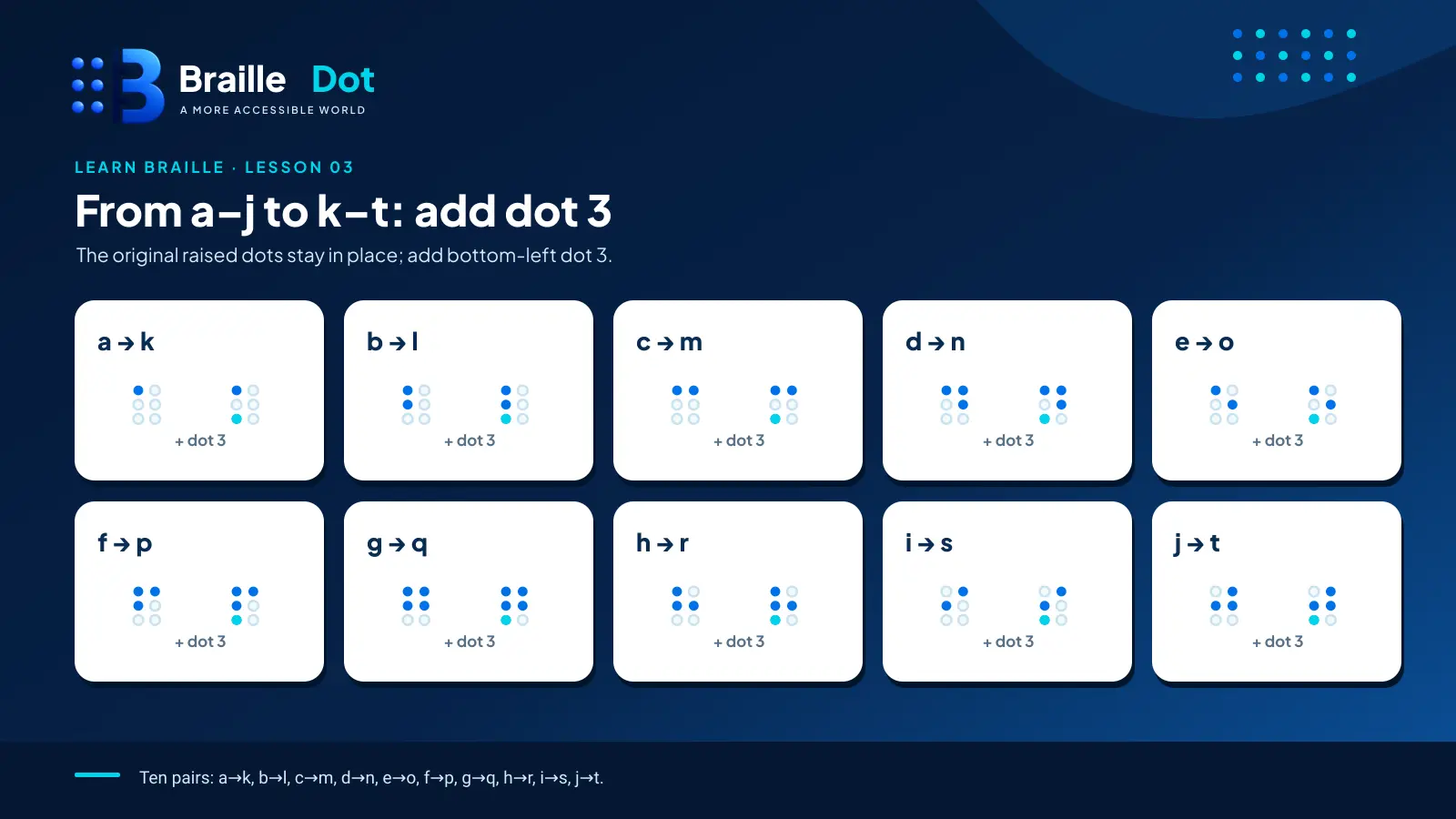
Dot 3 is the bottom-left position of the six-dot cell. Here are the complete pairings.
| Earlier letter | Add dot 3 | New letter | New dots |
|---|---|---|---|
| a ⠁ | +3 | k ⠅ | 1-3 |
| b ⠃ | +3 | l ⠇ | 1-2-3 |
| c ⠉ | +3 | m ⠍ | 1-3-4 |
| d ⠙ | +3 | n ⠝ | 1-3-4-5 |
| e ⠑ | +3 | o ⠕ | 1-3-5 |
| f ⠋ | +3 | p ⠏ | 1-2-3-4 |
| g ⠛ | +3 | q ⠟ | 1-2-3-4-5 |
| h ⠓ | +3 | r ⠗ | 1-2-3-5 |
| i ⠊ | +3 | s ⠎ | 2-3-4 |
| j ⠚ | +3 | t ⠞ | 2-3-4-5 |
Notice that the original letter’s raised dots remain in place. Nothing shifts upward or sideways. The second group simply adds dot 3.
Three comparisons worth practicing
m ⠍ and n ⠝. Both have dots 1-3-4. Only n adds dot 5.
p ⠏ and q ⠟. Both have dots 1-2-3-4. Only q adds dot 5.
s ⠎ and t ⠞. Both have dots 2-3-4. Only t adds dot 5.
These pairs can look similar when you first read them. Rather than tracing the entire cell again, check whether dot 5 is raised.
Read words using letters a–t
You now have twenty letters available. Read the following words from left to right. The plus signs in the Breakdown column separate the print letters for teaching; they are not part of the word.
| Print word | Uncontracted Braille | Breakdown |
|---|---|---|
| milk | ⠍⠊⠇⠅ | m + i + l + k |
| star | ⠎⠞⠁⠗ | s + t + a + r |
| moon | ⠍⠕⠕⠝ | m + o + o + n |
| train | ⠞⠗⠁⠊⠝ | t + r + a + i + n |
| stop | ⠎⠞⠕⠏ | s + t + o + p |
Read star twice. The first time, identify all four letters. The second time, try to recognize st as two successive letters without stopping to consult the chart. You are still reading uncontracted Braille; noticing a familiar pair is a reading habit, not a contraction rule.
The five examples above use only the letters you’ve learned. That is intentional: you can solve them without needing capitals, punctuation, numbers, or any of the remaining six letters.
Spot the single wrong cell
These three lines are supposed to represent familiar words, but one cell in each line has been replaced. Find the incorrect position and supply the right cell.
| Intended word | Given Braille | Cell to correct |
|---|---|---|
| line | ⠇⠊⠍⠑ | ______ |
| pest | ⠏⠑⠎⠎ | ______ |
| tent | ⠞⠑⠇⠞ | ______ |
Check the corrections
- line: Replace the third cell ⠍ (m) with ⠝ (n). Correct: ⠇⠊⠝⠑.
- pest: Replace the last cell ⠎ (s) with ⠞ (t). Correct: ⠏⠑⠎⠞.
- tent: Replace the third cell ⠇ (l) with ⠝ (n). Correct: ⠞⠑⠝⠞.
The first two mistakes differ by dot 5; the third requires checking several dot positions. Being able to locate the error matters more than simply memorizing the correct word.
Independent practice: translate both ways
Read these three Braille words
- ⠗⠊⠝⠛ = ______
- ⠇⠊⠛⠓⠞ = ______
- ⠏⠗⠊⠝⠞ = ______
Write these three print words in Braille
- ink = ______
- plant = ______
- horse = ______
For the writing questions, it can help to write the letter sequence before converting: p-l-a-n-t. Then replace one letter at a time. Do not insert spaces within the word.
Reveal all six practice answers
- ring
- light
- ink = ⠊⠝⠅
- plant = ⠏⠇⠁⠝⠞
- horse = ⠓⠕⠗⠎⠑
Test the underlying pattern
This final task checks whether you understand how the two letter groups relate, rather than recalling only a chart.
- What letter do you make by adding dot 3 to c (⠉)?
- Remove dot 3 from r (⠗). Which letter remains?
- Which of these two is t: ⠎ or ⠞?
- Can you identify the dot numbers for q (⠟)?
Show pattern-test answers
- m (⠍).
- h (⠓).
- ⠞, dots 2-3-4-5.
- 1-2-3-4-5.
Twenty letters are now within reach. If you can correctly decode short words and explain the dot-3 relationship, begin Lesson 4. There, u, v, x, y and z extend another earlier group by one dot, while w follows its own pattern.
The BrailleDot translator can give you additional Grade 1 words to practice. Keep your first attempts short enough that you can check each letter yourself.
Code reference: ICEB, Rules of Unified English Braille, Third Edition (2024).
Written by Marcus Wren.