Lesson 6: Read Short Braille Words Without an Alphabet Chart
Watch Lesson 6: Read Braille Words Without a Chart
Watch the guided demonstration, pause to practise, then continue with the written lesson and exercises below.
Turn your alphabet chart face down. Read this first line slowly:
⠋⠊⠎⠓
You may recognize the first and last cells immediately and need a moment for the middle pair. That is fine. The letters are f – i – s – h, giving fish. The important change from writing your first Braille words in Lesson 5 is that you are now retrieving letters from the cells, without being shown the print word first.
This lesson builds visual recognition of uncontracted lowercase Braille as displayed on a screen. If you are learning tactile reading, work through the same sequence with appropriate raised-dot material as well; a screen pattern does not provide the physical feedback of an embossed cell.
Find the word without guessing the outline
Another line reads ⠗⠕⠉⠅.
Start at the left. The first cell is r. The next is o. Continue with c and k: rock.
It can be tempting to glance at the whole group and guess a familiar English word of the same length. Resist that habit during training. Correct reading requires recognizing the actual cells in order. A guess such as rack would be wrong here because the second cell is ⠕ (o), not ⠁ (a).
Use this three-pass method when a word feels difficult:
- First pass: name each letter you recognize, leaving a temporary blank for uncertain cells.
- Second pass: inspect the dot positions of the uncertain cells; do not restart at letter one if earlier letters were correct.
- Third pass: read the whole word again, preferably without pausing between the letters you already know.
The goal is accurate recognition that gradually becomes more fluent—not a race against a timer.
A small change can change the word
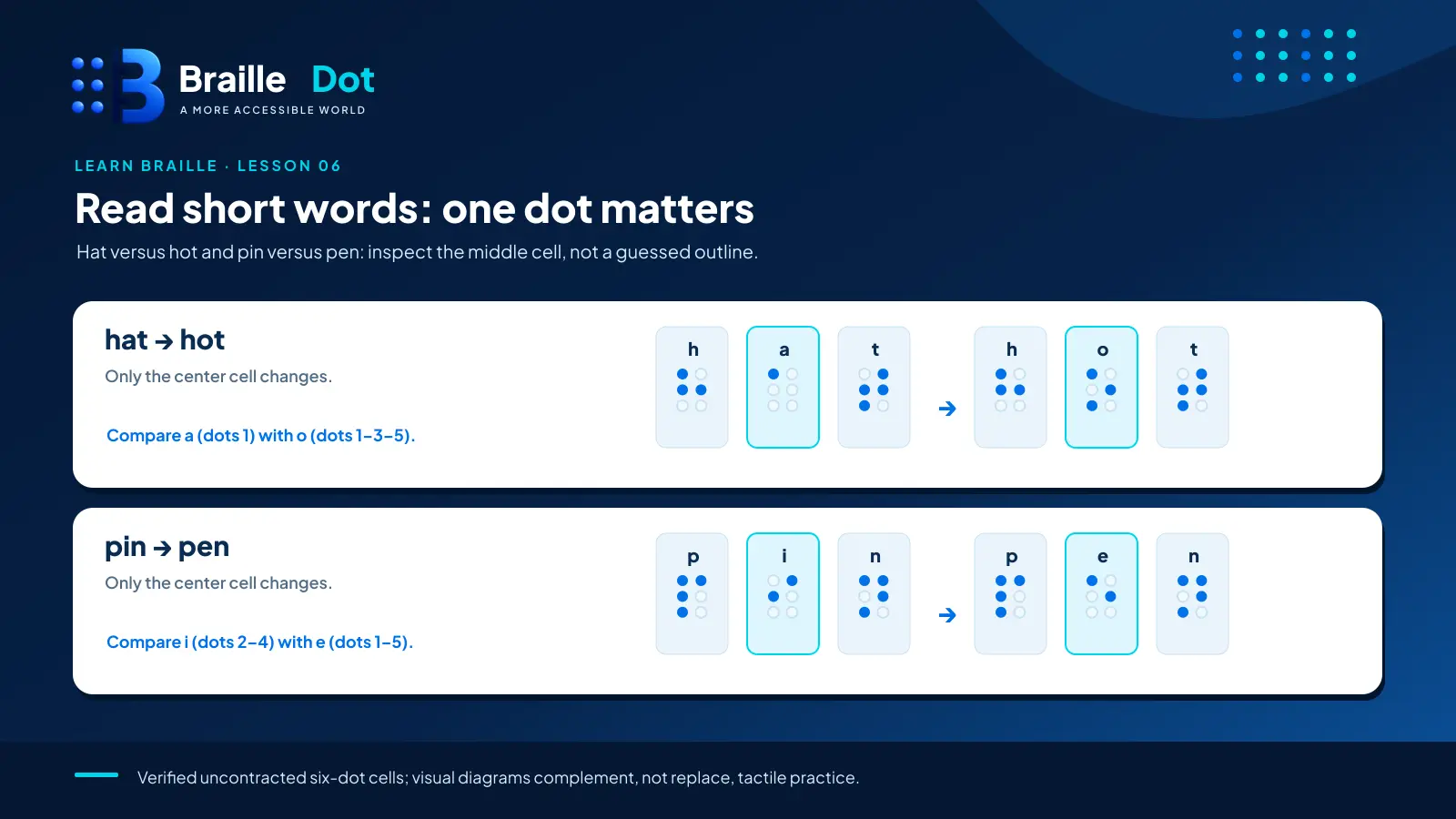
Compare ⠓⠁⠞ and ⠓⠕⠞. The first and last cells are identical; only the middle cell changes.
| Braille | Middle cell | Word |
|---|---|---|
| ⠓⠁⠞ | ⠁ = a | hat |
| ⠓⠕⠞ | ⠕ = o | hot |
Likewise, ⠏⠊⠝ and ⠏⠑⠝ differ only in the middle letter: pin and pen. These comparisons remind you to read the cell that is there, even when your mind expects a familiar word.
If you cannot tell two cells apart, describe their dot numbers. A correct dot description is a reliable way back to the right letter.
First independent round: three-letter words
Cover the explanations above. Decode the following lines without an alphabet chart if possible. Write the print word, not its dot numbers.
| # | Braille | Your reading |
|---|---|---|
| 1 | ⠍⠁⠏ | ______ |
| 2 | ⠗⠥⠝ | ______ |
| 3 | ⠓⠥⠞ | ______ |
| 4 | ⠛⠑⠍ | ______ |
Reveal the first-round answers
- map
- run
- hut
- gem
Do not read the answer list before attempting all four. If one was difficult, return to that word only and name each of its cells.
Second round: keep track of longer sequences
Four- and five-letter words require you to hold more letters in order. Follow each cell in sequence instead of inferring the word from its beginning.
- ⠉⠗⠁⠃ = ______
- ⠞⠕⠁⠎⠞ = ______
- ⠎⠝⠁⠊⠇ = ______
- ⠛⠗⠁⠏⠑ = ______
Reveal the longer-word answers
- crab
- toast
- snail
- grape
Check for dropped or transposed letters. For example, writing grap when you read ⠛⠗⠁⠏⠑ means you missed the final ⠑. No special reading rule is involved—you simply need to continue through the last cell.
A blank cell changes the task
Now try reading two words in one line. Each phrase has exactly one gap between its component words.
A. ⠎⠍⠁⠇⠇ ⠉⠥⠏
B. ⠺⠁⠗⠍ ⠃⠗⠑⠁⠙
Pause at the blank gap, then continue with the next word. You do not need capitals or punctuation for these lines.
Reveal the two phrase answers
- A: small cup
- B: warm bread
What to do when you get stuck
Suppose a new word, ⠎⠏⠁⠗⠅, is hard on your first attempt. You can still make a useful partial reading: s – p – ? – r – k. Instead of looking up the whole word, check the uncertain cell ⠁. It has dot 1 and represents a. The complete reading is spark.
For independent practice, use this order of help:
- Try recognizing the cell from memory.
- If needed, identify the raised dot positions and recall their letter.
- Check a chart only for the cell you cannot resolve.
- Cover the chart and reread the entire line once more.
Each reading should eventually be confirmed cell by cell; guessing the word is not a substitute for identifying its symbols.
A next-day retention check
Return tomorrow and decode three unfamiliar words, such as ⠞⠗⠥⠝⠅, ⠃⠇⠁⠙⠑, and ⠝⠑⠎⠞. Record only whether your first reading was correct and which cell caused hesitation. You can check your answers below, but wait until after making your attempt.
Reveal the next-day words
- ⠞⠗⠥⠝⠅ = trunk
- ⠃⠇⠁⠙⠑ = blade
- ⠝⠑⠎⠞ = nest
When those lines feel manageable, your next new skill is a capital indicator: a separate Braille cell that tells you the following letter is uppercase. Before moving on, you can create another small, lowercase-only reading set with the BrailleDot translator and decode it without the printed answer in view.
Learning reference: CNIB, Reading Uncontracted Braille.
Written by Marcus Wren.